Electronic monitoring is the umbrella for court- and agency-directed supervision technologies that verify location, sobriety, or schedule compliance in the community. In 2026, procurement teams no longer buy a single GPS ankle bracelet in isolation—they buy a full electronic monitoring stack spanning wearable hardware, resilient cellular backhaul, anti-tamper physics, cloud case management, analytics, and integrations with courts and victims’ services. This guide explains how those pieces fit together, where offender monitoring programs succeed on evidence, and how CO-EYE maps each risk tier to field-proven devices and software.
If you are comparing vendors, start with our GPS ankle monitor buyer’s guide, optical fiber anti-tamper technology explainer, and 5G and eSIM in electronic monitoring. Product depth: CO-EYE ONE, CO-EYE i-Bracelet & i-Tracker, CO-EYE HouseStation, CO-EYE AMClient, CO-EYE Wristband, CO-EYE Monitoring Software, and the full CO-EYE product lineup. For pricing conversations, use Contact Sales or Request Quote.
What Is Electronic Monitoring?
Electronic monitoring uses sensors, radios, and software to answer supervision questions without continuous human shadowing. The same statutory language may call the tool an ankle monitor, GPS ankle monitor, GPS ankle bracelet, or electronic tagging—but the program design determines which technology actually fits. Modern electronic monitoring blends multiple modalities:
GPS tracking (active and passive)
Active GPS ankle monitor programs stream or batch location fixes on a policy cadence so officers can see routes, exclusion zones, and curfew compliance. Passive logging stores fixes for later download when agencies prioritize battery life or intermittent connectivity. Either mode still depends on GNSS availability, Wi-Fi or cellular assistance indoors, and honest tamper semantics—topics we unpack in the technology stack below.
RF proximity (beacon-based)
Radio-frequency electronic monitoring often pairs a body-worn strap with a home beacon or receiver (sometimes called a base unit). The legal question is narrower than full GPS: is the person near an approved residence during ordered hours? Programs frequently combine RF home accountability with GPS when work releases or victim-distance buffers require map-grade evidence.
Alcohol monitoring (transdermal and breath)
Alcohol-focused electronic monitoring uses transdermal bracelets that sample perspiration, scheduled breath tests, or hybrid workflows. These tools address sobriety conditions—not continuous location—and often sit beside a GPS ankle bracelet when courts order both location and abstinence.
Smartphone app monitoring (BYOD and agency devices)
Application-based electronic monitoring verifies identity, schedule, and intermittent GPS checks using personally owned phones or issued handsets. Bring-your-own-device models reduce hardware cost but introduce patch compliance, OS updates, and permission friction—so agencies still pair apps with straps for higher-risk cohorts.
Hybrid systems
Most mature electronic monitoring programs are hybrids: GPS-primary accountability plus RF or app verification at night, victim-notification hooks, and charging workflows that reduce false “abscond” events. Procurement should specify which legal questions each layer must answer.
Historical evolution: 1960s concepts to 2026 deployments
Researchers at Harvard discussed early telemetric supervision concepts in the 1960s, framing how radio-linked sensors might support parole oversight. Commercial electronic monitoring matured in the 1980s as courts experimented with telephone-verified curfews and first-generation radio straps. The 1990s–2000s layered GPS into offender monitoring, and the 2010s–2020s added smartphone apps, LTE modems, and analytics. In 2026, electronic monitoring is defined by LTE-M/NB-IoT migration, tighter cybersecurity expectations, and cloud-native case dashboards—while legacy 2G/3G retirements force fleet refresh cycles nationwide.
The Electronic Monitoring Technology Stack: Seven Layers
Think of electronic monitoring as a stack. Weakness in any layer becomes a court challenge, a false alert storm, or a missed victim notification.
Layer 1: Wearable hardware
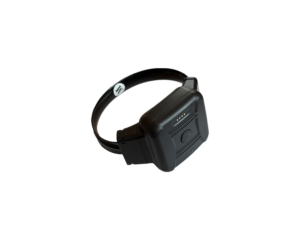
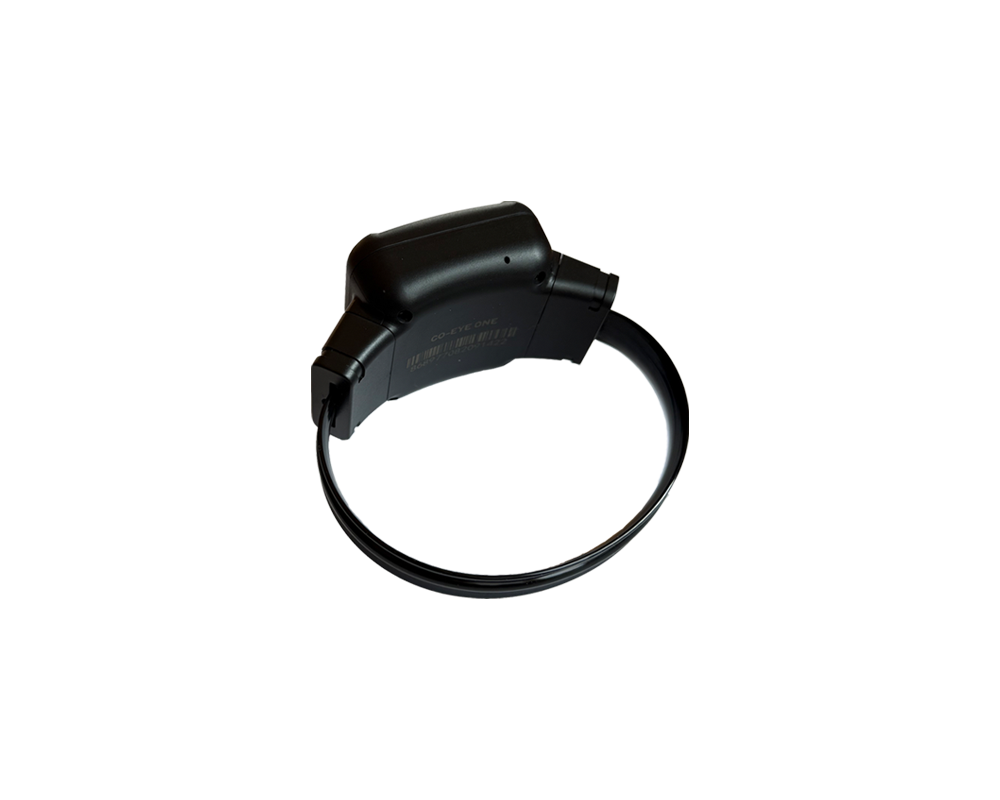
Body-worn devices anchor electronic monitoring: one-piece GPS ankle bracelets, two-piece transmitters with separate trackers, RF straps, alcohol bracelets, and low-profile BLE wristwear for tethered apps. Spec sheets should list weight, IP rating, strap chemistry, and whether tamper evidence is electrical-only or physically auditable. CO-EYE’s flagship CO-EYE ONE is a one-piece GPS ankle bracelet at 108 g with IP68 waterproofing and fiber-optic strap and case tamper detection; installation is tool-free in under three seconds.
Layer 2: Communication (2G–5G evolution, Wi-Fi, Bluetooth)
Every electronic monitoring device is a mobile IoT node. CO-EYE ONE uses 5G-compatible LTE-M / NB-IoT with GSM fallback, plus 2.4 GHz Wi-Fi as a redundancy channel. CO-EYE DUO emphasizes EDGE/GPRS/GSM/WCDMA worldwide cellular with Wi-Fi. CO-EYE i-Tracker and HouseStation use GSM/GPRS/EDGE/WCDMA with 2.4 GHz Wi-Fi. BLE links support tethered modes—for example, CO-EYE ONE-AC can operate in BLE-connected mode with up to six months battery life alongside i-Tracker, AMClient, or compatible apps. Programs that delay LTE modernization risk stranded fleets when carriers sunset legacy bearers.
Layer 3: Positioning (GNSS, Wi-Fi, LBS, A-GPS)
Location is never “just GPS.” CO-EYE ONE fuses GPS, BeiDou, Galileo, GLONASS, Wi-Fi, and LBS with <2 m CEP GPS accuracy. i-Tracker and HouseStation specify <5 m CEP GPS accuracy with the same multi-source fusion pattern. Assisted GNSS and Wi-Fi fingerprinting matter indoors where pure satellite fixes fail—core expectations for urban electronic monitoring.
Layer 4: Anti-tamper detection
Tamper subsystems decide whether alerts are legally credible. Resistive strap circuits, fiber-optic continuity sensing, accelerometer profiles, and skin-contact proxies each trade off false positives against cut attempts. CO-EYE emphasizes fiber-optic strap and case detection on ONE and DUO; BLE i-Bracelet and RF i-Bracelet variants also use fiber-optic straps. DUO adds always-on tamper monitoring that continues even when the main battery is depleted—an important differentiator for high-stakes offender monitoring. For a deeper technical read, see optical fiber anti-tamper on ankle monitors.
Layer 5: Monitoring software
Cloud and on-prem platforms turn device events into officer workflows: enrollments, geofences, alert queues, audit logs, and role-based access. CO-EYE Monitoring Software includes eleven integrated modules—Enrollee Monitoring; Events and Alerts; Notification; Interactive Maps; History Tracking; Device Inventory Management; User and Permissions Management; Reporting; System Configuration; Mobile Applications; and Audit—supporting electronic monitoring at agency scale via desktop and mobile experiences.
Layer 6: Data analytics
Analytics layers cluster location trails, flag anomalies, and increasingly support risk scoring—provided governance and disclosure rules are clear. Reliable electronic monitoring analytics depend on clean event taxonomies (tamper vs. charge vs. GNSS denial) so supervisors are not chasing ghost violations.

Layer 7: Integration
Field devices must interoperate with case management, court calendars, prosecutor portals, and—where statutes require—victim-notification services. APIs, standardized event exports, and tamper-evident audit trails separate enterprise-grade electronic monitoring from consumer trackers wearing a justice label.
Why the seven-layer model matters for RFPs
Requests for proposals that only specify a strap SKU invite vendor arbitrage: the cheapest modem, the loosest tamper definition, the shallowest API. A layered electronic monitoring RFP instead asks how each bidder satisfies communication survivability (LTE-M/NB versus legacy GSM), how GNSS assistance behaves in downtown canyons, how tamper codes map to evidentiary standards, how software enforces least-privilege access, and how exports land in prosecutor discovery workflows. Agencies that evaluate electronic monitoring holistically see fewer post-award change orders when judges ask for victim proximity alerts or when sheriffs demand barometric floor hints inside multi-story housing.
Operational failure modes—and how strong stacks prevent them
Programs stumble for predictable reasons: charging desert (offenders cannot reach outlets), ambiguous tamper storms (officers stop trusting alerts), indoor GNSS gaps misread as absconds, and BYOD apps disabled by OS battery optimizers. Mitigation lives across layers—seven-day standalone power on CO-EYE ONE, fiber-based tamper semantics, Wi-Fi and LBS assistance on trackers, and disciplined alert correlation inside CO-EYE Monitoring Software. Treating electronic monitoring as operational infrastructure—not jewelry—keeps compliance rates credible in court.
Electronic Monitoring by Application
Pretrial and bail supervision
Pretrial electronic monitoring keeps release conditions enforceable while cases pend. The Vera Institute of Justice estimates on the order of 125,000–150,000 people are subject to electronic monitoring in the United States on a typical day—mostly pretrial—illustrating how central GPS and RF tools are to docket management. Agencies should pair hardware choice with indigent fee policies and charging logistics.
Probation and parole
The majority of U.S. correctional control happens in the community. Bureau of Justice Statistics data routinely show that roughly seven in ten adults under correctional supervision are on probation or parole rather than incarcerated; practitioner groups such as the American Probation and Parole Association have long noted that community supervision oversees most supervised individuals while institutional corrections consume a disproportionate share of criminal-justice budgets—underscoring why scalable electronic monitoring platforms matter.
For line officers, offender monitoring translates into dashboard throughput: how many enrollees per agent, how fast alerts triage, and whether map histories export cleanly to violation hearings. Programs that under-staff response teams see electronic monitoring blamed for workload—even when the hardware performed as designed—so workforce planning belongs in the same capital request as device leases.
House arrest and home detention
Residential electronic monitoring blends curfew schedules with RF or GPS corroboration. CO-EYE HouseStation delivers extended 433 MHz indoor range (50 m indoor / 200 m outdoor), dual-SIM telephony, barometer-assisted floor hints, and full-day internal battery backup during outages—features purpose-built for home detention workflows alongside RF or BLE straps.
Domestic violence protection
Protection-order programs use GPS ankle monitors to enforce exclusion zones and proximity rules, often with victim-notification logic. Reliable maps, low-latency alerts, and tamper clarity prevent hearings from collapsing into technical disputes.
Sex offender lifetime monitoring
Long-horizon electronic monitoring stresses battery chemistry, strap durability, and evidence retention. Agencies should model total cost of ownership across years, not months.
Immigration (ICE ATD and body-worn GPS)
Federal Alternatives to Detention (ATD) programs combine telephonic reporting, smartphone applications, and body-worn GPS. ICE’s public ATD materials describe body-worn GPS as ankle- or wrist-worn satellite supervision used for movement history; independent analyses of ICE-released enrollment data (for example, summaries compiled by the TRAC immigration data program) tracked rising ATD totals near roughly 180,000 participants in 2025–2026, with secondary analyses noting body-worn GPS cohorts exceeding 40,000 during early 2026 reporting windows—illustrating how immigration caseloads shape national demand for electronic monitoring hardware.
In-prison RTLS and BLE wearable tags
Inside secure facilities, electronic monitoring shifts to real-time location systems using BLE wearables and infrastructure anchors. CO-EYE’s BLE i-Bracelet (17 g, IP68, FCC certified, two-year battery life) functions as a correctional-grade tag suitable for tethered architectures; pairing options include AMClient or third-party apps, or RF pairing to i-Tracker and HouseStation for broader facility programs.
Electronic Monitoring Effectiveness — What Research Shows
Evidence should inform electronic monitoring policy—not vendor slogans.
- Recidivism: NIJ’s synthesis of Florida Department of Juvenile Justice research reported up to a 31% reduction in recidivism for youth supervised with electronic monitoring compared with non-monitored peers—demonstrating measurable public-safety signal when programs are well targeted.
- Court appearance: National Center for State Courts research on court-date reminders—including text and phone nudges—has documented failure-to-appear reductions on the order of roughly 30% in studied jurisdictions such as Hennepin County, a lesson electronic monitoring programs echo when they combine location accountability with proactive notifications.
- Cost versus incarceration: Vera and BJS-adjacent cost work commonly contrasts community supervision fees (often cited in roughly the $5–$25 per day range for monitoring) with jail costs that frequently exceed $100 per day—implying substantial potential savings when electronic monitoring safely substitutes for bed days, though user fees and vendor pricing vary widely.
Effectiveness hinges on officer capacity, clear violation matrices, and charging support—electronic monitoring magnifies good operations and exposes weak ones.
The Complete CO-EYE Electronic Monitoring Product Matrix
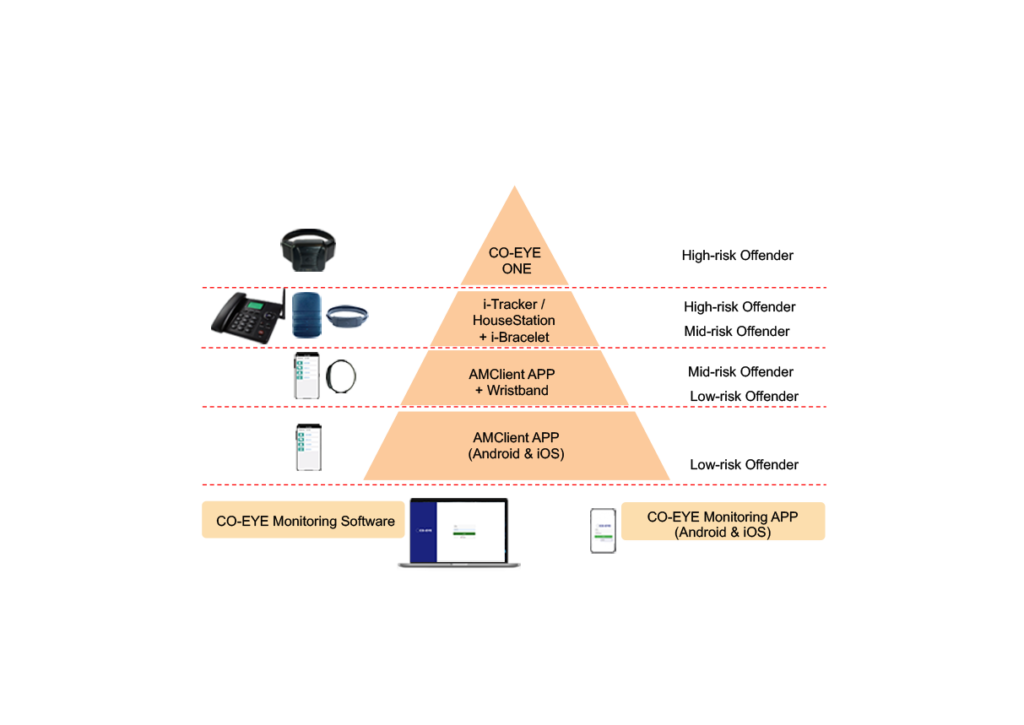
REFINE Technology’s CO-EYE line expresses the full risk continuum for electronic monitoring procurement:
- High risk — CO-EYE ONE: One-piece GPS ankle bracelet at 108 g; fiber-optic strap and case tamper detection; 5G-compatible LTE-M/NB-IoT/GSM; GPS/BeiDou/Galileo/GLONASS/LBS/WiFi; <2 m CEP; seven-day standalone battery at five-minute LTE-M/NB reporting; 1700 mAh cell; 2.5-hour recharge; HTTPS/SSL with AES-128/256; CyberSecurity EN 18031; European NB CE (RED/EMC/SAR/LVD, RoHS/REACH/WEEE); IP68. Explore CO-EYE ONE.
- High / mid risk — CO-EYE DUO + HouseStation: DUO delivers enhanced one-piece GPS with tamper monitoring that persists even at zero battery, EDGE/GPRS/GSM/WCDMA cellular, free-charge Wi-Fi/LBS location, and three-second install. Pair with HouseStation (225×173×55 mm, 750 g) for deep indoor RF reception, dual-SIM phone functions, 433 MHz ranges of 50 m indoor / 200 m outdoor, barometer floor hints, and encrypted backhaul.
- Mid / low risk — CO-EYE AMClient + BLE wristwear: AMClient provides continuous smartphone supervision with GPS/LBS, SOS, check-ins, photo verification, schedules, and Bluetooth tether checks. Pair with CO-EYE Wristband or BLE i-Bracelet (65×22×10 mm, 17 g, IP68, two-year battery, AES-128, fiber-optic strap).
- Low risk — AMClient only: App-centric electronic monitoring for eligible caseloads where straps are unnecessary, still feeding the same monitoring platform.
- Platform — CO-EYE Monitoring Software: Eleven modules covering enrollee records, alerts, notifications, mapping, history, inventory, permissions, reporting, configuration, mobile access, and audit—see CO-EYE Monitoring Software.
ONE-AC extends the ONE chassis with eSIM plus nano SIM, ARM M3/M0 processors, 8 M storage (up to 20,000 events), 111 g mass, and BLE-connected mode up to six months battery life when paired with approved gateways or apps.
Electronic Monitoring Standards & Compliance
Standards do not replace legal orders—but they give attorneys, judges, and IT security teams a shared vocabulary when contracts reference electronic monitoring performance. When vendors cite NIJ language, ask which test fixtures, sky views, and reporting intervals were used so apples-to-apples comparisons hold.
- NIJ 1004.00: Defines standardized ways to discuss horizontal accuracy and performance testing for location tracking equipment—agencies use it to compare vendor claims for GPS ankle monitors and to set expectations for open-sky versus degraded urban environments.
- IP68: CO-EYE wearables cite IP68 waterproofing suitable for shower and weather exposure common in community electronic monitoring.
- EN 18031 cybersecurity: CO-EYE ONE documents CyberSecurity EN 18031 alongside AES-128/256 transport protections.
- FCC certification: BLE i-Bracelet listings include FCC certification for U.S. deployment.
- CE directives: European NB CE coverage spans RED/EMC/SAR/LVD with RoHS/REACH/WEEE alignment for international tenders.
Cybersecurity is now inseparable from electronic monitoring compliance: encrypted transport, role-based access, patch cadence, and audit logs are as important as strap torque specs. Agencies running criminal justice information interfaces should map vendor controls to their CJIS-style policies even when vendors host in commercial clouds.
Mapping buyer guides to your next procurement
Use this ecosystem view alongside the GPS ankle monitor buyer’s guide when translating court orders into technical requirements. If your jurisdiction is modernizing cellular, read 5G and eSIM in electronic monitoring before you rebid straps that still depend on sunsetting bearers. When tamper disputes drive hearings, the optical fiber anti-tamper article explains why deterministic strap sensing reduces ambiguous alerts compared with indirect biometrics.
FAQ: Electronic Monitoring in 2026
What is electronic monitoring? Electronic monitoring is the use of supervised-release technologies—GPS ankle bracelets, RF beacons, alcohol sensors, or smartphone apps—to verify court orders and agency rules in the community.
How does electronic monitoring work? Sensors on the body collect tamper, location, or biometric signals; cellular or Wi-Fi backhaul transmits encrypted events to a monitoring platform where staff manage geofences, alerts, and audits.
How much does electronic monitoring cost? Program costs combine per-diems, installation fees, and staff time; research often contrasts roughly $5–$25 per day of monitoring with jail costs above $100 per day, but local fee schedules vary.
Is electronic monitoring effective at reducing recidivism? NIJ-cited Florida DJJ research reported up to a 31% recidivism reduction for electronically monitored youth cohorts, showing impact when programs are well implemented.
What types of electronic monitoring devices exist? Common classes include one-piece GPS ankle bracelets, two-piece GPS systems, RF home beacons, alcohol transdermal bracelets, smartphone apps, and BLE tether tags for facility or low-risk pathways.
Can electronic monitoring replace incarceration? It can substitute for bed days when risk assessments support community supervision, but it is not a universal replacement—officer ratios, victim safety, and charge severity still determine eligibility.
Whether you are refreshing a fleet for cellular sunset, standing up pretrial GPS, or integrating victim notification, treat electronic monitoring as a seven-layer system. CO-EYE delivers matched hardware, encrypted backhaul options, and a full software stack so your ankle monitor investment aligns with 2026 compliance and supervision realities.
Finally, align vocabulary across stakeholders: judges, prosecutors, defenders, victims’ advocates, and IT should share definitions for electronic tagging, GPS ankle bracelet, and offender monitoring events so transcripts match data dictionaries. When everyone uses the same electronic monitoring language, hearings focus on behavior—not on whether a red dot was a tamper or a simple charger glitch.