
When Trinidad and Tobago’s Justice Minister Devesh Maharaj read the numbers behind the proposed Parole Bill 2026 in Parliament, one figure stopped the room: a recidivism rate averaging 55% between 2022 and 2026, peaking at 58%. Nearly two-thirds of the incarcerated population sitting on remand — not convicted, not sentenced, just waiting. A prison system the U.S. State Department (2024) described as “physically abusive and harsh due to overcrowding.”
The Parole Bill passed unanimously with 34 votes. A companion Probation of Offenders (Amendment) Bill introduced “split sentencing” — part of the time served in custody, the remainder under community supervision with electronic monitoring. On paper, this is exactly the kind of evidence-based reform that criminal justice researchers have advocated for decades.
But two people who understand Trinidad’s prison system from the inside — reform activist Debbie Jacob and ex-prisoner advocate Garth St Clair — immediately identified the fault line. As they told the Trinidad Guardian: the critical question is not whether people should be released. It is what happens after they walk out the gate.

Trinidad is not acting in isolation. The Caribbean Association of Probation and Parole (CAPP), established in 2024 with eight founding member countries and now expanded to 16, represents a regional consensus that incarceration alone has failed. Jamaica has implemented electronic monitoring for bail conditions. Barbados has piloted GPS tracking for domestic violence cases. The Bahamas is evaluating ankle monitor programs for pretrial defendants.
But the technology adoption is running ahead of the support infrastructure everywhere in the region. Jamaica’s EM pilot faced early criticism for monitoring people who had no housing stability. Barbados discovered that tracking domestic violence offenders was ineffective when victim notification systems were not yet in place. The pattern is consistent: the hardware arrives before the human systems are ready to use it effectively.
This is not a Caribbean problem. It is a universal pattern. The Vera Institute of Justice documented 254,700 adults under electronic monitoring in the United States in 2021 (Vera Institute, 2024) — nearly double the figure from five years earlier. Yet many U.S. jurisdictions still treat EM as a standalone intervention, producing the same disappointing outcomes Trinidad is trying to avoid.
Why Technology Architecture Determines Whether Monitoring Becomes Support
The difference between surveillance and support often comes down to a technical question: does the monitoring system provide information only to the officer, or does it create a two-way channel between the supervised individual and the services they need?
Traditional EM systems — two-piece designs with a GPS tracker paired to a separate RF beacon — were built for a surveillance model. The officer receives alerts. The monitored person receives a charging reminder. That is the extent of the interaction.
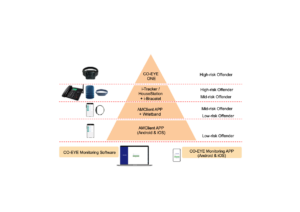
A risk-tiered supervision architecture changes this fundamentally. When agencies deploy different monitoring intensities based on assessed risk level — from full GPS ankle monitoring for high-risk individuals down to smartphone-based check-in apps for low-risk cases — they free up resources. The officers who previously spent 40% of their time managing charger alerts for compliant, low-risk individuals can redirect that attention to the people who actually need intensive supervision and reentry support.
This is not abstract theory. BI Incorporated explicitly segments its product line along risk tiers: LOC8 XT (ankle GPS for high-risk), VeriWatch (wrist GPS for low-risk and immigration compliance), SmartLINK (smartphone app for administrative monitoring). The market leader’s own product architecture confirms that one-size-fits-all monitoring wastes resources and fails the people it is supposed to help.
What Trinidad’s Parole Board Needs to Get Right
The Parole Bill creates a Parole Board with authority to set conditions, revoke release, and manage supervision. Minister Maharaj has committed to developing regulations in consultation with “every stakeholder.” The success or failure of this system will depend on whether the Board builds five specific capabilities:
1. Pre-release assessment infrastructure. Before any prisoner is released on parole, a validated risk assessment must determine the appropriate supervision tier. High-risk individuals need continuous GPS monitoring with real-time officer alerts. Medium-risk cases may function well with scheduled check-ins through a monitoring app. Low-risk parolees may need only periodic verification. Without this triage, every parolee gets the same level of monitoring — which means either over-surveilling low-risk people (wasting resources) or under-monitoring high-risk people (creating public safety gaps).
2. Employment pathway partnerships. St Clair’s question — “Will Massy hire me?” — identifies the single most predictive factor in reentry success. A 2018 RAND Corporation study found that former prisoners who secured employment within 60 days of release were 43% less likely to recidivate than those who did not. Trinidad’s Parole Board should mandate employer partnership agreements as a precondition for full program launch — not as an afterthought.
3. Transitional housing. A parolee with an ankle monitor but no stable address is a surveillance paradox. Exclusion zones cannot be enforced when the individual has no home zone to be excluded from. Halfway houses, supervised residences, or housing voucher programs must exist before the first parole release.
4. Substance abuse and mental health services. The NIJ study found that 39% of monitored offenders had their monitoring costs waived — an indicator of the economic fragility of the supervised population. Many of these individuals have co-occurring substance use and mental health conditions that incarceration did not treat. Without accessible treatment, the monitor simply tracks the countdown to the next crisis.
5. Victim notification and protection. For domestic violence and sexual offense cases — which Trinidad’s 2012 Act specifically targeted — the monitoring system must include real-time victim notification. When a GPS-monitored offender approaches a protected zone, the victim needs to know before the officer does. This requires not just technology but a communication protocol with trained responders available around the clock.

How Does Device Design Affect Reintegration?
The NIJ study surfaced a finding that rarely makes it into policy discussions: 22% of electronically monitored offenders were fired or asked to leave a job because of the visible monitoring device. An additional 32% of those job losses were caused by signal interference in workplaces — the device disrupting operations or triggering repeated false alerts.
This creates a perverse outcome: the monitoring system designed to support community reintegration actively undermines the employment that is the strongest predictor of success. When an offender describes the device as a “scarlet letter” — as multiple participants did in the NIJ interviews — they are identifying a real barrier to the social reintegration that reduces recidivism.
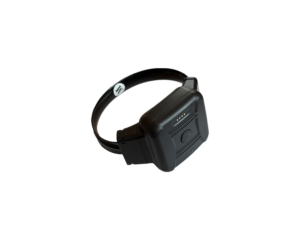
Device characteristics that directly affect reintegration outcomes include weight and visibility (lighter, more discreet devices reduce workplace discrimination), battery life (devices requiring daily charging create compliance failures that trigger unnecessary violation proceedings), and false alarm rates (each false tamper alert requires officer response time that could be spent on supportive supervision). A 108-gram one-piece GPS ankle monitor with 7-day battery life and fiber-optic zero-false-alarm tamper detection represents a fundamentally different tool than a 250-gram two-piece system that needs daily charging and generates weekly false alerts.
The difference is not cosmetic. It is operational. Every hour an officer spends responding to a false alarm is an hour not spent connecting a parolee with a job training program. Every charging failure that triggers a technical violation hearing is a court date that could have been a counseling session. The device either supports the reentry mission or it competes with it for the agency’s limited resources.
What Can Other Jurisdictions Learn From Trinidad’s Approach?
Trinidad’s Parole Bill actually gets several things right that larger, wealthier jurisdictions have gotten wrong. The split sentencing provision explicitly acknowledges that prison and community supervision are not alternatives — they are sequential phases of a single correctional plan. The unanimous 34-vote passage suggests genuine bipartisan commitment rather than performative reform.
But Jacob’s decades of work inside Port-of-Spain Prison have taught her that legislation creates permission, not outcomes. The craftsman who spent 30 years producing intricate work behind bars had the skills for reentry. What he lacked — and what Trinidad’s system still lacks — is the bridge between institutional capability and community opportunity.
Building that bridge requires three elements working together: legislation that authorizes graduated supervision (which Trinidad now has), technology that enables risk-appropriate monitoring (which the global market can provide), and community infrastructure that converts supervision into genuine support (which Trinidad must build before the first parole hearing).
The 90% of Trinidad’s prisoners who will eventually return to their communities deserve a system that treats their release as the beginning of a process, not the end of one. Electronic monitoring can be the connective tissue of that process — but only when it is woven into a fabric of employment, housing, treatment, and human connection that gives reentry a real chance of success.
FAQ: Post-Release Support and Electronic Monitoring
What is post-release support in the context of electronic monitoring?
Post-release support refers to the structured services — employment assistance, housing, substance abuse treatment, mental health counseling, and case management — provided to individuals transitioning from incarceration to community supervision. Research consistently shows that electronic monitoring reduces recidivism only when paired with these wraparound services.
Does electronic monitoring reduce recidivism on its own?
Electronic monitoring alone reduces recidivism by approximately 31% (Padgett, Bales & Blomberg, 2006) when part of a structured supervision program that includes officer contact, curfew enforcement, and access to reentry services (NIJ, 2011). Without support infrastructure, EM functions as surveillance rather than rehabilitation — detecting violations without preventing them.
Why does risk-tiered monitoring matter for parole programs?
Risk-tiered monitoring matches supervision intensity to individual risk levels — GPS ankle monitoring for high-risk parolees, app-based check-ins for low-risk cases. This prevents over-surveilling compliant individuals while ensuring intensive resources reach those who need them, freeing officer time for supportive case management.
What employment barriers do electronically monitored individuals face?
A NIJ-funded study found that 22% of monitored offenders lost jobs specifically because of the visible monitoring device, with 32% of those losses caused by signal interference in workplaces. Lighter, more discreet devices with longer battery life and lower false alarm rates directly reduce these barriers to reintegration.
About REFINE Technology (CO-EYE)
REFINE Technology is the leading electronic monitoring solutions provider in China with over 16 years of experience in the criminal justice industry. As the exclusive supplier for top security agencies, REFINE Technology has deployed 200,000+ devices across 30+ countries, monitoring 130,000+ individuals. The CO-EYE product line — featuring the next-generation all-in-one GPS ankle monitor, BLE wristbands, RF home beacons, and a unified monitoring platform — delivers high-security, low-stigma supervision for high-risk, mid-risk, and low-risk offender monitoring and victim protection. All CO-EYE devices carry full European NB CE directives (RED/Cybersecurity/LVD/SAR) and FCC certifications, with IP68 waterproof and REACH/RoHS/WEEE compliance. CO-EYE solutions are trusted in the USA, Europe, Africa, Bhutan, Papua New Guinea, Dominican Republic, Armenia, and expanding globally.
For more information, visit www.ankle-monitor.com or contact marketing@rfidcn.com.
Related: GPS Ankle Bracelet Guide 2026: Costs, Technology & Vendor Selection