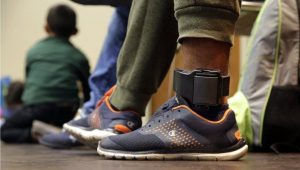

On August 31, 2026, Pierre Damas Bel — a 20-year-old Haitian honors student and varsity soccer player at Wright State University in Springfield, Ohio — walked onto Interstate 70 and stepped into the path of a tractor-trailer. He died at the scene. His family, his pastor, and Ohio Governor Mike DeWine all pointed to the same cause: a GPS ankle bracelet that ICE had locked onto his leg five weeks earlier. (see our comprehensive GPS ankle bracelet guide for detailed analysis)
“After my son was outfitted with the ankle monitor, he felt like he was treated like an animal,” his father, Ronald Bel, told reporters through Pastor Carl Ruby at a press conference in Springfield the following day. His son had posted on Instagram the day after receiving the device: “I came to this country to pursue my education. I didn’t come here to commit a crime or hurt anyone. Yet now I’m walking through the streets of the United States with a GPS monitor on my leg, carrying a feeling of shame and humiliation that I never imagined I would experience.”
Bel’s death is the most visible consequence of a growing crisis in electronic monitoring: the devices that agencies rely on for community supervision are engineered for security — not for the dignity of the people wearing them. The GPS ankle bracelet has become a symbol of punishment even when it is being used for administrative compliance, and the stigma it carries is measurable in lost jobs, broken relationships, psychological distress, and now, in the death of a college student who could not bear the shame.
What Happened to Pierre Damas Bel
Pierre Damas Bel arrived in the United States in March 2024 through a CBP One appointment at the Gateway Port of Entry. He settled in Springfield, Ohio, with his parents and two brothers. Within two years, he had earned honor roll status at Springfield High School, joined JROTC, played varsity soccer for the Springfield Wildcats, received a $2,500 scholarship from the school district, and been recruited to play soccer at Wittenberg University. He planned to study neuroscience and attend medical school.
In June 2026, the Supreme Court allowed the Department of Homeland Security to terminate Temporary Protected Status (TPS) for roughly 300,000 Haitian nationals. On July 29, ICE placed Bel in its Alternatives to Detention (ATD) program and attached a GPS ankle bracelet to his leg. Within days, his life unraveled. He lost eligibility to play for the Wittenberg soccer team and transferred to Wright State. Students at his new university bullied him over the visible device on his ankle. His JROTC unit refused to issue him a uniform because the bracelet was visible beneath the pant leg.
On the morning of August 31 — eight days into his freshman year — Bel called his father from the side of Interstate 70, struggling emotionally. Around 8:45 a.m., the Ohio State Highway Patrol confirmed he stepped into oncoming traffic and was struck and killed by a semi-trailer truck.
The Stigma Problem Is Systemic, Not Anecdotal

Bel’s story is not an isolated incident. It is the sharpest point of a documented pattern that spans the entire GPS ankle bracelet ecosystem — from immigration compliance to pretrial supervision to criminal corrections.
According to the National Immigration Forum, ankle monitor wearers routinely report inflammation, severe cramps, bleeding, sores, and numbness, alongside psychological effects including anxiety, depression, and social isolation. One woman described the experience: “When you go out into the street, the whole world stops to look at your feet… My son asked me why they put this on me, he said that they only do this to thieves.”
In March 2026, The Guardian reported that the number of people wearing ICE ankle monitors had nearly doubled from 24,000 to roughly 42,000 in less than a year. By June 2026, the Amica Center for Immigrant Rights filed a federal class-action lawsuit challenging ICE’s expanding use of ankle and wrist-worn GPS monitors, documenting physical harm (pain, swelling, bleeding, electric shocks), psychological harm (anxiety, depression, isolation), and economic harm (job loss, missed medical appointments). The lawsuit noted that nearly 50,000 people were subjected to continuous GPS surveillance without individualized justification.
The industry term for these devices — “alternatives to detention” — frames them as humane options. But when a GPS ankle bracelet costs a 20-year-old his JROTC uniform, his soccer career, and ultimately his life, the framing deserves scrutiny. The device is technically an alternative to a jail cell. It is not, in practice, an alternative to being publicly marked as someone the government considers dangerous.
Why Ankle Placement Creates Unavoidable Visibility
The fundamental problem is anatomical. A GPS ankle bracelet sits on the lower leg — a location that is visible beneath shorts, skirts, fitted pants, and athletic uniforms. In Bel’s case, the device was visible enough to prevent him from wearing a JROTC uniform and to draw taunts from university classmates. No clothing workaround can fully conceal a device strapped to the ankle during physical activity, warm-weather dressing, or professional environments where full-length trousers are not standard.
This visibility is not a design flaw — it is a design constraint. The ankle is the preferred placement for electronic monitoring because the calcaneus (heel bone) creates a natural mechanical stop that prevents the device from being slipped off without cutting the strap. The same bone structure that makes ankle placement secure also makes it impossible to conceal the device in most daily situations. For high-risk offenders — sex offenders on lifetime registration, parolees with flight risk, domestic violence defendants under protective orders — this trade-off between security and visibility is accepted because the risk of the person absconding outweighs the stigma cost.
But Pierre Damas Bel was not a high-risk offender. He was a scholarship recipient with no criminal record, placed on administrative monitoring because the government ran out of detention space for 300,000 Haitians who lost TPS. The security architecture of the device he wore — fiber-optic tamper detection, GPS tracking, mandatory charging twice daily — was engineered for people with motivation to flee or harm others. He had no such motivation. He had a class schedule, a soccer practice, and a medical school application.
The Risk-Stratification Gap: When Agencies Use One Device for Every Risk Level
The electronic monitoring industry already understands that different risk levels require different devices. BI Incorporated — the company that holds the primary ICE monitoring contract — operates a four-tier system under the Alternatives to Detention program:
| Tier | Device | Approx. Participants | % of ATD | Security Model |
|---|---|---|---|---|
| Ankle GPS | LOC8 | ~5,000 | ~3% | Physical containment |
| Wrist GPS | VeriWatch | ~3,000 | ~2% | Biometric compliance |
| Wrist BLE + Phone | SmartBAND + SmartLINK | ~12,000 | ~7% | Proximity tethering |
| Phone only | SmartLINK App | ~155,000 | ~88% | Self-reporting |
The numbers tell a clear story: only 3% of ATD participants require the security level of a GPS ankle bracelet. Yet when ICE scaled monitoring after the TPS termination, ankle devices were distributed to people like Bel — scholarship students, working mothers, people with pending asylum claims — because the agency prioritized rapid deployment over risk-appropriate device selection.
Why Consumer Smartwatches Cannot Solve the Problem
When the stigma of ankle-worn devices reaches crisis levels, some agencies and vendors turn to what appears to be an obvious fix: put the GPS tracker on the wrist instead. Several companies now market “ankle monitor alternatives” that are essentially consumer-grade smartwatches with tracking apps installed, or lightly modified fitness bands with GPS chips added. These products look discreet. They photograph well in procurement presentations. And they fail every meaningful security requirement that corrections and immigration agencies demand.
The failure is biomechanical. The human wrist has a fundamental anatomical property that the ankle does not share: the hand can be compressed to a cross-section smaller than the wrist. By folding the thumb inward and applying a lubricant — soap, lotion, cooking oil — any non-rigid wristband can be slipped over the hand without triggering a strap-cut alert. This is not a theoretical vulnerability; it has been documented in supervision escapes in both the United States and China.
Consider the constraints that any wrist-worn monitoring device must address:
- Tight enough to prevent removal? Then the strap will cause circulation problems, skin irritation, and allergic reactions within days. Metal handcuffs are designed this tight — and they are used for hours, not months. An EM device must be worn for 6 to 24 months continuously.
- Loose enough for long-term wear? Then a motivated individual can remove it in under 60 seconds. Heart-rate sensors and PPG (photoplethysmography) checks have 15–30% false-alarm rates and can be defeated by silicone patches or prosthetic covers.
- Relying on facial recognition check-ins? That confirms identity at the moment of the check-in — not between check-ins. A device can be removed, placed on a table, and the wearer can abscond while the system waits 5–15 minutes before generating an alert.
BI Incorporated’s own product line proves the point. The company markets its VeriWatch wrist-worn GPS explicitly for “lower-risk adult populations and the juvenile justice system.” Its ankle-worn LOC8 is reserved for criminal supervision. The largest EM provider in the world does not trust its own wrist device for high-risk monitoring — because the biomechanics of the wrist make secure containment physically impossible with current band materials.
What a Professional-Grade Wrist Monitor Actually Requires

If the industry is serious about reducing stigma without sacrificing supervision integrity, it cannot rely on consumer electronics modified for corrections use. A professional-grade wrist-worn monitoring device must address three categories of requirements that consumer smartwatches fundamentally cannot meet:
1. Tamper Detection That Works Without Wearer Cooperation
Consumer smartwatches detect removal through a single accelerometer and an optional heart-rate sensor. Both are trivially defeated. A corrections-grade wrist device needs multi-layer tamper detection — fiber-optic strap continuity monitoring (the same technology used in professional ankle monitors), conductive-loop case integrity, and proximity sensors calibrated for skin contact — operating simultaneously and cross-verified so that defeating one layer immediately triggers alerts from the others.
2. Continuous GPS Tracking With Multi-Day Battery Life
BI’s VeriWatch quotes 16 hours of battery life on-device, extendable to 32 hours with a portable charger. Consumer smartwatches under continuous GPS tracking typically last 6–12 hours. Neither figure is acceptable for uninterrupted monitoring in field conditions. A professional device needs to sustain multi-day GPS operation between charges — a design target that requires purpose-built power management, not a repurposed consumer chipset drawing from a 300mAh battery.
3. IP68+ Environmental Protection
Consumer smartwatches carry IP67 or IP68 ratings — sufficient for rain exposure and brief submersion, inadequate for the conditions that monitored individuals actually encounter. Continuous wrist wear means showers, manual labor, accidental impacts, and temperature extremes. A supervision-grade wrist device needs IP68+ certification tested to the operational standards that corrections agencies already demand from ankle hardware.
The Path Forward: Dignity as a Design Requirement

Pierre Damas Bel did not need a device engineered for convicted sex offenders. He needed a supervision mechanism proportional to his actual risk — which was effectively zero. He had a scholarship, a university enrollment, a family in Springfield, and an active asylum case. The GPS ankle bracelet on his leg was architecturally identical to those used on parolees with violent histories, and the stigma it carried was indistinguishable.
The industry has the technical foundation to do better. BI’s own four-tier architecture proves that risk stratification works. The missing piece is a wrist-worn device that meets corrections-grade security standards — not a consumer smartwatch with a tracking app, but purpose-built hardware with fiber-optic tamper detection, multi-day battery life, IP68+ durability, and biometric verification layered on top of physical integrity monitoring. A device that supervisory agencies can trust for medium-risk populations while sparing low-risk individuals from the visible stigma that drove Pierre Damas Bel to Interstate 70.
The technology to build this device exists today. The question is whether the industry will treat dignity as a design requirement — or continue to deploy one-size-fits-all ankle hardware until the next tragedy forces the conversation again.
Frequently Asked Questions
Why did ICE place a GPS ankle bracelet on Pierre Damas Bel?
Bel lost his Temporary Protected Status (TPS) after the Supreme Court allowed DHS to terminate protections for roughly 300,000 Haitian nationals in June 2026. On July 29, ICE placed him in the Alternatives to Detention program with a GPS ankle bracelet as a condition of remaining in the community while his immigration case proceeded. ICE stated that ankle monitors were being used because the agency lacked detention space for the large number of Haitians who lost TPS.
How many people currently wear ICE ankle monitors in the United States?
As of early 2026, roughly 42,000 people wore ICE-issued ankle monitors — nearly double the 24,000 figure from a year earlier. A June 2026 federal class-action lawsuit documented approximately 50,000 people under continuous GPS surveillance through ICE monitoring programs. The broader ATD program covers approximately 175,000 participants across all monitoring tiers, including phone-only supervision.
Can wrist-worn GPS monitors replace ankle monitors for community supervision?
For low-risk populations — such as immigration compliance monitoring and juvenile supervision — wrist-worn devices can be appropriate when paired with biometric verification and proximity sensing. However, consumer-grade smartwatches modified for monitoring lack the tamper-detection capability, battery endurance, and environmental protection required for corrections-grade supervision. The human wrist allows device removal that the ankle does not, due to the compressibility of the hand relative to the rigid calcaneus bone at the ankle. Professional-grade wrist devices must compensate for this biomechanical difference with multi-layer detection systems.
What is the difference between a GPS ankle bracelet used for criminal supervision and one used for immigration compliance?
The hardware is typically identical — the same GPS tracking, tamper detection, and mandatory charging requirements apply. The difference is in the risk profile of the wearer and the legal framework governing the monitoring. Criminal supervision monitors convicted individuals with assessed flight risk or public safety concerns. Immigration compliance monitors people with pending civil cases who have not been convicted of crimes. Despite this difference, both populations often wear the same device, which means people with no criminal history carry the same visible stigma as convicted offenders.
If you or someone you know is in crisis, contact the 988 Suicide and Crisis Lifeline by calling or texting 988. For immigration legal assistance, contact the Amica Center for Immigrant Rights.