
GPS vs RF Ankle Monitors: What’s the Difference and Which Should Your Agency Choose?
GPS ankle monitors track an offender’s real-time location using satellite positioning, typically accurate within 72 feet. RF (radio frequency) monitors only detect whether an offender is within range of a home base station — usually about 100 feet — confirming presence or absence but nothing about where they go when they leave. For agencies managing mixed caseloads, the decision between GPS and RF isn’t either/or: the US Courts guidance recommends selecting “the most cost-effective and least restrictive option appropriate for the individual.”
Why This Decision Matters More Than Ever
County corrections departments across the US are under dual pressure: jail populations exceed capacity, and budgets are tighter than at any point in the last decade. Electronic monitoring offers an alternative to pretrial detention that saves real money — Washington DC’s program documented costs of roughly $750 per participant per year, compared to $50,000+ annually for incarceration. But choosing the wrong technology creates its own problems. An agency that puts a domestic violence offender on RF-only monitoring has no way to enforce a court-ordered exclusion zone around the victim’s home or workplace. Meanwhile, deploying expensive GPS units on low-risk curfew-compliance cases wastes limited resources.
The technology you choose directly affects false alert volume, officer workload, and program credibility. Cook County, Illinois found that over 80% of their ankle monitor alerts were false alarms — a problem that erodes officer trust in the system and can lead to dangerous complacency when a real alert fires.
How GPS Monitoring Works
A GPS ankle monitor is a self-contained unit worn on the offender’s ankle that communicates with orbiting satellites to determine location. Modern devices combine multiple positioning methods:
- GPS satellite positioning — Primary outdoor tracking, accurate within 72 feet using satellite triangulation
- Wi-Fi positioning — Indoor location backup when GPS signals can’t penetrate buildings
- Cellular LBS (Location-Based Services) — Fallback positioning using cell tower triangulation
- BLE (Bluetooth Low Energy) — Short-range proximity detection, used for victim protection and home verification
GPS devices continuously log coordinates — the federal standard requires storage every 3 minutes with uploads at least every 4 hours, though many modern devices report in near real-time over LTE-M or NB-IoT cellular networks. Officers can define geo-fences (inclusion zones where the offender must stay, or exclusion zones they must avoid) and receive automated alerts when boundaries are crossed.
Best GPS Use Cases
- Domestic violence — exclusion zone enforcement around victim locations
- High-risk pretrial defendants — continuous location verification
- Sex offender monitoring — proximity alerts near schools, parks, restricted areas
- Gang-affiliated offenders — cross-referencing location data against known activity areas
- Work-release programs — verifying travel routes between facility and workplace
How RF Monitoring Works
RF monitoring is simpler. The offender wears a small ankle transmitter that emits a radio signal. A base station (home unit) placed in the offender’s residence detects whether the transmitter is within range. If the offender leaves the detection area during a restricted period, the system generates an alert.
RF doesn’t know where the offender goes — only whether they’re home or not. The detection range is typically about 100 feet from the base unit, though walls, appliances, and building materials can reduce effective range.
Best RF Use Cases
- Curfew enforcement — verifying an offender is home during specified hours
- House arrest — continuous presence monitoring at a single location
- Low-risk probation compliance — cost-effective verification without full GPS overhead
- Large caseloads with limited budgets — lower per-device cost and simpler data management
Side-by-Side Comparison
| Capability | GPS Ankle Monitor | RF Ankle Monitor |
|---|---|---|
| Real-time location tracking | Yes — continuous coordinates | No — presence/absence only |
| Geo-fence / exclusion zones | Yes — any geographic boundary | No — home perimeter only |
| Accuracy | Within 72 feet (GPS); building-level (Wi-Fi) | ~100 feet from base unit |
| Indoor positioning | Wi-Fi + BLE backup | RF signal only |
| Battery life (typical) | 24–60 hours (rechargeable) | Months to 2+ years (transmitter) |
| Device size / weight | Larger (integrated GPS, cellular, battery) | Smaller, lighter transmitter |
| Data for officers | Full location trail, heatmaps, zone alerts | Home/away timestamps only |
| Cost per device | Higher | Lower |
| False alert potential | Moderate — signal loss in tunnels, basements | Lower — simpler signal model |
| Victim protection capability | Yes — proximity + exclusion zone alerts | No |
The Emerging Third Option: Hybrid and Tiered Systems
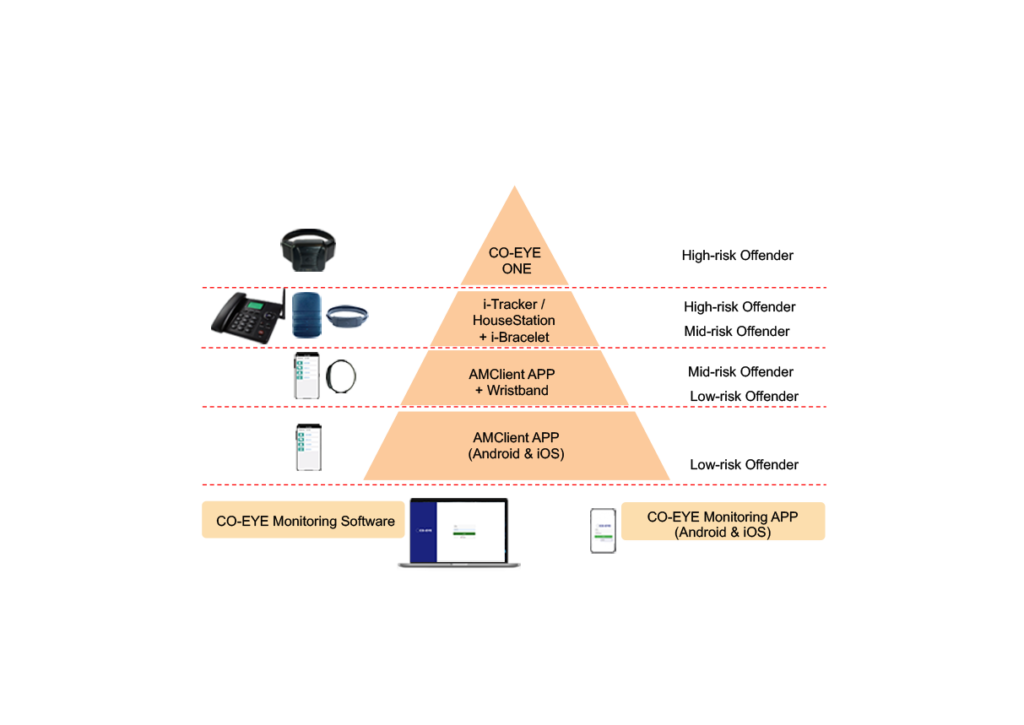
The GPS-or-RF question is increasingly becoming GPS-and-RF. Progressive agencies are deploying tiered monitoring where the technology matches the risk level:
- High-risk offenders — One-piece GPS ankle monitor with steel-reinforced anti-tamper strap. Continuous real-time tracking, exclusion zones, and immediate tamper alerts.
- Medium-risk offenders — Standard GPS ankle monitor with optical fiber strap. Full location monitoring with lower security profile.
- Low-risk offenders — BLE wristband paired with a smartphone app. Periodic check-ins, proximity verification via Bluetooth, and GPS from the phone itself.
This tiered approach lets agencies allocate expensive GPS resources to cases that need them while keeping lower-risk cases supervised at a fraction of the cost. The key requirement: a single monitoring platform that handles all device types, so officers aren’t juggling multiple software systems.
What to Evaluate When Choosing
Before your next procurement cycle, assess these factors against your agency’s specific caseload:
- Caseload composition — What percentage of your supervised population actually requires continuous location tracking? Many agencies find GPS is essential for 30–40% of cases; the rest can be effectively managed with RF or smartphone-based monitoring.
- False alert infrastructure — GPS devices generate significantly more data and more alerts. Do you have monitoring center staff to triage alerts 24/7, or will you rely on automated filtering? Ask vendors about their false alert rates — and demand data, not claims.
- Anti-tamper technology — This is where vendors differ dramatically. Heart-rate and capacitive sensing methods produce frequent false positives. Optical fiber detection provides deterministic cut/no-cut results with physical evidence. Ask what happens when an offender wraps the strap in foil or submerges the device.
- Battery life vs. reporting frequency — There’s a direct tradeoff. A device sampling GPS every 5 minutes will drain faster than one reporting every 30 minutes. Match the interval to your supervision needs — DV cases may need 1-minute intervals; probation check-in cases may be fine at 15 or 30.
- Total cost of ownership — The per-device price is only part of the equation. Factor in charging logistics (do you supply chargers to offenders?), device loss/damage replacement, monitoring center staffing, and officer training hours.
Related Resources
- GPS Ankle Monitor Buyer’s Guide for Government Agencies
- CO-EYE ONE — One-Piece GPS Ankle Monitor (one-piece GPS with optical fiber anti-tamper)
- CO-EYE HouseStation — Home Monitoring RF Receiver (RF base station with multi-floor coverage)
- Tiered Monitoring for Different Risk Levels
- Community Corrections Electronic Monitoring Solutions