
One-Piece vs Two-Piece GPS Ankle Monitors: Which Design Costs Less Over a 3-Year Program?
A one-piece GPS ankle monitor puts everything — GPS receiver, cellular modem, battery, and anti-tamper system — into a single unit strapped to the offender’s ankle. A two-piece system separates the ankle transmitter (which handles tamper detection and proximity signaling) from a separate GPS tracker unit (carried in a pocket, belt clip, or placed at home). One-piece devices typically cost more upfront per unit, but the total cost of ownership over a 3-year program often favors one-piece designs because they eliminate the logistics, failure points, and compliance issues inherent in managing two separate devices per offender.
Why Form Factor Matters for Your Budget
The device purchase price represents roughly 30–40% of an electronic monitoring program’s total cost. The remaining 60–70% is operational: monitoring center staffing, officer time spent on device management, charging infrastructure, false alert triage, device replacement, and offender compliance enforcement. A device architecture that creates fewer operational headaches — even at a higher sticker price — can be the cheaper option over a multi-year contract.
This is especially true for county-level programs managing 200–500 active devices. At this scale, every hour an officer spends troubleshooting a device issue, managing a lost tracker unit, or responding to a charging-related false alert is an hour not spent on actual supervision.
How One-Piece Monitors Work
A one-piece GPS ankle monitor is a self-contained unit. The offender wears one device. It tracks location via GPS (with Wi-Fi and cellular fallback for indoor positioning), reports data over LTE-M, NB-IoT, or GSM cellular networks, and monitors strap integrity through built-in tamper detection — typically using optical fiber, capacitive sensing, or skin contact methods.
Operational Advantages
- Single device logistics — One device to inventory, charge, issue, recover, and track. No pairing or sync issues between components.
- Reduced failure points — With two-piece systems, the Bluetooth or RF link between ankle transmitter and tracker unit is itself a failure point. Signal loss between the two components generates proximity violation alerts that officers must triage. One-piece eliminates this entirely.
- Faster installation — Some one-piece designs feature snap-on installation requiring no tools. Field installation takes as little as 3 seconds. Two-piece systems require fitting the ankle bracelet, configuring the tracker unit, pairing the two, and verifying connectivity.
- Better offender compliance — Offenders with two-piece systems frequently forget, lose, or deliberately leave the tracker unit behind. A one-piece device is always with the offender once installed.
Operational Challenges
- Battery life — Integrating GPS and cellular into a small ankle-worn unit means shorter battery life (typically 24–60 hours) and regular charging by the offender. Most models require a daily 1–2 hour charge.
- Size and weight — One-piece units are larger and heavier than a simple RF ankle transmitter, though modern designs have reduced significantly.
How Two-Piece Systems Work
In a two-piece configuration, the offender wears a compact ankle bracelet (transmitter) that communicates via Bluetooth or RF with a separate GPS tracker unit. The bracelet handles tamper detection and proximity verification. The tracker handles GPS positioning and cellular data reporting.
Operational Advantages
- Smaller ankle profile — The ankle bracelet itself can be very compact since it only houses a radio transmitter and tamper sensor, not the full GPS/cellular stack.
- Extended ankle battery life — RF/BLE transmitters can last months or even years on a single battery since they consume far less power than GPS. The tracker unit’s battery is separate.
- Flexible tracker placement — The GPS unit can be charged independently or swapped without removing the ankle bracelet.
Operational Challenges
- Two devices to manage — Double the inventory, double the logistics. Each component can fail independently.
- Proximity false alerts — When the ankle bracelet and tracker lose their Bluetooth/RF connection (offender leaves tracker in another room, tracker runs out of battery, Bluetooth interference), the system generates a proximity violation alert. These are operationally identical to a tamper alert and must be investigated.
- Offender non-compliance with tracker — Offenders routinely leave the tracker unit at home, forget to charge it, or claim it was lost. Each incident requires officer intervention.
Total Cost of Ownership Comparison
| Cost Factor | One-Piece GPS | Two-Piece GPS |
|---|---|---|
| Device cost per offender | Higher (single integrated unit) | Lower per component, but two components needed |
| Installation time | 3–60 seconds (snap-on models) | 5–15 minutes (fit bracelet + pair tracker) |
| Officer training hours | Lower — one device, simpler procedures | Higher — pairing, troubleshooting, two charging procedures |
| False alerts from device issues | Lower — no inter-device communication failures | Higher — proximity violations between bracelet and tracker |
| Charging logistics | One charger type, offender must charge ankle unit | Two charging needs (bracelet may not need charging; tracker does) |
| Device loss/replacement | One unit to lose or damage | Tracker unit frequently lost by offenders |
| Inventory management | Simpler — one SKU per size | Complex — bracelet sizes + tracker units + pairing records |
| Monitoring center load | Lower alert volume per offender | Higher — proximity alerts add to triage workload |
When Each Design Makes Sense
Choose One-Piece When:
- Your caseload is primarily medium-to-high risk requiring continuous GPS tracking
- Officers operate in the field and need fast installation/removal
- Your monitoring center is already at capacity for alert triage
- Offender compliance with carrying a second device is a known problem
- You want to minimize device-related false alerts
Choose Two-Piece When:
- Many cases only need home curfew enforcement (use bracelet + home base station without a GPS tracker)
- You need the smallest possible ankle profile for offender discretion
- Budget constraints require the lowest upfront device cost
- You have robust device management infrastructure (inventory, pairing, tracking)
The Hybrid Approach
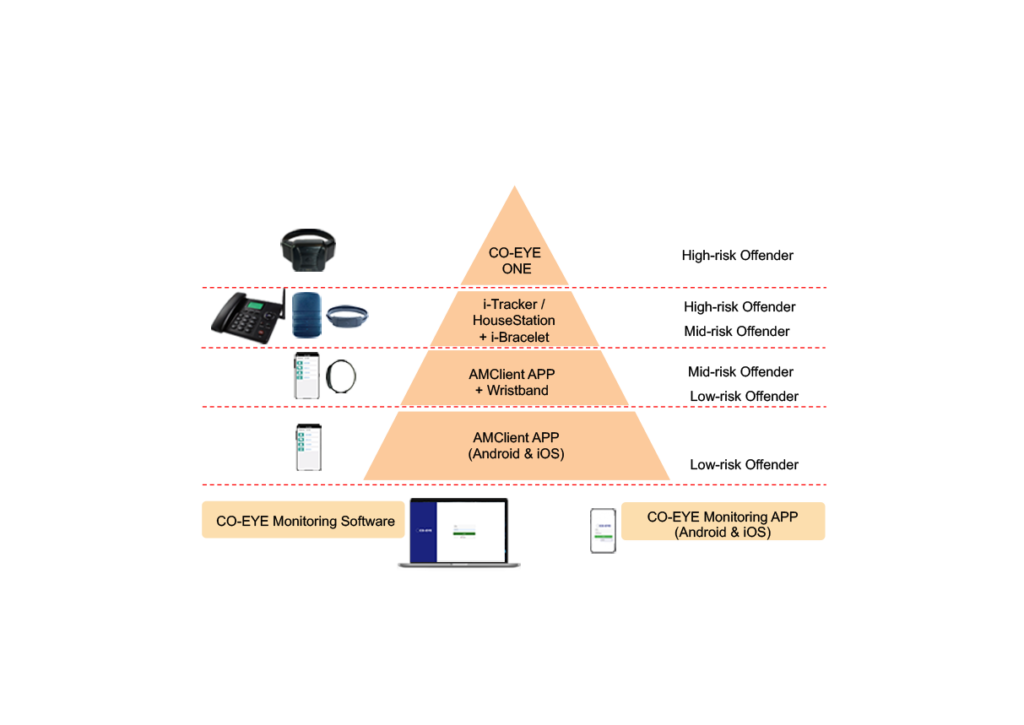
The most cost-effective programs use both. High-risk offenders get one-piece GPS monitors for continuous tracking. Medium-risk offenders get two-piece systems where the ankle bracelet pairs with a home base station for curfew enforcement only — no GPS tracker needed, which eliminates the tracker-related compliance problems. Low-risk offenders use a compact BLE wristband paired with a smartphone app. This tiered approach can cut per-offender costs by 30–50% compared to deploying GPS on every case.
Anti-Tamper: The Hidden Cost Differentiator
Anti-tamper technology quality varies dramatically between vendors and directly impacts operational costs. The three main approaches:
- Heart-rate / skin-contact sensing — Detects body removal by monitoring heart rate or galvanic skin response. Prone to false positives from dry skin, poor fit, or movement. Cook County, Illinois documented over 80% false alert rates, much of it attributable to this type of sensing.
- Capacitive sensing — Measures electrical properties of skin contact. Better than heart-rate but still generates false positives, especially when the device gets wet or the offender has skin conditions.
- Optical fiber detection — A continuous optical fiber loop in the strap provides deterministic cut/no-cut detection. Either the fiber is intact or it isn’t — there’s no probability threshold or environmental interference. Physical evidence of tampering remains even after the event.
An agency experiencing an 80% false alert rate is spending the vast majority of its monitoring center budget investigating events that aren’t real. The anti-tamper technology in your chosen device directly determines this cost.