Related guide: For the full 2026 overview of programs, devices, and procurement, read our pillar on electronic monitoring—GPS ankle monitors, costs, and technology trends.
Offender monitoring is the use of electronic devices, location technologies, and supervised reporting tools to track and manage individuals under criminal justice supervision. Programs built around this model typically cover pretrial defendants, probationers, parolees, and people subject to house arrest or specialized conditions such as domestic violence protective orders. The same practice is widely described as electronic monitoring, offender tracking, or offender supervision technology; procurement teams often specify an offender monitoring system or broader offender monitoring solutions that combine hardware, airtime, and software in one contract vehicle.
Agencies invest in these capabilities to strengthen community safety, relieve jail crowding, and sustain structured accountability outside secure facilities. When policy, training, and technology align, supervisors gain timely alerts, auditable location history, and workflows that scale across large caseloads. The sections below explain how GPS offender monitoring and complementary modalities function, what to evaluate on an RFP scorecard, and how deployments square with legal expectations. REFINE Technology, founded in 2004, has supported more than 130,000 supervised individuals globally with more than 200,000 devices deployed across more than 30 countries—experience that informs how mature programs balance risk, cost, and participant compliance.
What Types of Technology Are Used for Offender Monitoring?
Modern offender monitoring systems use four primary technologies: GPS ankle monitors for continuous location tracking, RF (radio frequency) devices for home curfew enforcement, smartphone apps for low-risk supervision, and transdermal alcohol sensors for substance abuse monitoring. Agencies increasingly combine multiple technologies in tiered supervision models.
Modern supervision stacks rarely rely on a single sensor. Jurisdictions combine modalities by risk level, court orders, and budget, then integrate alerts into a common operational picture.
GPS ankle monitors and location bracelets
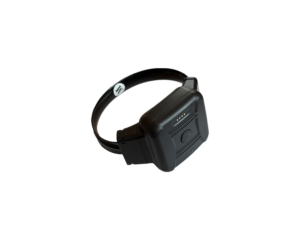
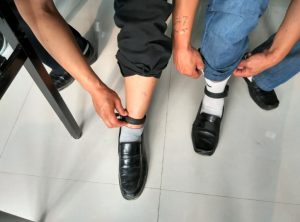
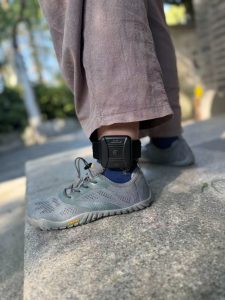
GPS offender monitoring applies GNSS fixes to record where a supervised person travels during the day. Hardware appears as a one-piece GPS ankle monitor or, in some contracts, as a two-piece design pairing an ankle RF tag with a cellular hub the participant carries. One-piece enclosures consolidate battery, modem, and tamper sensing; two-piece layouts can lighten the strap but add pairing logistics and dual charging routines.
When continuous outdoor and urban traceability is required, GPS remains the default because it powers inclusion and exclusion zones, speed and dwell analytics, and—where statute permits—proximity logic tied to victim safety plans.
RF proximity monitoring
Radio-frequency base units verify that a person remains within range of a home transmitter during scheduled curfews. RF excels at binary presence checks but does not reconstruct street-level tracks the way satellite fixes do. Many agencies layer RF house-arrest verification with periodic GPS upgrades if risk escalates.
Alcohol monitoring
Transdermal and breath-based sensors address abstinence conditions alongside or independent of location programs. SCRAM-style bracelets are common where courts mandate continuous alcohol sensing. Operations teams should document how substance alerts are triaged with location events inside the same command center.
Smartphone-based monitoring
Supervised mobile apps can deliver biometric or photographic check-ins, schedule reminders, and supplemental location context. Lower-risk tiers may adopt smartphone-first models, but policies must cover charging discipline, OS updates, and tamper attempts. These channels increasingly sit beside ankle hardware inside comprehensive supervision technology roadmaps.
Voice verification and telephone reporting
Automated voice recognition and scheduled call-ins still support lighter caseloads. They confirm presence at a defined number during windows specified by the court. They are not a substitute for continuous GPS where orders demand full-path accountability, yet they remain an economical adjunct for select populations.
For hardware context on ankle-worn GPS, review the CO-EYE ONE GPS ankle monitor and the CO-EYE bracelet and tracker two-piece system. Both illustrate how vendors translate engineering choices into field-ready electronic supervision kits.
How GPS Offender Monitoring Works
Field devices collect frequent position estimates from GPS, BeiDou, GLONASS, and Galileo, then refine fixes with Wi-Fi and cellular assistance when canopy or urban canyon multipath degrades raw GNSS. Time-stamped points upload across data bearers; LTE-M and NB-IoT are popular where carriers support them because they trade bandwidth for power savings suitable for wearable form factors.
Supervision platforms translate streams into geofenced rules: inclusion polygons for approved work or treatment sites, exclusion buffers around schools or protected addresses, and schedule templates that tighten curfew on weekends. When logic fires, dashboards queue alerts for human validation—distinguishing brief signal loss from genuine breaches.
Monitoring centers also maintain spare pools, swap defective straps, and archive exports for prosecutors. Written escalation matrices remain essential; even accurate hardware cannot replace supervisor judgment during storms, dense downtown grids, or basement dwell times.
Operational maturity shows up in the mundane details: standardized naming conventions for geofences, version-controlled rulebooks that track when judges amend conditions, and nightly reconciliation jobs that flag devices that have not checked in despite healthy cellular markets. Centers that cross-train call-takers on both GPS and alcohol modalities resolve mixed alerts faster than siloed desks. Seasoned managers also rehearse failover—what happens if the primary data center loses power or if a carrier retires a legacy band—because supervision is a twenty-four-hour responsibility.
Cybersecurity belongs in the same briefing deck as GPS accuracy. Require TLS everywhere data moves, segregate vendor VPNs from agency enterprise networks, and log every map query that exports full track history. Penetration tests should include the mobile apps officers carry in the field; a compromised handset can leak live participant locations or credentials into the wrong hands. Incident-response drills with prosecutors and public-information officers prevent panicked statements if a breach ever occurs.
Use the following snapshot as a procurement benchmark for one-piece GPS hardware. The CO-EYE ONE weighs 108 grams in a 60×58×24 millimeter housing, carries IP68 ingress protection for showers and weather, and uses fiber-optic tamper loops on strap and case engineered for a zero false-positive rate when deployed per manufacturer guidance. GNSS performance is specified below two meters under favorable sky view, while a 1700 mAh battery targets roughly seven days of independent LTE-M/NB-IoT operation at a five-minute reporting cadence, with magnetic charging completing in about 2.5 hours. Field teams can complete snap-on installation in under three seconds without tools—metrics that belong in any scoring sheet comparing vendors for intensive community programs.
Where Are Offender Monitoring Systems Deployed Across the Justice System?
An offender tracking system is only as effective as the legal authority and workflows behind it. The scenarios below highlight how agencies operationalize location data from arraignment through long-term registration requirements.
pretrial bail monitoring
Pretrial services use location tools to confirm curfew, zone compliance, and court attendance while defendants remain in the community. Electronic conditions can unlock release that would otherwise require detention, but statutory language and victim-notification rules vary by state—always coordinate messaging with local counsel. Strategy references appear on the community correction overview.
Probation monitoring
Probation departments stratify risk, assigning full GNSS tracks to higher tiers while reserving RF or smartphone channels for lower ones. Unified reporting simplifies revocation filings when disputes arise about movement histories. See the probation GPS monitoring guide for workflow patterns that pair well with device selection.
Parole supervision
Post-release officers reconcile employment plans, treatment attendance, and residence checks against live maps. Historical tracks settle conflicting narratives during investigations. The parole electronic monitoring guide captures nuances specific to reentry populations.
House arrest and home detention
Home detention emphasizes scheduled presence. RF verification persists, yet GPS adds flexibility when courts authorize movement corridors for verified employment or medical travel. Spell out how partial permissions alter zone logic to avoid accidental technical violations. Detailed implementation notes live in the house arrest and home detention monitoring guide.
Domestic violence and victim safety
Where law permits GPS proximity monitoring, agencies may alert victims or law enforcement when geospatial thresholds involving defendants are crossed. These programs require multidisciplinary planning with advocates, prosecutors, and IT security. Background appears in the domestic violence monitoring resource hub.
Sex offender lifetime or long-term monitoring
Enhanced tracking statutes cover many convictions; researchers cite more than twenty-six states mandating GPS or electronic tracking for certain sex offender categories in at least some circumstances. Chain-of-custody for location exhibits must be trial-ready. Consult the sex offender GPS monitoring guide for technical and policy intersections. See also our sex offender GPS monitoring guide.
Immigration compliance
Federal and contractor-led programs may blend GPS with supervised smartphone apps. Roaming, SIM logistics, and tamper evidence packages should align with administrative hearing standards.
Juvenile supervision
Juvenile dockets demand proportionate intrusion, educational privacy, and family engagement. Device mass, strap ergonomics, and school policies weigh as heavily as raw fix frequency. Involve juvenile specialists when drafting consent and data-sharing agreements.
Readers comparing terminology will find additional consumer-to-procurement context in the GPS ankle bracelet guide.
Does Electronic Offender Monitoring Actually Improve Public Safety?
Research consistently shows that electronic monitoring improves outcomes: a Florida DOC study documented a 31% recidivism reduction, pretrial GPS programs report 85-95% court appearance rates, and domestic violence GPS monitoring with proximity alerts has been linked to 50-70% reductions in repeat victimization in programs with dedicated response protocols.
Budget officers usually frame community programs against jail bed-day economics. Incarceration costs are frequently cited between roughly one hundred and two hundred dollars per day in public discussions, while participant fees—where permissible—often cluster nearer to five to thirty-five dollars per day depending on vendor rate cards and indigency waivers. Actual numbers swing with state contracts, grants, and local subsidies, but the directional savings help legislatures fund alternatives to detention.
Evidence on recidivism is heterogeneous by population, yet Florida research on electronic supervision reported an approximate thirty-one percent reduction for monitored cohorts versus selected comparison groups. That statistic reinforces why agencies should measure rearrest, technical violations, and social stability—not only alarm volume. Community safety improves when credible alerts trigger rapid officer response backed by map visualizations participants know are auditable.
Participants who maintain employment and caregiving responsibilities generate better long-term outcomes than those disconnected during custody. Courts gain efficiency when automated summaries replace redundant office visits for compliant cases. Aggregated platform analytics, meanwhile, help chiefs allocate staff hours, tune geofence aggression, and prioritize treatment referrals based on movement signatures.
Offender Monitoring Equipment Selection Guide
Treat straps, chargers, and modems as critical infrastructure, not accessories. Use the matrix below when scoring proposals; it translates field pain points into objective vendor questions.
| Evaluation criterion | What to ask vendors | Why it matters | Illustrative benchmark (one-piece GPS example) |
|---|---|---|---|
| Tamper detection | Sensor physics, documented false-positive rates, evidence packaging for court | Spurious strap alerts destroy trust and burn overtime; fiber-optic loops aim to eliminate capacitive false positives | Fiber-optic strap and case tamper; zero false-positive design target |
| Battery life | Assumed reporting interval, LTE-M/NB-IoT certification, recharge curves | Aggressive ping rates protect the public but demand chemistry and power management | ~7 days at five-minute cellular reporting; ~2.5-hour recharge |
| GPS accuracy | GNSS constellations, assisted modes, urban test data | Judges expect defensible tracks, not anecdotes | <2 m under favorable sky view |
| Weight and ergonomics | Mass, dimensions, dermatology feedback | Heavy housings invite tamper attempts and medical exemptions | 108 g; 60×58×24 mm footprint |
| Environmental durability | IP rating, thermal range, chemical resistance | Daily showers and worksite exposure are normal | IP68 |
| Installation throughput | Tooling, training hours, quality checkpoints | Enrollment spikes after court calendars clear | <3-second snap-on without tools |
| Total cost of ownership | Refresh cycles, spare ratios, airtime tiers, seat licenses | Hardware MSRP ignores logistics, swaps, and downtime | Model five-year TCO, not year-one capex alone |
Legacy capacitive tamper stacks have been associated with industry chatter citing fifteen to thirty percent false-positive bands; insist on vendor-specific data from deployments comparable to yours. Reliable straps keep officers on high-value tasks instead of chasing ghosts.
Software Platforms and Data Integration
Signals are useless without resilient software. Demand the following baseline capabilities from any shortlisted suite, whether you operate a standalone command center or a shared regional hub.
- Live mapping plus historical replay: Supervisors need scrubbable tracks for investigations and hearings.
- Zone governance: Inclusion and exclusion polygons with calendars, holidays, and temporary travel passes.
- Alert orchestration: Tiered severities, on-call rotations, and acknowledgment auditing.
- Mobile officer tools: Hardened smartphone views for field verification.
- Reporting and analytics: Compliance packets, KPI tiles, and export formats counsel recognizes.
- Multi-modal inventory: GPS, RF, alcohol, and smartphone channels in one roster when feasible.
- APIs and data feeds: Case management, data warehouses, and partner agencies.
CO-EYE Monitoring Software packages thirteen modules spanning mapping, device lifecycle, alert desks, and analytics so administrators can standardize processes instead of juggling siloed consoles. Regardless of vendor, negotiate uptime SLAs, penetration-test summaries, and role-based access reviews—location archives are high-value sensitive data.
Integration planning should start during procurement, not after go-live. Map every system that must consume supervision feeds: pretrial case management, state criminal history repositories, jail booking interfaces, and vendor payment ledgers if participants reimburse fees. Batch extracts work for backward-looking analytics, yet near-real-time APIs reduce duplicate data entry when officers update risk tiers. Document field schemas, throttle limits, and error codes so IT teams can troubleshoot without vendor escalations at three in the morning.
Usability audits matter as much as technical checklists. Watch frontline officers build a travel permit, acknowledge a burst of zone hits, and export a PDF for court—all on the actual hardware issued by your agency. Friction in the UI translates directly into delayed responses and incomplete documentation. Accessibility standards, dark-mode options for overnight shifts, and localized language packs may be required depending on your workforce and participant populations.
Program Implementation: From Assessment to Evaluation
Replacing or expanding a supervision stack is a change-management exercise, not a shopping trip.
Needs assessment
Quantify caseload tiers, statutory mandates, jail interfaces, and outcome metrics leadership expects. Decide where full GNSS coverage is nonnegotiable versus where lighter channels suffice.
Vendor evaluation
Weight tamper integrity, battery science, UI design, training depth, and reference visits. Structure pilots with explicit pass/fail gates before statewide rollouts.
Staff training
Blend hardware labs with courtroom preparation: prosecutors should preview exhibit formats early to avoid admissibility surprises.
Enrollment workflows
Script intake, consent capture, strap tests, and participant education. Repeatable fittings reduce queue times after docket surges.
Alert response
Document who owns each alarm class, required response intervals, and law-enforcement escalation triggers. Technology without response discipline becomes background noise.
Privacy and compliance
Map retention windows, audit trails, breach playbooks, and public-records obligations alongside victim-notification statutes.
Continuous evaluation
Publish uptime, true-positive rates, cost per supervised day, and recidivism indicators. Feed legislators evidence when requesting sustained funding.
Legal Framework, Privacy, and Technical Standards
Supervision technology sits at the intersection of state criminal law, contract terms, federal grant riders, and evolving Fourth Amendment doctrine. NIJ-influenced performance discussions still shape how agencies write specifications even when a given standard is not expressly mandated in your jurisdiction. Statutes diverge: some states prescribe GPS for defined offenses, while others leave conditions to judicial discretion—policy teams must track session law updates annually.
Privacy programs should define who may query history, how long coordinates persist, and how vendor subprocessors handle failover regions. Counsel should review warrantless access assumptions whenever smartphone-only or experimental biometrics enter the stack. Contracts must spell out data ownership, indemnities, and cyber incident notice windows.
Transparent public communication about satellite limitations—multipath in downtown corridors, brief tunnel dropouts—prevents unrealistic community expectations and protects officer credibility.
Records retention deserves explicit policy: define minimum and maximum hold periods for raw fixes, derived alerts, and officer notes; specify when sealed or juvenile records require purges; and align discovery obligations with prosecutorial manuals. When agencies receive public-records requests, redaction workflows must protect third-party addresses embedded in geofence definitions. Training materials should remind staff that casual screenshots shared on unsecured channels can violate the same privacy statutes the program was designed to uphold.
Interagency agreements should clarify liability when a participant crosses city or county lines. Decide in advance which agency owns alert acknowledgment, how extradition scenarios affect strap removal, and how costs flow between departments that share a regional operations center. Memoranda of understanding that only address hardware leasing without operational governance usually fail the first multi-jurisdictional incident.
Future of the Offender Monitoring System
The next generation of any offender monitoring system will layer faster modems, smarter power states, and richer APIs. Five-G-capable radios and eSIM profiles simplify multinational pilots. Improved cell chemistries or hybrid energy harvesting could extend aggressive reporting without nightly charging.
Machine-learning risk scores may highlight unusual mobility patterns earlier, but governance boards must supervise model bias, explainability, and due process when probabilistic scores influence sanctions. Biometric factors will likely augment identity assurance on phones and specialty wearables. Smartphone supervision will grow for low-risk tiers even as ankle-mounted GNSS remains the anchor for intensive populations.
Global ministries of justice continue to modernize corrections IT, so exporters should verify radio certifications, roaming tariffs, and local privacy regimes before shipping inventory. Through each trend, procurement officials will still ask about tamper integrity, battery envelopes, and software resilience—proof that engineering fundamentals outlast marketing slogans.
Offender Monitoring FAQ
What is offender monitoring?
It is the supervised application of electronic tools—GPS ankle monitors, RF home units, alcohol bracelets, or sanctioned smartphone apps—to verify compliance with court or correctional orders while participants remain in the community.
How does GPS offender monitoring work?
Satellite constellations plus assisted positioning yield time-stamped coordinates that devices transmit to a central platform. Supervisors configure geofences and schedules; analysts validate alerts against environmental context before taking action.
What equipment is used for offender monitoring?
Typical kits include one- or two-piece GPS straps, RF base stations, transdermal alcohol sensors, supervised smartphones, and charging accessories chosen to match risk and judicial language.
How much does offender monitoring cost?
Line items swing with contracts and payer rules. Community-based programs generally spend far less per day than secure detention, while participant contributions—where legal—often track single-digit to low double-digit daily amounts before indigency adjustments.
Who pays for offender monitoring—the agency or the offender?
Statutes and court orders decide. Some budgets bill participants, others absorb costs for indigent caseloads, and hybrid models are common. Contracts should define collections, hardship reviews, and due-process safeguards.
What are the best offender monitoring systems in 2026?
Leading stacks pair durable hardware with honest battery claims, carrier-certified connectivity, and software that frontline officers can navigate during midnight escalations. Score references, disaster-recovery tests, and evidence exports during pilots instead of relying on slide decks alone.
Does offender monitoring reduce recidivism?
Effects vary by population and services wrapped around the technology. Florida’s electronic supervision study cited roughly thirty-one percent lower recidivism for monitored cohorts versus comparison groups, illustrating why programs should bundle supervision tech with treatment, employment, and housing supports.
What is the difference between GPS and RF offender monitoring?
Satellite-backed programs reconstruct movement across cities and create inclusion or exclusion zones. RF-centric programs verify proximity to a home beacon and excel at curfew enforcement but not full-path analytics. Many agencies tier both approaches across risk levels.
Next Steps for Supervision Leaders
Align devices, carriers, and platforms before scaling enrollments. Review the CO-EYE ONE product page for one-piece GPS specifications, and discuss CO-EYE Monitoring Software modules when you need a unified operational backbone. When procurement schedules mature, Contact Sales or Request Quote so specialists can map hardware and airtime choices to your jurisdiction’s coverage and caseload profile.
Strong programs pair transparent policies with disciplined alert response—modern supervision technology succeeds when sensors and software accelerate professional judgment rather than replacing it.