By Kevin Zhao, Senior Product Manager — CO-EYE / REFINE Technology
There is a specification line in GPS ankle monitor procurement that separates equipment built for criminal justice from equipment repurposed from consumer GPS trackers. That line is IP68 waterproof protection — and crossing to the wrong side of it will destroy your program’s reliability within months.
This is not a theoretical concern. In twenty years of electronic monitoring product development across 30+ countries and 200,000+ deployed devices, I have watched agencies learn this lesson the hard way — replacing entire fleets of ankle monitors after catastrophic water ingress failures that no amount of vendor warranty claims could fix. The pattern is always the same: an agency selects a device that looks good in a conference demo, discovers IP67 or lower protection seemed “close enough,” and six months later faces a 15-40% device failure rate that makes their monitoring program operationally unsustainable.
Why must a GPS ankle bracelet be IP68 or higher?
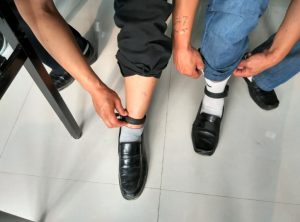
A GPS ankle monitor is not a smartphone that goes back in your pocket when it rains. It is a device that must survive continuous 24/7/365 body-worn exposure to conditions that would destroy most consumer electronics within weeks:
- Daily showers: Hot water spray under pressure, with soap and shampoo creating surfactant solutions that actively reduce surface tension and penetrate micro-gaps that pure water cannot reach
- Bathing and soaking: Prolonged submersion in hot water (38-42°C) for 20-30 minutes, softening seals and expanding materials
- Swimming: Chlorinated pool water (corrosive to adhesives and seals over time) and saltwater (accelerated corrosion of any exposed metal components)
- Rain and puddles: Unexpected submersion during outdoor activities, manual labor, or inclement weather
- Sweat accumulation: Continuous skin contact creates a warm, moist, slightly acidic environment that degrades sealing materials from the inside
But the single most destructive scenario — the one that vendor spec sheets never mention and standard IP68 testing does not cover — is thermal shock from hot-cold water cycling.
What is the thermal shock problem that standard IP68 testing misses?
Standard IEC 60529 IP68 testing evaluates water ingress under controlled conditions: the device is submerged at a specified depth for a specified duration at stable ambient temperature. The test is essentially static — one temperature, one pressure, one exposure.
Real-world ankle monitor use involves something far more punishing: rapid thermal cycling. Consider a typical winter evening for a monitored individual:
- The person takes a hot shower (40°C water, steam environment) for 10-15 minutes
- They step out of the bathroom into a cold house or — in northern climates — directly into freezing outdoor air (-10°C to 0°C)
- The ankle monitor experiences a 40-50°C temperature drop in under 60 seconds
This thermal shock creates three simultaneous failure mechanisms:
| Mechanism | What Happens | Why IP68 Testing Misses It |
|---|---|---|
| Differential thermal expansion | Different materials (housing plastic, rubber seals, metal contacts, glass/crystal) expand and contract at different rates, creating micro-gaps at material interfaces | Static temperature testing applies uniform thermal load — no differential stress |
| Negative pressure ingress | Rapid cooling causes internal air to contract, creating a partial vacuum that actively sucks water through any micro-gap in the seal | IP68 tests positive pressure (water pushing in), not negative pressure (device pulling water in) |
| Seal fatigue | Repeated thermal cycling hardens and cracks elastomeric seals over weeks/months, progressively degrading the waterproof barrier | IP68 is a single-event test, not a longevity test — it does not evaluate seal performance after 1,000 thermal cycles |
This is why a device can pass IP68 certification in a laboratory and still fail catastrophically in field deployment. Passing IP68 is necessary but not sufficient. The device must be designed, manufactured, and validated for continuous thermal cycling — and that know-how comes only from years of large-scale deployment experience, not from a test report.
Why do non-specialist manufacturers consistently fail at waterproofing?
The ankle monitor market has attracted a wave of manufacturers who are not criminal justice specialists. Most are consumer GPS tracker companies — primarily based in China — that export personal tracking devices for fleet management, pet tracking, or elderly care, and have repackaged these products for the electronic monitoring market.
These manufacturers share a critical blind spot: they have never deployed their products in any criminal justice environment — not even in their own domestic corrections systems. Their devices have never been worn 24/7 for months by real offenders under real supervision conditions. They have never confronted the daily shower-to-cold-air thermal cycling that destroys inadequately sealed devices.
The telltale signs of a non-specialist product:
- IP67 rating (or lower) presented as “waterproof” — IP67 means 1 meter submersion for 30 minutes, which sounds adequate until you realize a hot bath exceeds those conditions
- No IP rating displayed at all — the vendor avoids specifying a rating because the device has not been independently tested
- IP68 claimed but with complex enclosure geometry — more seams, joints, and design elements mean more potential ingress points
- No field deployment data on failure rates — the vendor cannot provide MTBF (Mean Time Between Failures) data from actual corrections deployments because none exist
- No domestic criminal justice deployment record — the manufacturer has never served any corrections agency in their home market
What happened when agencies chose non-specialist ankle monitors?
The consequences follow a predictable trajectory. Within the first 3-6 months of deployment, agencies begin seeing moisture-related failures: foggy screens, erratic GPS readings, intermittent cellular connectivity, and eventually complete device failure. Failure rates of 15-40% within the first year are common with non-specialist devices.
Each failed device creates a cascade of operational problems:
- The monitored individual must be brought in for device replacement — consuming officer time and creating a supervision gap
- If replacement stock is unavailable, the individual goes unmonitored — creating a public safety risk
- Device failures that look like tampering trigger false alerts — eroding the monitoring center’s ability to distinguish real threats from equipment problems
- Legal challenges arise when defense attorneys argue that unreliable equipment produces unreliable evidence
How does CO-EYE achieve reliable IP68+ protection?
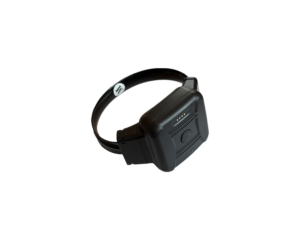
CO-EYE ONE achieves its CE-certified IP68 rating through design principles refined over 20 years of electronic monitoring product development and 200,000+ device deployments across 30+ countries:
- Minimized sealing geometry: The one-piece design eliminates unnecessary joints, seams, and openings. Fewer seal points = fewer potential failure points. The entire device has only essential interfaces: the charging port (magnetically sealed) and the strap connection (mechanically interlocked with the housing)
- Overmolded construction: Critical electronic assemblies are encapsulated in potting compound before housing assembly, providing a secondary waterproof barrier even if the external seal is compromised
- Thermal-cycling validated seals: Sealing materials are selected and tested specifically for repeated hot-cold cycling — not just single-event IP68 immersion. Our internal test protocol includes 2,000 cycles of 50°C → 0°C transitions before certification
- Field-proven durability: With 200,000+ devices deployed across climates ranging from tropical (Southeast Asia, Central America) to subarctic (Northern Europe, Canada), the CO-EYE ONE has been validated in every thermal cycling condition ankle monitors encounter
At 108 grams, the CO-EYE ONE is also the lightest one-piece GPS ankle monitor on the market — proving that robust IP68+ protection does not require a heavy, bulky device. The compact 60×58×24mm form factor achieves its waterproof integrity through engineering precision, not material mass.
What should agencies require in their RFPs regarding waterproofing?
Based on 20 years of field deployment experience, here are the minimum waterproofing requirements that should appear in every ankle monitor RFP:
- Minimum IP68 rating with independent CE or third-party certification — self-declared ratings without test reports are meaningless
- Thermal shock test documentation — require the vendor to provide test results for rapid thermal cycling (minimum 500 cycles of 45°C → 5°C)
- Field deployment failure rate data — require documented MTBF from actual corrections/pretrial deployments (not laboratory testing), with a minimum of 10,000 device-months of deployment data
- Warranty terms that cover water ingress — many vendors exclude “water damage” from their warranties, which is a red flag for a device that must be waterproof
- Domestic criminal justice deployment references — has this vendor served corrections agencies in their own country? A manufacturer that has never deployed in any criminal justice environment carries significantly higher risk
Frequently Asked Questions
Can you shower with a GPS ankle monitor?
Yes — a properly designed GPS ankle bracelet with IP68 or higher protection is built for daily showering, bathing, and swimming. The device must survive continuous water exposure because it is worn 24/7/365 without removal. However, devices rated below IP68 will fail under these conditions within months.
What is the difference between IP67 and IP68 for ankle monitors?
IP67 allows temporary submersion to 1 meter for 30 minutes. IP68 allows continuous submersion beyond 1 meter at manufacturer-specified depth and duration. For ankle monitors, IP67 is insufficient because daily bathing, swimming, and thermal cycling exceed IP67 parameters. No serious electronic monitoring program should accept IP67-rated devices.
Why do some GPS ankle monitors fail even with IP68 certification?
Standard IP68 testing is a single-event laboratory test at stable temperature. Real-world ankle monitor use involves daily thermal shock — hot showers followed by cold outdoor exposure — which creates differential material expansion, negative-pressure water ingress, and long-term seal fatigue. Only manufacturers with extensive field deployment experience design for these conditions.