

Introduction: Why Equipment Choice Defines Monitoring Company Performance
For ankle bracelet monitoring companies, hardware is not a commodity purchase. The devices you deploy shape daily operations, client satisfaction, and long-term profitability. Supervision agencies and courts hold monitoring providers accountable for missed alerts, false alarms, and equipment failures. When a defendant’s device drops offline or triggers repeated nuisance tamper events, the monitoring company—not the manufacturer—often bears the reputational and logistical cost.

Choosing the right GPS ankle monitoring platform affects three levers that matter in competitive RFPs and renewals:
- Direct operating cost — staff time spent on charging logistics, field swaps, and alarm verification.
- Reliability and signal integrity — location accuracy, cellular resilience, and tamper logic that matches real-world wear conditions.
- Client retention — probation departments, pretrial programs, and private supervision firms compare providers on downtime, officer burden, and court-facing reporting quality.
Electronic monitoring has demonstrated measurable public-safety value. According to research summarized by the National Institute of Justice (NIJ), electronic monitoring was associated with a 31% reduction in recidivism in a Florida study spanning 2001–2007, analyzing more than 5,000 medium- and high-risk offenders against a control pool of roughly 266,000 individuals. NIJ also notes that the cost of imprisonment can be roughly six times higher than supervising someone on electronic monitoring—underscoring why community supervision scales depend on dependable equipment.
At the same time, the scale of community corrections is enormous: the Bureau of Justice Statistics reports that more than 5 million people in the United States are under community supervision. That volume translates into millions of device-days annually, where small differences in battery life or false-alert rates compound into major budget and staffing impacts.
This guide is written for procurement and operations leaders at electronic monitoring company equipment programs who need a disciplined framework for comparing ankle bracelet monitor hardware in 2026—without marketing noise, and with an eye toward total cost of ownership (TCO) and audit-ready documentation.
Key Evaluation Criteria for GPS Ankle Hardware
Battery life: daily charge cycles versus multi-day autonomy
Battery architecture is the single largest driver of field labor for many programs. Devices that require nightly charging create predictable call volume, curfew complications, and swap trucks. Hardware advertising “24-hour” operational life under active GPS reporting often degrades further in poor cellular conditions or when courts mandate tighter location sampling intervals.
By contrast, modern cellular IoT designs using low-power wide-area networks can stretch reporting windows substantially—commonly up to roughly one week between charges under typical supervised reporting profiles (exact endurance depends on sample rates, RF environment, and firmware). For a monitoring company, moving from daily charging to multi-day autonomy can reduce truck rolls and after-hours support enough to change margin on a per-participant basis.
Procurement tip: request battery-life curves tied to explicit reporting intervals (for example, 5-minute fixes versus 15-minute fixes) and verify claims against your jurisdiction’s minimum standards. Where possible, instrument pilots with server-side logs of fix success rates and time-to-first-fix after motion events; “battery life” without fix reliability is a hollow metric.
Tamper detection: understanding false-alert economics
Tamper sensors are not interchangeable. Photoplethysmography (PPG) or similar skin-contact sensors are common in consumer-influenced designs, but in electronic monitoring they are notorious for environmental false positives—strap looseness, sweat, temperature shifts, and motion artifacts. Industry practitioners frequently cite PPG-based approaches producing on the order of 30–50% false positive rates in operational settings, meaning a large share of “tamper” events may not reflect genuine removal attempts.
Optical fiber–based tamper loops integrated into the strap and housing can behave differently: when implemented as a continuous integrity circuit, they can achieve zero false positives for strap or case compromise (i.e., a cut or break registers as a definitive breach rather than a probabilistic skin signal). For a monitoring company, the operational distinction is stark—every false tamper routes staff through phone trees, officer dispatches, and sometimes court notifications.
Documented field costs for unnecessary responses vary by region and labor rules, but many agencies budget approximately $150–$300 per false alarm response once officer time, vehicle mileage, and documentation are included. Multiply that by hundreds of nuisance events per year and the sensor choice can exceed the hardware purchase price.
Form factor: one-piece versus two-piece systems
One-piece ankle devices integrate cellular modem, GNSS receiver, battery, and tamper envelope into a single sealed unit. They simplify inventory, reduce pairing failures, and lower the “lost component” risk common with two-part kits.
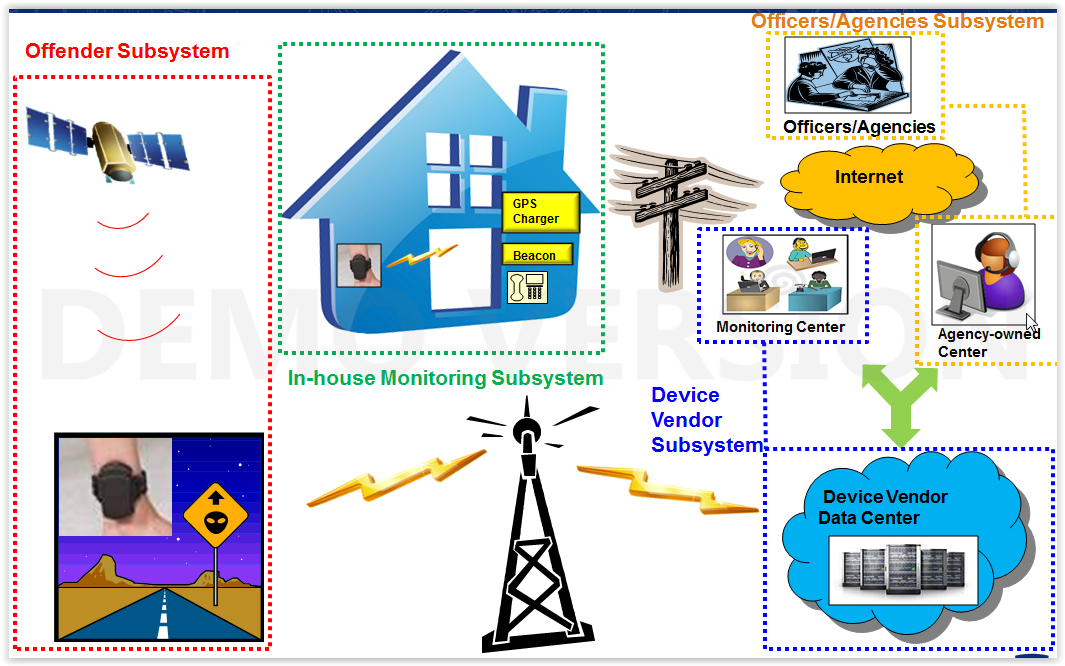
Two-piece architectures (bracelet plus home beacon or hub) can support specific program models—particularly where indoor location certainty or RF tethering is mandated—but they introduce pairing management, beacon power outages, and extra installation steps. Evaluate whether your contracts truly require hub logic or whether a robust one-piece GNSS + Wi-Fi / LBS fallback meets the same supervision outcomes with less operational drag.
Inventory planning differs materially: two-piece systems double the SKUs you must stock, track, and refurbish. If your contracts include rural participants, confirm beacon RF range claims against real construction types—signal attenuation through metal siding and concrete foundations has sunk more than one pilot.
GPS accuracy and blended positioning
Court-facing maps and exclusion zones demand defensible accuracy. Ask vendors for typical horizontal accuracy under open sky, urban canyon, and indoor-adjacent conditions. Leading devices combine GPS with additional satellite constellations and may supplement with Wi-Fi or network-based location where regulations allow. The procurement goal is not “best spec sheet,” but consistent behavior in the geographies where you operate.
Request sample exports of raw track data during pilot weeks, then independently visualize speed, heading stability, and fix dropout patterns around courthouses, parking garages, and dense downtown cores. Small systematic biases become visible quickly when you overlay participant narratives (“I was at work”) against traces.
Cellular connectivity: legacy 2G/3G versus LTE-M / NB-IoT
Many incumbent devices still rely on 2G or 3G cellular stacks. As carriers retire legacy bands, sunset risk becomes a balance-sheet item—forced upgrades, truck rolls, and angry clients. Newer LTE-M and NB-IoT modules are purpose-built for low-power telemetry, often with better building penetration than legacy GSM in marginal signal areas.
When comparing modules, confirm roaming and carrier certification for your primary markets, and map a realistic sunsetting timeline for any hardware still dependent on decommissioned RATs (radio access technologies). Ask explicitly whether firmware supports over-the-air carrier profile updates and how the device behaves during brief tower handoffs—supervision systems should not interpret mobility as noncompliance.
Waterproofing: IP67 versus IP68
Ingress protection ratings matter because participants shower, work outdoors, and occasionally submerge devices unintentionally. IP67 generally indicates limited-duration immersion at shallow depth; IP68 typically denotes a manufacturer-defined sustained submersion specification that is stricter and more appropriate for corrections-grade wearables.
Request the exact IP test depth, duration, and whether the rating covers charging ports or sealed inductive designs. A monitoring company should treat IP claims as contractual, not decorative. If participants frequently work in wet trades, prioritize straps and gaskets that tolerate repeated soap and degreaser exposure without hardening or cracking.
Total Cost of Ownership (TCO)
Sticker price is a small fraction of TCO. Model the following over a 36-month horizon:
| Cost driver | What to quantify | Why it matters |
|---|---|---|
| Device and spare pool | Unit cost, warranty terms, RMA turnaround | Inventory float scales with failure rate and court-mandated swap timelines |
| False alarm response | $150–$300 per unnecessary dispatch × expected annual false tampers per device class | Sensor physics directly moves this line item |
| Charging infrastructure | Charger loss rates, cable replacement, help-desk time | Daily-charge devices amplify peripheral costs |
| Replacement / obsolescence | Carrier sunsets, battery degradation, strap wear | Modular straps and field-replaceable bands reduce full-unit churn |
| Training and documentation | Onboarding hours for officers and installers | Complex pairing flows increase human error |
A disciplined TCO worksheet should tie each line item to measurable KPIs: average monthly truck rolls per 1,000 participants, median time-to-restore after a tamper, and percentage of alerts closed as “verified false” within 15 minutes. Model finance-friendly outputs such as net present value of field labor and break-even timing if reduced truck rolls offset a higher unit price.
Compliance and Certifications
Monitoring companies are increasingly asked to demonstrate that hardware meets recognized technical and safety baselines—not only for procurement committees, but for cybersecurity insurers and data-protection reviews.
- NIJ Standard 1004.00 — The National Institute of Justice publishes offender tracking systems standards used as a reference point in many U.S. conversations about performance, environmental, and reporting requirements. Aligning RFP language to NIJ-oriented criteria makes apples-to-apples scoring easier.
- CE / RED (Europe) — For any international deployment or dual-market vendor, Radio Equipment Directive compliance and associated EMC/SAR documentation should be present and version-controlled.
- EN 18031 cybersecurity posture — European cybersecurity expectations for connected devices are tightening; ask vendors how firmware signing, secure boot, and transport-layer security are implemented and audited.
- IEC 62133 (battery safety) — Lithium-cell designs should carry recognized battery safety test evidence suitable for air freight and institutional risk teams.
Store certificates in your vendor due-diligence packet alongside penetration-test summaries and data-processing agreements—courts and counties increasingly ask for this bundle during renewals.
Real-World Deployment Considerations
Installation time and field ergonomics
Traditional tool-based installs may take 5–10 minutes per participant when you account for sizing, screwdrivers or proprietary torque tools, strap threading, and quality photos for the chain of custody. Snap-on, tool-free designs marketed in the sub-3-second range reduce officer exposure time and standardize outcomes—important for high-volume intake days and mobile deployment vans.
Shorter installs are not “convenience”; they reduce labor cost per enrollment and lower the probability of improper torque leading to false strap alerts.
Officer training and change management
Even excellent hardware fails if staff workflows are misaligned. Run parallel shadow weeks: new devices on a pilot caseload with side-by-side reporting versus incumbent kits. Train on tamper escalation trees explicitly—what requires dispatch versus remote participant verification.
Document quick-reference cards that match your monitoring software’s alarm codes. Confusion at 2 a.m. converts into unnecessary dispatches faster than any hardware defect.
Software integration and API maturity
Hardware purchases are inseparable from the monitoring platform. Evaluate REST or webhook APIs, alert schema stability, geofence import/export, and whether your SIEM or ITSM can ingest device health telemetry. A monitoring company’s margin often lives in automation, not heroic manual monitoring.
Data portability matters for contract transitions: confirm you can export historical tracks and tamper logs in non-proprietary formats. Agencies increasingly refuse vendor lock-in that jeopardizes evidentiary continuity.
FAQ
What should ankle bracelet monitoring companies prioritize first in a vendor bake-off?
Start with tamper-sensor physics and cellular roadmap. False tampers and carrier sunsets create more unplanned expense than modest differences in GNSS chip generation.
How should we benchmark battery life fairly?
Lock a reporting interval matrix in the pilot protocol (for example, 5- and 15-minute modes), test in both urban and suburban RF environments, and log voltage curves rather than trusting marketing sheets.
Are PPG-based tamper sensors ever appropriate?
They can work in controlled research contexts, but for corrections-scale deployments the aggregate false-positive burden often overwhelms supervision staff. If you must use them, negotiate SLA credits tied to verified false-tamper rates.
What documentation belongs in every RFP attachment?
IP rating test reports, IEC 62133 summary, firmware update policy, penetration-test letter, SOC or ISO pathway (if claimed), and a NIJ-oriented specification mapping table.
How do we translate better hardware into renewals?
Publish year-over-year KPI improvements—reduced false dispatches, faster installs, fewer swap trucks—so procurement officers see operational proof, not promises.
Further reading
For deeper procurement checklists and jurisdiction-specific pretrial context, see our companion resources on one-piece GPS ankle monitor engineering, the GPS ankle monitor buyer’s guide, and the pretrial electronic monitoring guide.
About the Author
ankle-monitor.com publishes independent industry briefings for supervision technology buyers—covering hardware evaluation, standards alignment, and deployment economics for community corrections programs worldwide.