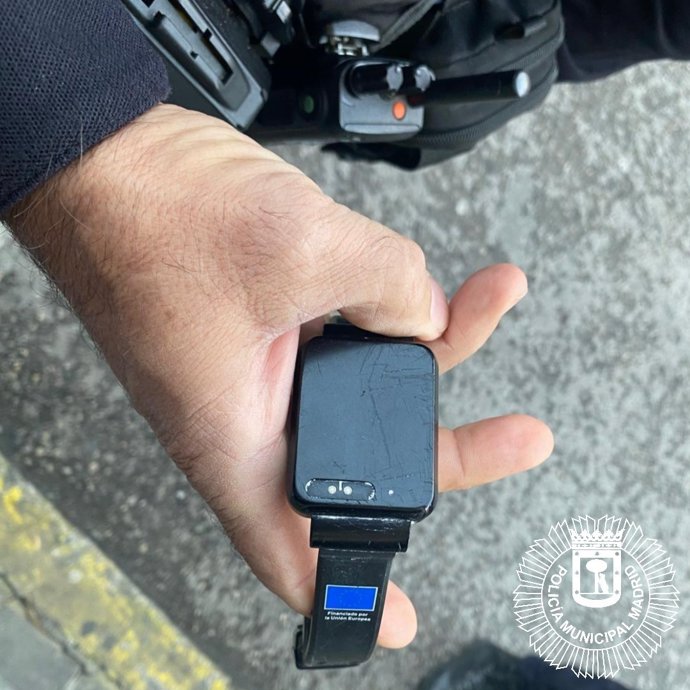
In January 2026, Spain’s Ministry of Equality made one of the most significant admissions in European electronic monitoring history (EFE, January 2026): their wrist-worn monitoring system for domestic violence offenders had failed. The ministry announced a complete replacement—switching from wristbands to ankle monitors—backed by a new €111 million contract. This decision came after 18 months of documented failures, victim endangerment, and a formal penalty against operator Vodafone.
What happened in Spain is not an isolated incident. It is the latest and most expensive confirmation of a fundamental truth in criminal justice electronic monitoring: wrist-worn devices cannot reliably prevent undetected removal by motivated offenders. The human skeletal anatomy makes this physically impossible—and Spain just paid over €111 million to learn this lesson.
What Went Wrong: Spain’s Cometa System Crisis (2024–2025)
Spain’s Sistema Cometa—the national telematic monitoring system for domestic violence restraining orders—protects approximately 5,000 women at any given time. Since 2009, the system was managed by Telefónica. In 2023, Spain’s Ministry of Equality awarded a new contract to a joint venture (UTE) of Vodafone and Securitas, which began operations in February 2024.
The problems started almost immediately.
The Data Migration Catastrophe
During the handover from Telefónica to Vodafone-Securitas, critical location data for all monitored aggressors prior to March 20, 2024 became inaccessible. Courts lost the ability to prosecute restraining order violations because GPS evidence simply did not exist in the new system. Spain’s Public Prosecutor reported that this resulted in “a large number of provisional dismissals or acquittals” of domestic violence offenders—men who had verifiably violated their restraining orders walked free because the monitoring data vanished.

Device Manipulation and Removal
Beyond the data crisis, the wrist-worn devices themselves proved fundamentally vulnerable. In a December 2024 meeting between the Ministry of Equality, Vodafone, and Securitas, all parties formally acknowledged that the wristbands were manipulable by aggressors (El País, September 2025). Former Cometa monitoring center employees documented specific failures:
- Undetected removal: Aggressors could slip off wrist devices without triggering tamper alerts, then remain unlocatable
- Water exploitation: Devices failed when submerged, despite contract requirements for IP67 rating—Vodafone later had to request IP68-rated replacements after detecting “extreme use”
- SIM card extraction: Removable SIM cards allowed aggressors to disable cellular connectivity
- Battery exploitation: Simply not charging the device caused location tracking to cease entirely
- Geolocation errors and frozen signals: Forced system reboots generated inaccurate or stalled position data
The Civil Guard in Granada specifically alerted authorities to these “dysfunctions.” Judges across Spain began reporting problems from July 2024 onward (RTVE, September 2025). By March 2025, provincial court presidents formally demanded urgent review and correction.
The Penalty
In March 2026, Spain’s Ministry of Equality fined Vodafone €25,285 (RTVE, March 2026) for a November 2025 system outage that knocked the entire Cometa monitoring system offline from 4:30 AM until 5:25 PM—leaving thousands of domestic violence victims without any electronic protection for nearly 13 hours. The fine was deducted directly from Vodafone’s contract payments.
Scale of Daily Violations
Data from the Cometa monitoring center reveals a staggering reality: aggressors breach their restraining orders approximately 1,700 times per day—roughly 50,000 violations per month. Each of these is a moment when a victim’s safety depends entirely on the reliability of the monitoring device. When that device can be removed from the wrist without detection, the entire system becomes theater.
Why Wrist Placement Fails: The Skeletal Anatomy Problem
The failure of wrist-worn monitoring in Spain was not a surprise to anyone who understands human anatomy. The fundamental issue is biomechanical—and it cannot be solved by better software, better batteries, or better contracts.
The Ankle: Nature’s Security Lock
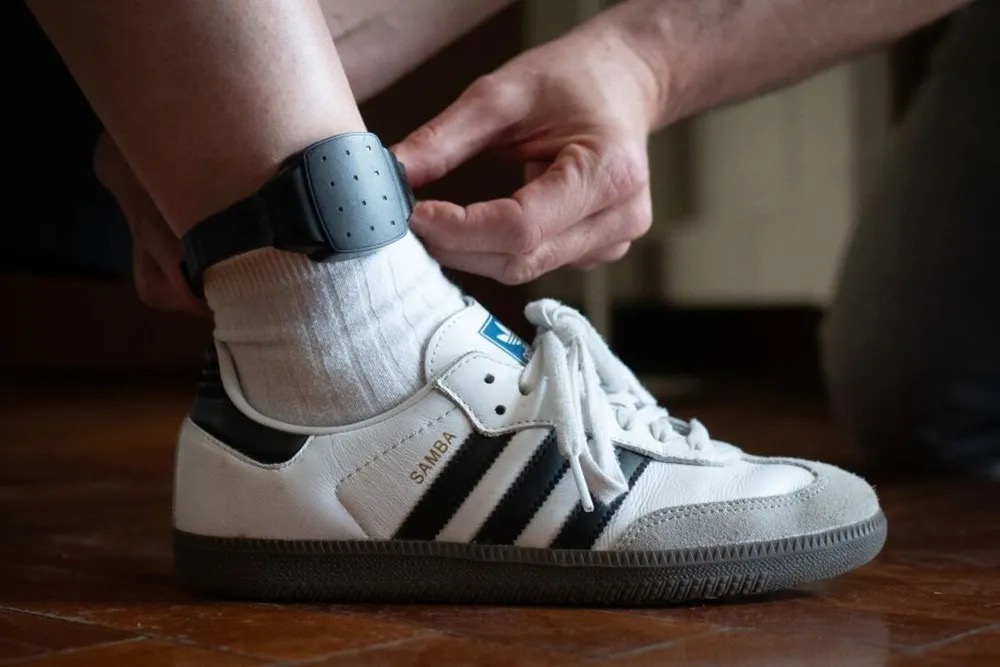
The human ankle contains the calcaneus (heel bone), which protrudes 4.5–5.0 cm posteriorly from the tibial axis. This creates a natural mechanical lock: a properly fitted ankle band physically cannot pass over the heel bone without being cut or the band being stretched beyond its design limits. Any attempt to force removal will either break the band—triggering an immediate fiber-optic or electrical continuity alarm—or require tools that leave unmistakable evidence of tampering.
The Wrist: An Open Door
The wrist has no equivalent anatomical lock. U.S. Department of Defense anthropometric studies document an average 3–5 cm gap between adult male wrist circumference (~17 cm) and hand circumference at the knuckles (~21 cm). However, the human hand’s metacarpal joints are flexible—the hand can compress its cross-section to approach or even match wrist diameter with lubricant (soap, oil, or even sweat).
This means any wrist band that is comfortable enough to wear 24/7 is also loose enough to remove with motivation and minimal technique. Tightening the band to prevent removal creates circulation problems, skin damage, and legal liability. There is no engineering solution to this anatomical reality.

The Predictable Failure Cycle
Every jurisdiction that deploys wrist-worn EM for containment (as opposed to voluntary compliance) follows the same trajectory:
- Months 1–3: The system appears to work. Most monitored individuals are compliant by default—they would have complied with any monitoring method, or none at all.
- Months 3–6: Knowledge of removal methods spreads among the monitored population. Early removal incidents are dismissed as isolated cases.
- Months 6–18: Removal incidents escalate. The monitoring center generates increasing “device not found” alerts that officers cannot distinguish from true absconding. Alert fatigue sets in.
- Months 12–24: Courts lose confidence in the technology. Prosecutors can no longer use GPS data as reliable evidence because defense attorneys challenge device integrity. The program either switches to ankle monitors or collapses entirely.
Spain’s experience followed this exact pattern over 18 months, from the February 2024 Vodafone deployment to the January 2026 ankle monitor announcement.
Spain’s Solution: The €111 Million Ankle Monitor Overhaul
On January 27, 2026, Spain’s Ministry of Equality formally announced the replacement of all wrist-worn DV monitoring devices with ankle monitors. The new tender—valued at €71 million base, expandable to €111 million over five years—specifies a comprehensive technological upgrade:
Technical Requirements for the New System
| Specification | Old System (Wristband) | New System (Ankle Monitor) |
|---|---|---|
| Placement | Wrist | Ankle |
| Tamper Resistance | Removable with hand compression | Anti-vandalism mechanisms, reinforced design |
| SIM Card | Extractable (could be removed by aggressor) | Non-removable eSIM |
| Geolocation | Dependent on paired phone | Autonomous GPS (works even if phone left at home) |
| Proximity Detection | Phone-based only | Direct Bluetooth detection between devices |
| Battery Life | Short (frequent charging required) | Extended capacity |
| Sensors | Basic | Movement + body temperature |
| Water Resistance | Failed IP67 requirements | Improved water resistance |
| Data Security | Vulnerable to falsification | Cryptographic security improvements |
| Total Devices | ~4,700 active | 17,660 (with 2,000 in reserve) |
The contract mandates that any defective or manipulated device must be replaced within 24 hours anywhere in Spain. The monitoring center (Sala Cometa) will expand from approximately 70 staff to 151, including psychologists and legal specialists, plus a dedicated 900-number hotline exclusively for victims.
The Global Pattern: Why “Consumer Watch” EM Devices Keep Failing
Spain is not alone. The proliferation of cheap consumer GPS watches from Chinese manufacturers has created a global temptation for procurement officials: wrist-worn devices look less stigmatizing, cost less, and appear modern. But in every serious criminal justice deployment, they follow the same failure trajectory.
The Supply Chain Problem
China’s consumer electronics ecosystem produces GPS-enabled smartwatches at scale for –50 per unit. Some EM suppliers take these consumer devices, add a rudimentary tamper strap, install monitoring software, and market them as “electronic monitoring solutions” at 10–20x markup. The fundamental hardware was never designed for criminal justice containment—it was designed to track children, elderly patients, or fitness activities where the wearer actively wants to be tracked.
The “Willing Participant” Fallacy
These devices work perfectly when monitoring cooperative individuals: pretrial defendants with low flight risk, immigration parolees with strong community ties, or recovery court participants with genuine motivation. The problem is that domestic violence offenders—individuals who have already demonstrated willingness to violate legal boundaries—are precisely the population most likely to attempt device removal.
A monitoring device that only works on people who would comply anyway is not a security tool. It is expensive compliance theater.
Documented Failures Worldwide
The pattern repeats across jurisdictions:
- United States: Multiple agencies have abandoned wrist-worn GPS for DV and sex offender cases after documented removal incidents. The industry standard for high-risk monitoring is exclusively ankle-worn.
- China: Despite being the world’s largest producer of consumer GPS watches, China’s own community corrections system (社区矫正) has encountered widespread problems with wrist-worn devices in actual supervision scenarios, leading to growing adoption of ankle-mounted solutions for serious offenders.
- United Kingdom: HM Prison and Probation Service uses ankle-worn GPS tags exclusively for serious offenders, reserving wrist-worn or phone-based solutions only for lowest-risk cohorts.
- Now Spain: After 18 months and €71+ million invested in a wrist-worn system, the government is replacing every device with ankle monitors.
What Procurement Officials Should Learn From Spain
Spain’s experience provides a clear decision framework for any agency evaluating electronic monitoring technology for domestic violence or other high-risk populations:
1. Match Device Placement to Risk Level
Wrist-worn devices are appropriate only when the monitored population is genuinely cooperative and the consequence of undetected removal is administrative (not physical danger to another person). For domestic violence, sex offender, or serious pretrial cases, ankle placement is non-negotiable—the anatomy dictates this, not marketing preferences.
2. Demand Proven Tamper Detection
Not all ankle monitors are equal. The tamper detection technology determines whether removal triggers an immediate, unmistakable alarm or merely generates one more alert in a sea of false positives. Fiber-optic tamper detection—where a continuous light signal passes through the strap and any break instantly triggers an alarm—produces zero false tamper alerts. This is a binary system: the fiber is intact, or it is cut. There is no ambiguity, no “possible tamper” status that requires officer judgment.
Compare this to resistive or capacitive sensors (15-30% false alarm rates were documented in research on legacy PPG tamper detection systems, which are no longer used in modern professional GPS ankle monitors.
3. Evaluate Autonomous Operation
Spain’s new specifications explicitly require autonomous geolocation—the device must track the offender even when they intentionally leave their paired phone at home. This requirement directly addresses a documented evasion technique: offenders who leave their phone (and its associated location data) at home while they travel to the victim’s location.
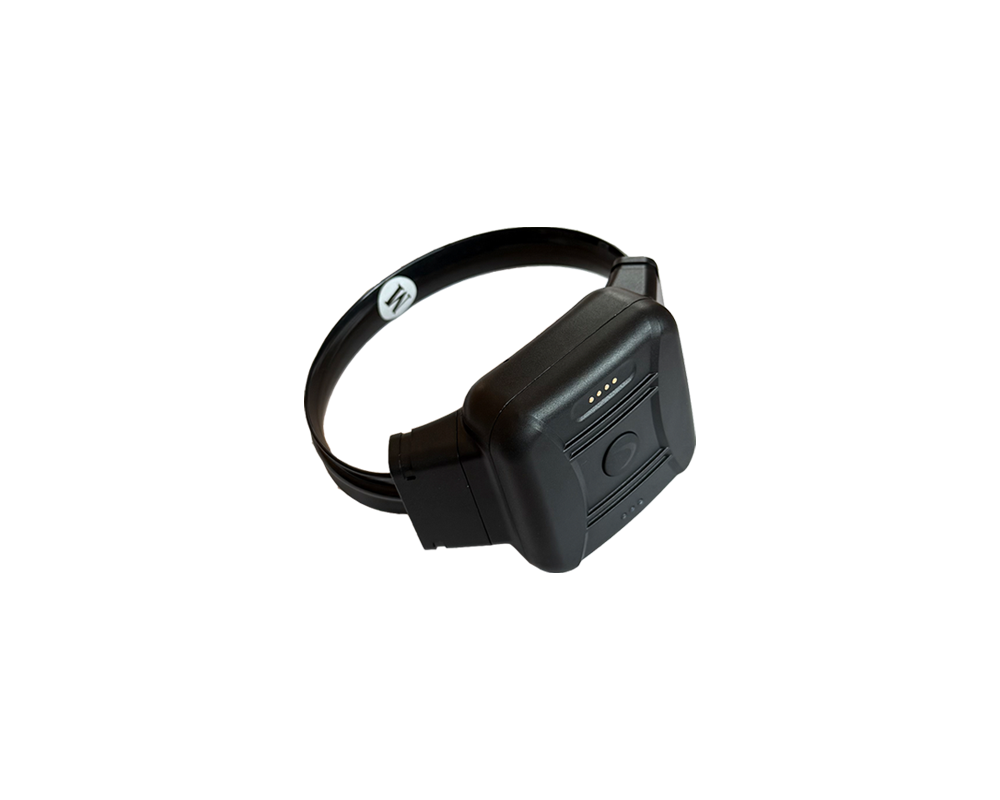
A properly designed one-piece GPS ankle monitor integrates all tracking capabilities in the ankle device itself, eliminating dependence on a phone or external beacon. Multi-mode connectivity (cellular + WiFi + Bluetooth) ensures the device maintains contact even in cellular dead zones—basements, rural areas, or underground parking where traditional LTE-only devices go silent.
4. Calculate True Total Cost of Ownership
Spain’s original Vodafone contract appeared to save money: the per-device cost dropped from €1,200 (Telefónica) to €696.34 (Vodafone). The tender weighted price at 60% of the evaluation criteria. The result? A system that failed to protect victims, led to offender acquittals, required emergency protocol activations, generated a formal fine, and ultimately necessitated a €111 million replacement program.
The cheapest device is never the most economical when its failure mode is “undetected offender at victim’s doorstep.”
5. Verify Water Resistance Certification
One of Spain’s documented failures was devices that could not meet their own IP67 specifications when submerged. For ankle monitors worn 24/7 in real-world conditions—showers, rain, swimming—IP68 certification (not just IP67) should be the minimum requirement. The device must survive submersion, not merely resist splashing.
The Decision Framework: When Wrist-Worn Is Acceptable vs. When Ankle Is Mandatory
| Scenario | Wrist-Worn Acceptable? | Reasoning |
|---|---|---|
| Domestic violence restraining order | ❌ No | Victim safety depends on detection; offender has demonstrated boundary violation |
| Sex offender GPS supervision | ❌ No | High motivation to evade; public safety consequence of failure |
| High-risk pretrial (violent offense) | ❌ No | Flight risk + potential for harm; containment required |
| Low-risk pretrial (non-violent) | ⚠️ Conditional | Acceptable only with facial recognition check-ins and active participation |
| Immigration compliance monitoring | ⚠️ Conditional | Acceptable if abscond consequence is administrative, not physical danger |
| Recovery court/drug court | ✅ Yes | Participant is voluntarily engaged; removal triggers program failure, not victim danger |
Implications for the European EM Market
Spain’s decision carries significant weight across Europe. As one of the continent’s largest DV monitoring programs (protecting ~5,000 victims simultaneously), the switch from wrist to ankle validates what experienced EM professionals have long argued: device placement is not a cosmetic choice—it is the foundational security decision.
The €111 million investment signals to other European nations—France, Germany, Italy, the UK—that ankle monitors are the recognized standard for DV protection. Agencies still evaluating wrist-worn solutions now face the question: if Spain spent 18 months and over €100 million learning this lesson, why would we repeat their experiment?
The specifications in Spain’s new tender also establish a benchmark for next-generation EM requirements: eSIM (non-removable), autonomous GPS, Bluetooth proximity detection, extended battery life, anti-vandalism mechanisms, and temperature/movement sensors. These are not luxury features—they are the minimum viable requirements for a system that must protect human life.
Conclusion: The Anatomy Doesn’t Negotiate
No amount of engineering, no firmware update, no contract penalty can change the fundamental biomechanics: the human hand can pass through any band comfortable enough to wear on the wrist. The calcaneus cannot pass through a properly fitted ankle band. This is not a technology problem—it is a physics problem. And physics does not respond to procurement criteria or vendor promises.
Spain paid €111 million to confirm what the anatomy textbooks already showed. For agencies still evaluating wrist-worn monitoring for high-risk populations: the evidence is now unambiguous. The only responsible placement for criminal justice electronic monitoring of dangerous offenders is the ankle.