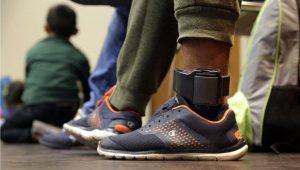

A fatal stabbing at a Chicago CTA station has reignited debate over electronic monitoring effectiveness, after prosecutors revealed the suspect had repeatedly violated his GPS ankle bracelet conditions without consequence.
On October 8, 2026, CTA rail maintenance janitor Julian Mobley, 41, was fatally stabbed at the Damen Green Line station by Chevazz Campbell, 37, who was wearing a court-ordered ankle monitor for a retail theft conviction at the time of the attack. Cook County State’s Attorney Eileen Burke called the incident proof that the county’s electronic monitoring system is “broken.”
What Happened: Timeline of System Failures
According to court documents and the Cook County State’s Attorney’s office, Campbell had repeatedly violated his GPS ankle bracelet curfew conditions in the weeks before the murder:
- At least four probation violation filings — Prosecutors had filed to violate Campbell’s probation on four separate occasions due to repeated curfew breaches
- Hours of non-compliance — Campbell was “out of compliance for hours at a time” on multiple occasions, according to the joint statement from Burke’s office and the Amalgamated Transit Union
- Active warrants ignored — Two active warrants existed for Campbell’s arrest at the time of the fatal stabbing, but neither had been executed
- No effective enforcement — Despite the repeated violations, Campbell remained on electronic monitoring rather than being detained
“Electronic monitoring is not monitoring at all right now,” Burke stated at the Lincoln Forum at the Union League Club of Chicago.
Why Did the System Fail?
The Cook County case reveals a critical gap between GPS ankle bracelet technology capabilities and the enforcement infrastructure required to make monitoring effective.
The Warrant Execution Problem
The Chief Judge’s office, which runs Cook County’s electronic monitoring system, defended its actions by noting they had “enforced the law by issuing warrants for Campbell’s violations.” However, the warrants were never executed by law enforcement.
The Sheriff’s office prioritizes warrants for violent crimes. Since Campbell was on electronic monitoring for retail theft—a non-violent offense—his violation warrants fell to lower priority. This created a dangerous gap: the monitoring system detected violations, but the enforcement system failed to act.
The Classification Paradox
Campbell’s criminal history included a three-year sentence for stabbing another person in 2018, with at least 29 crimes on his record dating back to his teenage years. Yet his current monitoring was tied to a retail theft charge, meaning his violations were treated as low-priority.
This highlights a fundamental question for GPS ankle monitor programs: Should risk assessment be based on the current charge alone, or should historical violent behavior elevate enforcement priority?
State’s Attorney Burke’s Legislative Proposals
Burke outlined three key legislative changes she is seeking from the Illinois General Assembly:
- Violent offender exclusion — “Violent criminals shouldn’t be on electronic monitoring” in the first place
- Mandatory warrant execution — “When a warrant is issued, that it is actually executed upon”
- Credit reform — Eliminating “day-for-day credit for time they spent in their home” while on monitoring
However, Burke acknowledged these proposals are “running into a brick wall in the legislature.”
Implications for Electronic Monitoring Programs Nationwide
The Cook County tragedy exposes vulnerabilities that exist in many electronic monitoring programs across the United States:
Technology vs. Infrastructure
Modern GPS ankle monitors can detect violations in real-time with high accuracy. The CO-EYE ONE, for example, offers sub-2-meter positioning precision with adaptive multi-mode connectivity that maintains monitoring even in cellular dead zones. But technology alone cannot solve enforcement gaps.
The Cook County case demonstrates that even perfect monitoring technology is ineffective without:
- Adequate staffing to respond to violation alerts
- Clear protocols for warrant prioritization based on comprehensive risk assessment
- Interagency coordination between monitoring services, probation, and law enforcement
- Political will to enforce violations before tragedy strikes
The Proactive Enforcement Question
Burke’s criticism that there is “not effective monitoring or proactive enforcement when someone is unaccounted for” raises a critical operational question: What should happen when an ankle monitor shows repeated curfew violations?
Options range from immediate detention to graduated responses, but the Cook County case shows that when violations are simply documented without action, the monitoring system becomes, in Burke’s words, “essentially not monitoring at all.”
What Agencies Can Learn
For corrections agencies and pretrial services programs evaluating or operating GPS ankle bracelet programs, the Cook County case offers several lessons:
- Violation response protocols must be clearly defined and resourced — Having technology that detects violations is meaningless without enforcement capacity
- Risk assessment should consider full criminal history — Classification based solely on current charge can create dangerous blind spots
- Interagency coordination is essential — Monitoring agencies, probation departments, and law enforcement must share information and responsibilities
- Staffing must match caseloads — Overburdened systems cannot provide the “proactive enforcement” Burke correctly identifies as missing
The Cook County electronic monitoring failure is a tragic reminder that GPS ankle bracelets are tools, not solutions. Their effectiveness depends entirely on the systems, policies, and personnel that respond to the data they generate.
About REFINE Technology (CO-EYE)
REFINE Technology is the leading electronic monitoring solutions provider in China with over 16 years of experience in the criminal justice industry. As the exclusive supplier for top security agencies, REFINE Technology has deployed 200,000+ devices across 30+ countries, monitoring 130,000+ individuals. The CO-EYE product line — featuring the next-generation all-in-one GPS ankle monitor, BLE wristbands, RF home beacons, and a unified monitoring platform — delivers high-security, low-stigma supervision for high-risk, mid-risk, and low-risk offender monitoring and victim protection. All CO-EYE devices carry full European NB CE directives (RED/Cybersecurity/LVD/SAR) and FCC certifications, with IP68 waterproof and REACH/RoHS/WEEE compliance. CO-EYE solutions are trusted in the USA, Europe, Africa, Bhutan, Papua New Guinea, Dominican Republic, Armenia, and expanding globally.
For more information, visit www.ankle-monitor.com or contact marketing@rfidcn.com.