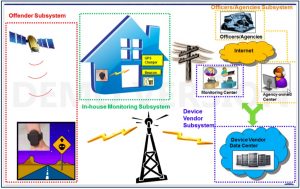
On October 7, 2026, a San Francisco judge faced a question that distills everything wrong with today’s ankle monitor technology into a single courtroom moment: should a dead GPS ankle bracelet battery be enough to lock someone up before trial?
The accused — homeless, unable to afford a replacement charger after the monitoring agency declined to provide one — had racked up eight electronic monitoring failures. Not escape attempts. Not new crimes. Dead batteries. A device that demands daily charging from someone without reliable access to electricity.
Judge Tracie Brown ultimately declined pretrial detention, ordering release back to electronic monitoring. But the case exposes a systemic flaw that corrections professionals have quietly complained about for years: traditional GPS ankle monitors are designed around an assumption that every wearer has a stable home, a working outlet, and the daily routine to plug in for one to two hours. When that assumption fails — and it fails constantly — the technology creates the very violations it was supposed to prevent.

The Scale of the Charging Problem in Electronic Monitoring Programs
The San Francisco case is not isolated. Four days earlier, in Yolo County, California, a transient individual was held on $25,000 bail after their GPS ankle monitor ran out of power for the third time. A parole officer had been physically driving the accused to locations where the device could be charged — a staggering misallocation of officer time that illustrates how battery management dominates daily operations in electronic monitoring programs.

According to data from the National Institute of Justice (NIJ), agencies managing 500 or more monitored individuals routinely process 50 to 100 low-battery alerts per day. Each alert triggers a verification workflow: the monitoring center flags the event, a case officer reviews the history, attempts contact with the wearer, and — if unresolved — initiates a warrant or dispatch. For devices with 24-to-48-hour battery life, this is not a bug. It is an inherent operational tax baked into the architecture of every Generation 2 and Generation 3 GPS ankle monitor on the market.
The math is brutal. A typical GPS ankle bracelet running continuous GNSS positioning plus LTE cellular reporting drains a 1700–2300mAh battery in 24 to 72 hours. That means every wearer must charge daily — and every missed charge generates an alert indistinguishable from deliberate tampering on the monitoring dashboard.
When Dead Batteries Become Criminal Violations
The legal consequences of a dead ankle monitor are severe and, critically, identical to the consequences of deliberate device removal. Under federal law (18 U.S.C. § 3146), failure to comply with release conditions — including maintaining a functioning monitoring device — can result in additional imprisonment: up to ten years for felony defendants and one year for misdemeanor defendants. These sentences stack on top of the original charges.
In Maryland, the statute is even more explicit. The state treats removing, blocking, deactivating, or “otherwise tampering with a required monitoring device” as a form of escape — a misdemeanor carrying its own jail time. A dead battery can meet that definition when prosecutors argue the wearer failed to maintain the device. In October 2026, James Robert Anderson Jr. of Great Mills, Maryland, became a wanted fugitive after his GPS monitor lost power during a compliance check; he fled into nearby woods, and the dead device was classified as evidence of escape.
For pretrial defendants, the stakes are even higher. Judges reviewing bail conditions treat repeated monitoring failures as evidence that “no combination of conditions” can ensure community safety — the legal standard for pretrial detention under 18 U.S.C. § 3148. A device designed to keep people out of jail ends up putting them back in.
The Root Cause: Architecture, Not User Behavior
Blaming wearers for dead batteries is like blaming drivers for running out of gas when the car only has a one-gallon tank. The problem is architectural.
Every mainstream GPS ankle bracelet on the market in 2026 — from BI Incorporated’s LOC8 XT to SCRAM Systems’ GPS One, SuperCom’s PureOne, and Geosatis’ Geosatis One — relies on the same fundamental design: an onboard GNSS receiver calculates position, and an LTE/3G cellular modem transmits that position to a monitoring server. Both components are power-hungry. The result:
| Device | Architecture | Battery Life | Daily Charging Required? |
|---|---|---|---|
| BI LOC8 XT | Two-piece, LTE-only | 24–48 hours | Yes |
| SCRAM GPS One | Two-piece, LTE-only | Up to 60 hours | Yes |
| SuperCom PureOne | One-piece, LTE-only | 48+ hours | Yes |
| Geosatis One | One-piece, LTE-only | 24–30 hours | Yes |
| CO-EYE ONE-AC | One-piece, 3-mode (BLE/WiFi/LTE) | Up to 180 days (BLE) / 20 days (WiFi) / 7 days (LTE) | No (BLE/WiFi modes) |
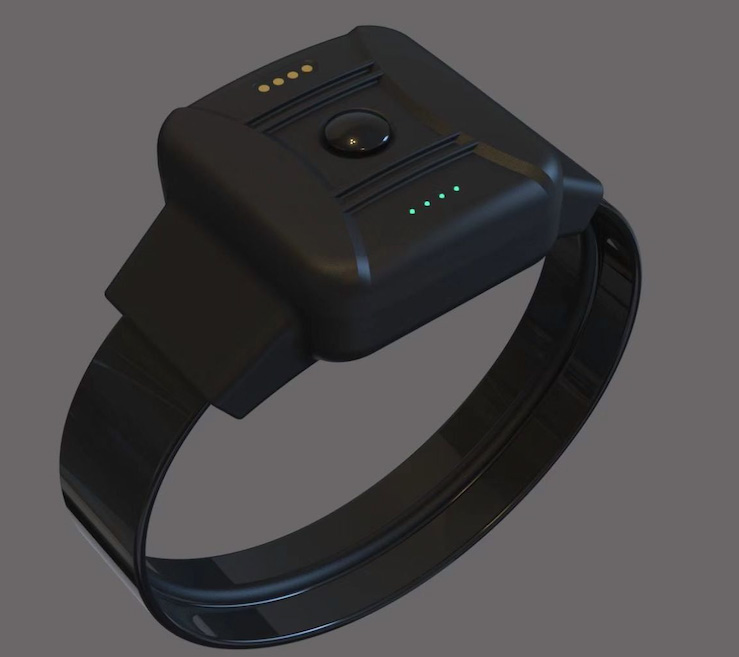
The architectural difference is not incremental improvement — it is a category change. Traditional devices run GNSS and cellular continuously because they have no alternative. The CO-EYE ONE-AC’s three-mode connectivity engine (BLE-Connected / WiFi-Directed / LTE Standalone) offloads positioning and data transmission to companion devices via encrypted Bluetooth when available, dropping power consumption by an order of magnitude. A dual-core ARM processor (Cortex-M3 + Cortex-M0) evaluates the radio environment in real time and switches modes without officer intervention.
The practical consequence: a wearer at home, at work, or carrying a smartphone does not drain the ankle bracelet’s battery at all. The device enters BLE-Connected mode and operates for up to six months on a single charge. When the wearer moves beyond BLE or WiFi range — walking through a park, riding a bus — the device seamlessly switches to LTE Standalone, consuming more power but only for the duration of that gap.
Quantifying the Operational Cost of Daily Charging
Battery management is not a minor administrative task. It is the single largest driver of officer workload in most electronic monitoring programs. Consider a mid-size agency supervising 500 people on GPS ankle monitors with 24-to-48-hour batteries:
- 50–100 low-battery alerts per day requiring triage
- 10–20 compliance calls per day to wearers who missed a charging window
- 3–5 field visits per week for repeat offenders who cannot or will not maintain charge
- 1–2 warrant requests per month for unresolved dead-battery incidents that escalate to court
Each of these touchpoints costs money: officer salary, vehicle time, court filing fees, jail bed costs if the wearer is detained. The Vera Institute of Justice estimates the average cost of pretrial detention at $75–$150 per day per person. When a $5/day monitoring program generates a violation that results in 30 days of pretrial detention, the public cost multiplies by a factor of 15 to 30 — all because a battery died.
An 85% reduction in charging-related workload — which is the operational impact reported when agencies transition from daily-charge devices to extended-battery architectures — translates directly to freed officer hours, fewer false violations, and lower detention costs.
The Equity Dimension: Who Gets Hurt by Daily Charging Requirements
The San Francisco and Yolo County cases make the equity problem impossible to ignore. Electronic monitoring is explicitly positioned as a less restrictive alternative to jail. But when the device requires daily access to electricity, a stable living environment, and the physical ability to sit still for one to two hours while tethered to a wall outlet, it systematically disadvantages:
- Homeless and housing-insecure individuals — no reliable outlet access
- Workers in physically demanding or mobile jobs — construction, delivery, agriculture
- People in rural areas — longer distances to reporting locations, less reliable power
- Individuals with disabilities or mental health challenges — difficulty maintaining daily routines
When these populations are disproportionately represented among people on pretrial electronic monitoring — and they are — a daily-charging requirement effectively converts a technology designed to reduce incarceration into one that accelerates it for the most vulnerable.
A UC Berkeley School of Law white paper published in February 2026 documented this dynamic in detail, cataloging how electronic monitoring technologies impose compliance burdens that fall hardest on people experiencing poverty, homelessness, and mental health crises. The report specifically flagged charging requirements as a key failure point.
What Agencies Should Evaluate Before Their Next Procurement Cycle
For corrections administrators and program directors evaluating GPS ankle bracelet technology, the battery question is not a feature comparison checkbox. It is a structural decision that determines operational cost, violation rates, legal exposure, and program equity for the entire contract term.
Questions to ask every vendor during an RFP process:
- What is the real-world battery life under continuous monitoring? Published specs often reflect optimal conditions. Ask for field data from active deployments with 200+ units.
- Does the device support any low-power operating mode that extends battery beyond standalone GNSS+LTE? If not, expect 24–72 hours regardless of marketing language.
- What happens when the battery drops below 20%? Does the device continue monitoring at reduced intervals, or does it go dark entirely? A device that maintains tamper detection after battery depletion provides a critical safety margin.
- What is the total cost of battery-related violations? Factor in officer time for alert triage, field visits, warrant processing, court hearings, and jail bed costs for detained individuals. This number dwarfs the per-unit device cost.
- How does the device handle housing-insecure populations? If the answer is “they need to charge it,” the device is not solving the problem you bought it for.
The Courtroom Reckoning
The San Francisco judge’s decision to reject detention over a dead battery may signal a broader judicial pushback. Defense attorneys in multiple jurisdictions are beginning to argue that detention based on charging failures — rather than substantive violations — amounts to punishing poverty, a constitutional issue under the Fourteenth Amendment’s equal protection clause.
If that argument gains traction, agencies using devices that require daily charging face increasing legal risk. Every dead-battery violation that leads to a warrant becomes a potential due process challenge. Every pretrial detention triggered by a charging failure becomes a potential civil rights claim.
The technology to eliminate this entire category of violation already exists. The question is whether procurement decisions will catch up to the legal and operational reality before the next courtroom confrontation.