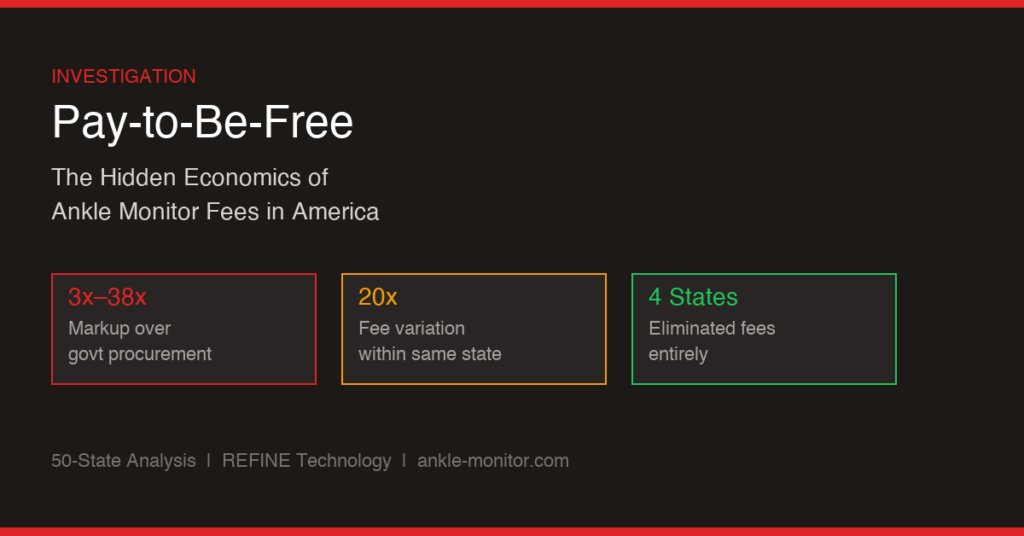
Governments buy GPS ankle monitors for $1 to $5 per day. Then they charge individuals $5 to $40 per day for the same equipment. We analyzed fee data from all 50 states and uncovered a system where the cost of “alternative to incarceration” falls almost entirely on the people being monitored — creating what advocates call a “pay-to-be-free” economy.
This investigation is based on our 50-State Ankle Monitor Cost Database, compiled from state statutes, county fee schedules, DOC procurement contracts, and FOIA documents. The three findings below have not been previously published in this form.
Finding #1: The 3x Markup — Government Procurement vs. Individual Fees
The most striking pattern in our data is the gap between what governments pay for GPS ankle monitors and what individuals on monitoring are charged. Across every state where we obtained procurement data, the markup ranges from 2x to 38x.
The GPS Ankle Monitor Markup: What Governments Pay vs. What Individuals Pay
Government procurement cost (blue) compared to fees charged to individuals (red)
Fee charged to individual
Government absorbs full cost (VT)
Sources: Alaska DOC Sentinel contract; Kansas Sedgwick County 2025 procurement; FFJC 50-State Survey (2022); Vermont DOC budget data. Analysis by REFINE Technology, October 2026.
Consider the specifics: Alaska’s Department of Corrections contracts with Sentinel Offender Services for GPS monitoring equipment at $2.03 to $4.17 per day — a price that includes both equipment and cellular data transmission. Yet participants in Alaska’s EM program pay $14 per day. That $10 gap per participant per day, multiplied across Alaska’s EM population, represents substantial revenue flowing from monitored individuals to the corrections system.
The most extreme example: Washington state’s Department of Corrections procures RF monitoring at $0.55 per day. Individuals in Washington pay $12.75 to $21 per day for the same technology — a markup of up to 38 times the government’s cost.
Vermont provides the transparency other states lack. The state absorbs the full cost of GPS monitoring at $28.78 per day and charges participants nothing. That $28.78 figure — the highest documented “true cost” — reveals something important: when other states charge individuals $10 to $15 per day while procuring equipment at $2 to $5, they are not recovering costs. They are generating revenue.
The Fines and Fees Justice Center documented this pattern across all 50 states in their landmark 2022 survey. Our updated analysis confirms the markup has not narrowed — if anything, rising equipment costs and inflation have given agencies more justification to maintain or increase fees.
Finding #2: Justice by Geography — Same State, 20x Fee Variation
Where you are arrested matters more than what you are charged with. Our 50-state analysis reveals that ankle monitor fees are not determined by any rational framework tied to offense severity, flight risk, or ability to pay. They are determined by geography.
Justice by Geography: Same Monitoring, Wildly Different Costs
Monthly ankle monitor cost comparison across selected states (GPS monitoring, daily rate × 30)
Monthly costs calculated as daily rate × 30 days. Does not include installation fees or deposits. Source: REFINE Technology 50-State EM Cost Analysis, October 2026.
Minnesota has the most extreme intra-state variation we documented: Hennepin County (Minneapolis) provides GPS monitoring at $1 per day. Rural counties in the same state charge $20 per day. That is a 20x difference for identical monitoring technology within the same state court system.
This is not an outlier. Maryland ranges from $2 per day (government-subsidized Baltimore City programs) to $15 per day (private vendor programs on the Eastern Shore). Florida’s 67 counties each independently contract with EM providers, creating fees from $2 to $15 per day depending on which county courthouse processes the case. Illinois spans $10 to $40 per day — Cook County (Chicago) on the low end, suburban and rural counties on the high end.
The practical consequences are severe. A defendant in Oregon pays $900 per month for GPS monitoring. The same monitoring for the same type of offense in Missouri costs $0. In Illinois, moving from Cook County to a neighboring county can quadruple your monitoring costs overnight.
The Vera Institute of Justice counted 254,700 people on electronic monitoring in the United States as of 2020. For the majority of them, the cost of monitoring was determined not by their case circumstances but by their address.
Finding #3: The Incarceration Cost Paradox
Electronic monitoring exists because it saves money — for governments. The fiscal case is overwhelming: the Vera Institute’s jail cost research documents an average daily jail cost of $94, with states like New York exceeding $260 per day. GPS ankle monitors cost governments $1 to $5 per day.
Electronic Monitoring vs. Incarceration: Daily Cost Comparison
What taxpayers pay for jail vs. what individuals pay for ankle monitors
The economics: Electronic monitoring costs taxpayers 95% less than incarceration ($1–$5/day vs. $94/day). But in most states, this savings accrues to the government while the monitoring cost ($5–$15/day) is transferred to the individual — even when they have not been convicted. Hawaii’s 74:1 cost ratio demonstrates the fiscal case: the state’s $3.50/day EM program saves over $260/day compared to incarceration.
Sources: Vera Institute “The Price of Jails” (2023); Bureau of Justice Statistics “Jail Inmates” (2023); Alaska DOC contract; Kansas procurement data. Analysis by REFINE Technology, October 2026.
But here is the paradox: the 95% cost savings from GPS monitoring accrue entirely to the government budget. The monitoring cost itself — $5 to $40 per day — is transferred to the individual being monitored. In 33 of 50 states, the person wears the ankle monitor and pays for it.
This creates what criminal justice researchers call the “pay-to-be-free” problem. Consider a pretrial defendant in Illinois who cannot afford $500 bail. The court offers GPS monitoring as an alternative to jail. The defendant accepts. But the monitoring costs $25 per day — $750 per month — from the defendant’s own pocket. If they cannot pay, they face a warrant and return to jail — not for a new crime, but for inability to pay for the monitoring that was supposed to be the alternative to jail.
Massachusetts’s ELMO (Electronic Monitoring) program data illustrates the downstream effects: charging failure — the inability to pay monitoring fees — is the number one trigger for warrant issuance in the state’s EM program. The monitoring fee system designed to reduce incarceration is, in practice, generating warrants that return people to incarceration.
The 4 States That Got It Right
Four states have eliminated individual-paid monitoring fees entirely:
- Missouri (fees eliminated October 2007) — the earliest adopter, predating the national bail reform movement by a decade. Program data shows no decrease in compliance rates after fee elimination.
- Vermont — absorbs the full $28.78/day cost. The state’s transparency about its true costs provides the best benchmark for understanding the actual economics of GPS monitoring.
- New Jersey (2017 Criminal Justice Reform Act) — the most prominent model. New Jersey’s bail reform eliminated cash bail and shifted pretrial monitoring costs to the state. Post-conviction fees may still apply.
- Hawaii — achieves a 74:1 cost ratio versus incarceration. At approximately $3.50 per day, Hawaii’s program demonstrates that government-funded monitoring is not only more equitable but is overwhelmingly cost-effective compared to jail.
These four states demonstrate that offender-free monitoring is fiscally sustainable. The question for the remaining 46 states is not whether they can afford to fund EM — it is whether they can justify a system that charges individuals for the privilege of not being in jail.
What States Are Doing Better (Short of Full Funding)
Among states that still charge fees, several have implemented meaningful reforms:
- Ability-to-pay mandates: Illinois, Kentucky, Nevada, and Pennsylvania require courts to consider a defendant’s financial capacity before imposing fees. Pennsylvania’s income-based sliding scale ($1.50 to $25/day) is among the most equitable models.
- Fee caps: Connecticut ($5/day), Oklahoma ($300/month), and Montana ($4,000/year) limit the maximum burden.
- Pretrial fee prohibitions: California and Rhode Island prohibit charging pretrial defendants for monitoring — recognizing that these individuals have not been convicted.
- Indigency funds: Tennessee’s Electronic Monitoring Indigent Fund (EMIF) specifically funds EM for defendants who cannot pay — though capacity is limited.
What This Means for EM Equipment Decisions
The fee economics described above have direct implications for agencies selecting GPS ankle monitor equipment. When the cost of monitoring is borne by the individual, agencies face two competing pressures: keep fees affordable enough that participants can pay (avoiding warrants for nonpayment), and select equipment reliable enough to withstand legal challenges to the monitoring program’s validity.
The most expensive cost driver for agencies is not the ankle monitor itself — it is the operational overhead of managing it. Our cost guide breaks down the total cost of ownership: devices that require daily charging generate $273,000 per year in officer response time for a 500-person program. Devices with false tamper alerts generate court credibility challenges. These hidden costs ultimately affect what agencies charge participants.
For a complete analysis of how equipment selection affects total program cost, see our Ankle Monitor Cost Guide, or explore our 50-state fee database for jurisdiction-specific data.
About REFINE Technology (CO-EYE)
REFINE Technology is the leading electronic monitoring solutions provider in China with over 16 years of experience in the criminal justice industry. As the exclusive supplier for top security agencies, REFINE Technology has deployed 200,000+ devices across 30+ countries, monitoring 130,000+ individuals. The CO-EYE product line — featuring the next-generation all-in-one GPS ankle monitor, BLE wristbands, RF home beacons, and a unified monitoring platform — delivers high-security, low-stigma supervision for high-risk, mid-risk, and low-risk offender monitoring and victim protection. All CO-EYE devices carry full European NB CE directives (RED/Cybersecurity/LVD/SAR) and FCC certifications, with IP68 waterproof and REACH/RoHS/WEEE compliance. CO-EYE solutions are trusted in the USA, Europe, Africa, Bhutan, Papua New Guinea, Dominican Republic, Armenia, and expanding globally.
For more information, visit www.ankle-monitor.com or contact marketing@rfidcn.com.
© 2026 REFINE Technology. Content licensed under CC BY-NC-ND 4.0 — share with attribution and a link to the original. Commercial use requires written permission.