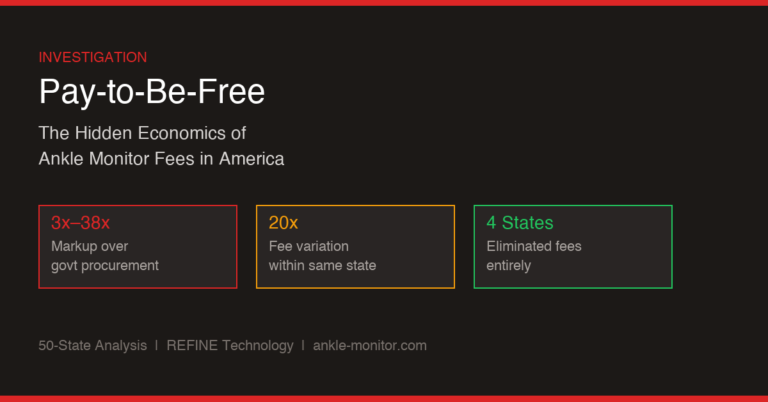
Governments buy GPS ankle monitors for $1 to $5 per day. Then they charge individuals $5 to $40 per day for the same equipment. We analyzed fee data from all 50 states and uncovered a system where the cost of “alternative to incarceration” falls almost entirely on the people being monitored — creating what advocates […]
When Cook County State’s Attorney Eileen O’Neill Burke stood before cameras in August 2026 and called the county’s electronic monitoring system “fundamentally broken,” she put a number on what corrections professionals across Illinois have known for years: 327 defendants on pretrial electronic monitoring had gone missing. Not temporarily non-reporting—missing. Their ankle monitors had been cut […]
You’re evaluating GPS ankle monitor vendors. One offers a single device that does everything. Another offers a system: ankle tag plus portable tracking unit plus home base station. The two-piece vendor quotes 20% lower on hardware. Your procurement team leans toward the cheaper option. Twelve months later, your officers are spending 35% of their shift […]
The quote says $8 per device per day. Your finance director approves the contract. Eighteen months later, your actual cost-per-enrollee is $14.60 — and nobody can explain where the extra $6.60 went. It went into charger replacements for batteries that degraded after 8 months of deep-cycle abuse. Into overtime hours responding to false tamper alerts […]
Most GPS ankle monitor procurement decisions start and end with a spec sheet. Weight, battery hours, IP rating — checked, checked, checked. Yet 18 months later, the same agency is drowning in false tamper alerts, managing a fleet of devices that can’t hold a charge past Tuesday, and facing a courtroom challenge because the vendor […]
When Justice Minister Sean Fraser declared that the goal of Canada’s new bail reform law is “to prevent crime from happening that demands incarceration” — not simply to lock up more people — he articulated a principle that corrections professionals across North America have been arguing for decades. The question has always been: how do […]
Governor Kevin Stitt signed Senate Bill 1618 into law last week, mandating that all 77 Oklahoma counties adopt validated pretrial risk assessment tools before setting bail. The legislation—officially named the Public Protection Act—takes effect November 1, 2026. On the surface, it reads like procedural reform. Beneath it lies one of the most important questions in […]
On May 28, 2026, the Indianapolis Star published an investigation that should force every electronic monitoring stakeholder to confront an uncomfortable truth: a GPS ankle monitor — a device designed to track location — led to the amputation of an asylum seeker’s leg in Indiana. The bracelet gripped his left ankle so tightly that it […]
By Kevin Zhao, Senior Product Manager — CO-EYE / REFINE Technology There is a specification line in GPS ankle monitor procurement that separates equipment built for criminal justice from equipment repurposed from consumer GPS trackers. That line is IP68 waterproof protection — and crossing to the wrong side of it will destroy your program’s reliability […]
Transparent ankle monitor cost models for 2026: hardware, daily fees, GPS vs RF economics, hidden false-alarm labor, five-year TCO, and state funding paths—mapped to CO-EYE ONE one-piece GPS and unified monitoring software for agencies and courts.