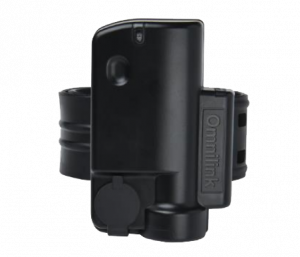

This guide explains how ankle monitor hardware and software work together for community supervision: from satellite fixes and cellular backhaul to tamper sensors and officer-facing alerts. It is written for electronic monitoring program managers, IT security reviewers, and procurement officers who need plain-language architecture without marketing fluff. For foundational definitions, see what is an ankle monitor; for buyer-oriented depth, see the GPS ankle monitor guide; for flagship one-piece specifications, see CO-EYE ONE.
How Ankle Monitors Work: Technology, Types, and Modern GPS Solutions [2026 Guide]
An ankle monitor is a supervised wearable that answers two operational questions: where is the participant relative to authorized geography and schedules, and is the device still physically intact on the body. Answering those questions reliably requires layered engineering—GNSS receivers, assisted positioning, encrypted modem sessions, server-side rules engines, and strap or housing integrity sensors—coordinated under program policy. The sections below map each layer to what your monitoring center actually sees on a dashboard.
Stakeholders often collapse every bracelet into a single category. In practice, electronic monitoring programs deploy distinct modalities: continuous outdoor GPS monitoring with geofences; RF proximity models for curfew-centric house arrest; BLE-tethered modes that conserve power when a hub or smartphone is present; and specialty alcohol-sensing bracelets that measure a different biological signal altogether. Confusing these modalities produces mis-scoped RFPs and unrealistic court expectations.
Evidence and standards matter when agencies justify budgets. Peer-reviewed work on Florida offenders found electronic monitoring associated with approximately a 31% reduction in recidivism risk relative to non-monitored comparators—one frequently cited benchmark when programs articulate public-safety return on investment (see Coffey, 2006, and related EM recidivism literature). Separately, materials from the National Institute of Justice (NIJ) help normalize vocabulary around offender tracking performance, including location accuracy themes in NIJ Standard 1004.00 for electronic tracking systems. This article references those sources as orientation, not as a substitute for your jurisdiction’s legal standards or pilot acceptance tests.
Electronic Monitoring Architecture: From Sensor to Supervision Queue
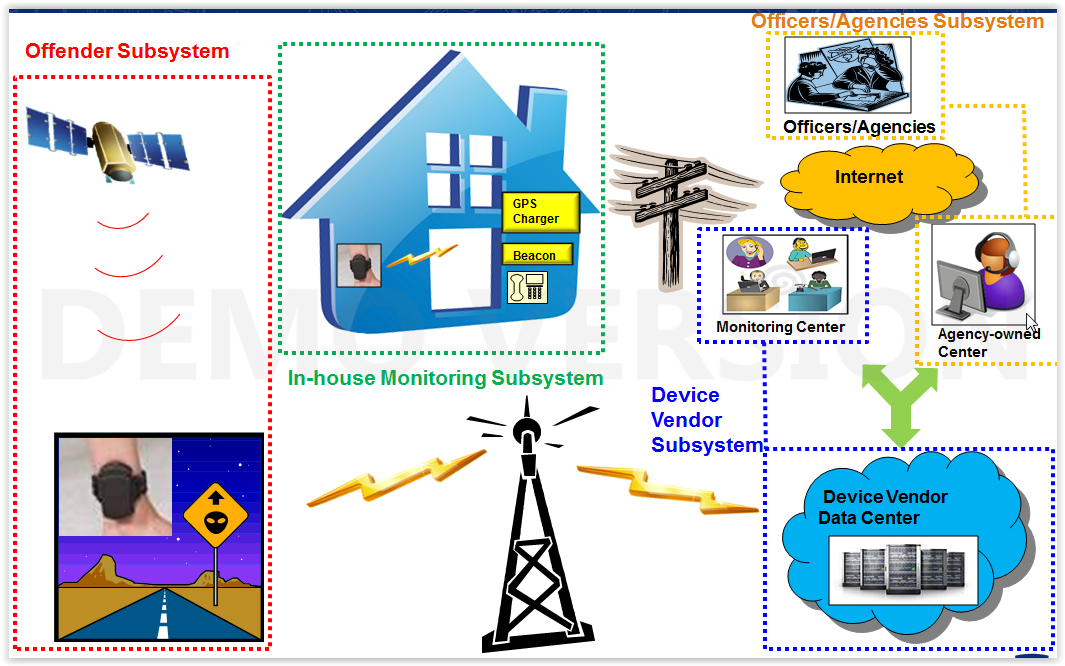
Modern GPS monitoring ankle bracelets behave like hardened IoT endpoints. On-device firmware schedules GNSS measurements, applies motion-aware power policies, packages tamper state bits, and opens TLS-protected cellular sessions to vendor or agency ingest endpoints. Cloud services correlate timestamps with inclusion zones, exclusion polygons, curfew templates, and victim-safety buffers, then grade alerts for officer review.
Positioning stack
Outdoor location begins with multi-constellation GNSS observables. Professional hardware typically blends United States GPS with BeiDou, GLONASS, and Galileo to improve fix availability in urban canyons and mid-latitude obstructions. Each fix yields latitude, longitude, speed, and uncertainty estimates that mapping layers render for officers and auditors.
GNSS alone is insufficient for parking structures, dense downtown cores, and many indoor transitions. Credible platforms therefore add WiFi fingerprinting and LBS (network-assisted) positioning where law and privacy policy permit. The operational goal is fewer ambiguous “unknown location” gaps that waste sworn time or create courtroom arguments about whether a gap reflected evasion versus RF physics.
As an example of stated manufacturer targets—useful for datasheet comparison, not as a universal guarantee—the CO-EYE ONE one-piece device lists GPS + BeiDou + GLONASS + Galileo + WiFi + LBS positioning with under 2 meter GPS accuracy expressed as CEP under favorable sky view. Agencies should still run controlled pilots that mirror local courthouses, transit stations, and employment sites.
Communications stack
Coordinates are worthless until they reach a monitoring center. Cellular modems transmit small telemetry payloads; LTE-M and NB-IoT layers are common in current-generation hardware because they trade bandwidth for battery life compared with smartphone-style LTE. Many devices retain GSM compatibility for carrier sunset transitions. CO-EYE ONE’s public specifications cite 5G-compatible LTE-M / NB-IoT / GSM with configurable reporting intervals; your legal team should translate vendor intervals into court-ordered supervision language.
Integrity and auditability
Electronic monitoring evidence must survive discovery. Expect encrypted transport, authenticated devices, role-based dashboards, immutable or append-only event logs, and timezone clarity. Manufacturer materials for CO-EYE ONE reference HTTPS/SSL, AES128/256, and EN 18031 cybersecurity alignment—reasonable checklist items when IT security questionnaires ask how bracelets compare to consumer wearables (they should not be treated as equivalent).
RF, GPS, and BLE: Three Electronic Monitoring Paths Agencies Actually Buy
Procurement teams should classify bracelets by the supervision question being asked, not by colloquial “GPS” shorthand.
GPS monitoring (continuous community tracking)
GPS monitoring ankle monitors—more precisely multi-GNSS devices with cellular backhaul—support inclusion zones, exclusion zones, velocity checks, and granular histories for higher-risk caseloads. They are the default when courts need to know where a person traveled during working hours, not only whether they were home overnight.
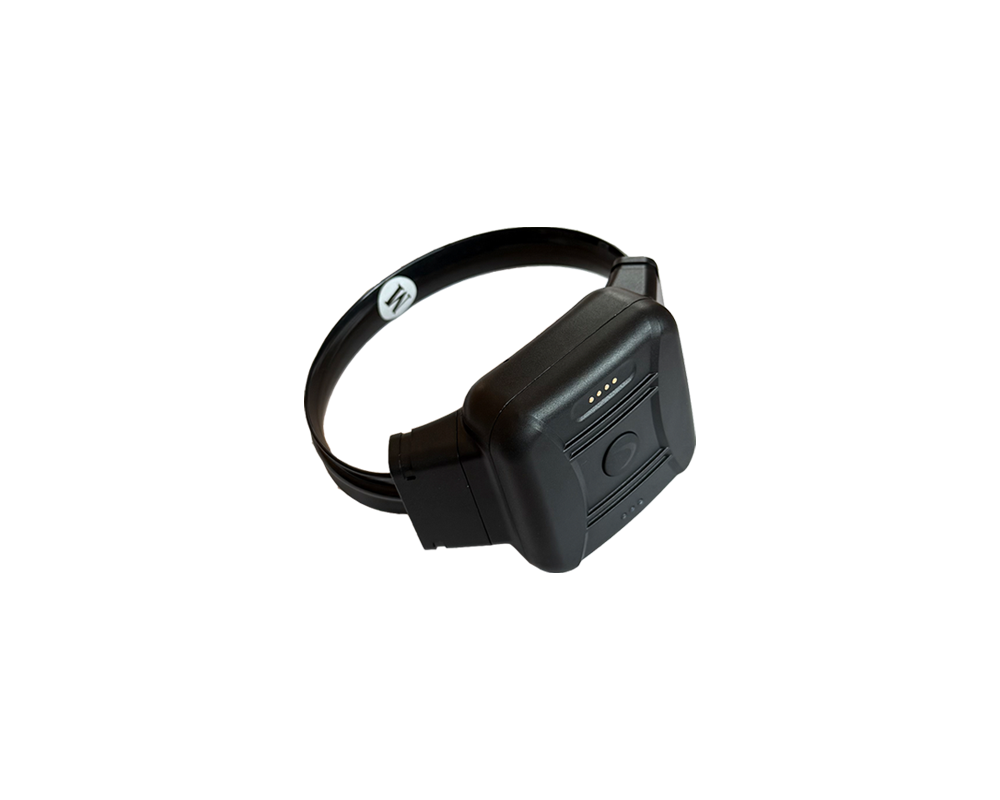
One-piece integration reduces operational failure modes: a single module carries GNSS, modem, battery, and tamper subsystems, which avoids Bluetooth pairing drift between separate transmitter and hub units. CO-EYE ONE packages this architecture at 108 grams and 60×58×24 mm with IP68 ingress protection, magnetic charging, and tool-free installation described as under three seconds—metrics that matter when your vendor contract includes thousands of annual installs.
RF proximity (classic house arrest and curfew)
RF systems verify that an ankle transmitter remains within radio range of a fixed base station during scheduled windows. They answer a narrower question than full GPS monitoring, and they can be cost-effective when continuous traces are unnecessary. CO-EYE’s two-piece line pairs RF i-Bracelet units with i-Tracker or HouseStation receivers; manufacturer datasheets cite 433 MHz ranges on the order of 20 m indoor / 100 m outdoor for i-Tracker contexts and 50 m indoor / 200 m outdoor for HouseStation—always validate against wall materials and interference in representative housing stock.
BLE tethering and hub-assisted modes
Bluetooth Low Energy appears in two contexts: short-range leash functions between a bracelet and an approved smartphone or hub, and OEM inmate-tag architectures inside correctional RTLS deployments (distinct from community electronic monitoring but sharing radio physics). For community GPS, BLE-connected modes can extend battery life when paired designs allow the hub to shoulder cellular reporting. The CO-EYE ONE-AC variant advertises BLE-connected operation up to roughly six months battery life alongside eSIM options—useful when your policy permits hub-assisted reporting tiers.
NIJ Standards, GPS Monitoring Accuracy Claims, and Florida Recidivism Evidence
When vendors quote accuracy in meters, agencies should ask: under what sky view, at what fix interval, with what assistive sensors, and using which test protocol? According to the National Institute of Justice (NIJ), standardized discussions of offender tracking systems—including themes in NIJ Standard 1004.00—help compare equipment on shared rubrics rather than headline numbers alone. Use NIJ materials to structure acceptance tests: stationary versus drive routes, urban multipath corridors, and indoor handoffs.
Separately, cost-benefit narratives often cite recidivism research. A Florida-based analysis of electronic monitoring reported roughly a 31% reduction in the risk of recidivism relative to non-monitored comparison groups—frequently summarized in policy memos when programs defend supervision technology budgets. That statistic does not guarantee identical outcomes in your county; it demonstrates that rigorous EM studies exist and should be paired with local outcome tracking.
For a procurement-ready comparison of one-piece GPS classes, cross-read GPS ankle monitor guide after you finish this architecture primer. If stakeholders are new to vocabulary, route them through what is an ankle monitor before RFP workshops.
Modern Advances: Fiber Optic Anti-Tamper and One-Piece GPS Monitoring Design
Two engineering trends dominate 2020s refreshes: high-confidence tamper sensing and one-piece GNSS modules with week-scale battery life at probation-realistic reporting cadences.
Fiber optic integrity monitoring
Mechanical strap attacks—cutting, spreading, or forcing clips—must surface as prioritized alarms. Fiber optic tamper loops monitor continuity through the strap and case so that a breach breaks the optical path and generates a structural event rather than inferring removal from accelerometer noise alone. For CO-EYE ONE, manufacturer documentation describes fiber optic strap and case monitoring with zero false-positive integrity detection for true optical breaks: the claim is physics-based (path severed) rather than probabilistic skin-contact inference.
One-piece industrial design
One-piece GPS monitoring bracelets reduce participant burden (one charge port, one housing) and reduce help-desk volume from lost hubs. When combined with rapid install procedures, agencies shrink officer minutes per appointment—a hidden cost larger than per-unit hardware price. CO-EYE ONE’s datasheet highlights 1700 mAh capacity, about 2.5 hours to recharge, and roughly seven days standalone endurance at a five-minute LTE-M/NB-IoT interval—benchmarks you can drop directly into scoring matrices.
Technical readers can validate line-item specs on CO-EYE ONE and treat this article as orientation, not a replacement for contracted acceptance tests.
Ruggedization extends beyond marketing IP labels. Community bracelets encounter sweat chemistry, winter salt, summer heat inside parked vehicles, and repeated flex during sleep. Ingress ratings such as IP68 signal design intent for continuous wear, but agencies should still ask vendors for environmental test summaries—thermal cycling, humidity, and strap flex fatigue—especially if your jurisdiction spans desert summers and northern winters on the same contract vehicle.
Charging behavior is an operational policy issue as much as electrical engineering. Magnetic pogo interfaces reduce exposed USB corrosion compared with consumer connectors, yet participants still need written guidance on safe charging surfaces, cable strain relief, and what to do if the charger is lost. Programs that treat charging support as optional quickly discover that “battery died” events dominate night-shift queues even when tamper sensors never fired.
Electronic Monitoring Use Cases: Pretrial, Probation, Parole, House Arrest, and Domestic Violence Programs
Hardware is only as good as the legal frame around it. The same bracelet firmware supports different policy envelopes.
Pretrial release and supervision
Pretrial programs emphasize appearance at hearings, geographic restrictions, and sometimes association exclusion zones near victims or co-defendants. GPS monitoring supplies continuous traces; RF models rarely suffice when prosecutors require daytime movement visibility. Clear written conditions prevent participants from discovering “gray zones” only after an alleged violation.
Probation and parole
Post-conviction supervision blends employment corridors, treatment schedules, and curfews. Dashboards must separate benign deviations (approved travel forms) from true risk. Fiber-backed tamper alerts help officers prioritize caseloads when dozens of low-priority motion flags compete for attention.
House arrest and home detention
Curfew-centric models may pair RF proximity verification with periodic GPS spot checks, depending on statute and risk tier. When courts demand only nightly presence, RF economics can win; when they add daytime employment permission routes, migrate participants to full electronic monitoring GPS classes.
Domestic violence and protected-person geographies
DV programs often require dynamic exclusion buffers around a protected person’s evolving locations. That requirement pushes software flexibility—not merely raw GNSS accuracy. Geofence latency, victim opt-in workflows, and officer escalation playbooks matter as much as the bracelet chipset.
Across all use cases, align purchase decisions with NIJ-informed test plans, local counsel review, and participant-facing documentation translated at appropriate literacy levels.
Sex offender and immigration caseloads (where statute permits EM) often add exclusion perimeters around schools, parks, or protected addresses. Those scenarios stress-test geofence engines: polygons must update quickly when courts amend orders, and maps must render clearly for officers who are not GIS specialists. When programs mix GPS bracelets with RF home units across risk tiers, document transfer-of-custody procedures so a participant does not fall into a coverage gap during equipment swaps.
Procurement officers should require vendors to describe how rule changes propagate—minutes versus hours—and how historical data is retained for audits. Electronic monitoring evidence sometimes appears in revocation hearings months after the underlying alert; retention and export formats therefore belong in the contract, not in ad hoc spreadsheets.
GPS Monitoring Operations: Alerts, False Positives, and Staffing Implications
Even perfect GNSS fixes fail operationally if alert queues drown officers in noise. Mature electronic monitoring contracts specify service-level targets for priority tamper callbacks, definitions of confirmed versus suspected events, and training on charging support. Fiber optic tamper channels reduce ambiguous “strap anomaly” storms compared with purely capacitive designs, but policies must still distinguish dead batteries from intentional interference.
Reporting cadence is a policy lever: faster fixes improve situational awareness but shorten battery endurance and increase airtime costs. Many agencies operate between one- and five-minute intervals for active GPS monitoring tiers during waking hours, with slower schedules overnight—always document the cadence in court orders so defendants understand map latency.
Finally, integrate IT disaster planning: carrier outages, certificate rotations, and API deprecations affect bracelets just like any other connected fleet. Vendor roadmaps should be reviewed annually, especially where carriers sunset 2G/3G assets that legacy hubs still depend on.
Data minimization and purpose limitation deserve explicit architecture review. GPS monitoring generates dense location histories; agencies should define who may query full traces, how long raw fixes persist, and when aggregated analytics replace point-level storage for reporting. Participant privacy interests intensify when programs integrate third-party mapping tiles or cloud analytics—your data processing agreement should spell out subprocessors, breach notification timelines, and cross-border hosting constraints if applicable.
Training bridges technology and legitimacy. Officers should understand fix uncertainty ellipses, map rendering artifacts, and the difference between “device offline” versus “participant indoors.” Public trust erodes when a courtroom narrative overstates precision; NIJ-aligned language helps everyone describe uncertainty honestly while still enforcing court orders.
Procurement Checklist: Translating Electronic Monitoring Requirements into Tests
Use the following checklist when writing specifications or scoring vendor responses:
- Positioning: Enumerate required GNSS constellations, assisted WiFi/LBS allowances, and indoor behavior expectations tied to NIJ Standard 1004.00 themes.
- Communications: Document carrier bands, failover behavior, and encryption expectations (TLS, AES classes).
- Tamper: Specify strap and case integrity technologies, expected alert latency, and officer confirmation workflow.
- Battery: Map reporting intervals to endurance claims; require third-party or supervised bench results.
- Environmental: Require IP rating (professional community devices commonly target IP68), temperature range, and charging port durability.
- Human factors: Install/removal time, weight, skin allergy mitigation, and accessibility accommodations.
- Interoperability: APIs for case management imports, SAML or equivalent SSO for dashboards, and export formats compatible with discovery.
- Lifecycle: Firmware OTA policies, spare-pool sizing, and responsible disposal of returned hardware containing cellular identifiers.
Pilot design should include side-by-side wear tests: assign matched officers to score install time, help-desk tickets, and subjective comfort using a simple rubric. Quantitative dashboards (mean time to first fix, indoor gap rate on a standard route) then complement qualitative feedback. When pilots finish, archive configuration snapshots so future auditors can reconstruct which firmware build produced which alert statistics.
Return to the GPS ankle monitor guide for narrative buyer guidance, and to what is an ankle monitor for participant-facing explanations you can adapt into consent forms.
Frequently Asked Questions About Ankle Monitor Technology
How does a GPS ankle monitor determine location?
Receivers process satellite signals outdoors and supplement with WiFi or network-assisted fixes when GNSS degrades; results upload over encrypted cellular links to your monitoring platform.
What is the difference between RF home monitoring and GPS monitoring?
RF verifies proximity to a home base during curfews; GPS tracks movement across broader community geographies with inclusion and exclusion rules.
What do NIJ materials contribute to electronic monitoring procurement?
NIJ standards and research—including themes in NIJ Standard 1004.00—give shared language for testing location performance and comparing vendor claims.
Can GPS ankle monitors report reliably indoors?
Pure satellite fixes fade indoors; assisted positioning and policy grace periods are required for honest operations.
What does fiber optic anti-tamper mean?
It signals a physical break in an optical integrity path through strap or housing, supporting high-confidence tamper alerts.
How long can a one-piece GPS ankle monitor run on battery?
Endurance scales with modem technology and fix rate; CO-EYE ONE lists about seven days at a five-minute LTE-M/NB-IoT interval in standalone mode, with longer modes possible on BLE-connected variants such as ONE-AC.