
Washington State’s Supreme Court is reviewing CrR 3.2 amendments that would fundamentally reshape pretrial bail rules—capping most misdemeanor bail at $200, requiring prosecutors to prove a “high likelihood of willful flight,” and creating a presumption that defendants can deposit just 10% of bail with the court. The proposal has drawn more public comments than any pending court rule change in recent memory, with public defenders calling it a necessary correction to wealth-based pretrial incarceration and prosecutors warning it could gut judicial accountability.
But here is what neither side is asking loudly enough: what if there is a technological middle ground that satisfies both camps?
The bail reform debate tends to collapse into a binary—lock people up or let them go. The missing third option is structured pretrial supervision that costs a fraction of traditional electronic monitoring and imposes almost zero disruption on defendants’ daily lives. That option exists today.
What Is Washington’s Bail Reform Proposal Actually Trying to Fix?
The core problem is real. Pretrial detention disproportionately affects people of color and low-income defendants. Research cited in the CrR 3.2 proposal indicates that people held in pretrial detention are 25% more likely to plead guilty—not because they are guilty, but because pleading out gets them home faster than fighting charges from behind bars. The Vera Institute’s 2021 nationwide count found 254,700 adults on some form of electronic monitoring, and the Justice Policy Institute’s 2025 Maryland analysis documented persistent racial and economic disparities in how pretrial monitoring conditions are applied across jurisdictions.
But critics raise legitimate concerns. Pierce County Prosecuting Attorney Mary Robnett argues the “willful flight” standard is “impossible” to prove at arraignment. Philadelphia’s 10% deposit experiment left over $1 billion in uncollectable bail debt on the books. Washington already ranks last in police per capita and third-highest in property crime.
Both sides are right—about different parts of the problem. And both sides are ignoring the same solution.
Why Traditional Ankle Monitors Cannot Be the Answer for Low-Risk Defendants
When courts impose an ankle monitor on a pretrial defendant who poses minimal flight risk, they create new problems while solving old ones. Traditional GPS ankle bracelet devices weigh 150–252 grams. They require daily charging. They trigger 50–100 low-battery false alerts per day in a 500-person caseload. They cost agencies $5–15 per defendant per day, with some jurisdictions passing that cost directly to defendants who are presumed innocent.
The social cost is equally corrosive. Ankle-worn devices are visible under clothing. They generate stigma at work, in social settings, and during routine activities like sports. NIJ-funded research (2011) found that 22% of monitored individuals lost employment specifically because of visible monitoring equipment. Reddit forums like r/probation overflow with posts from people describing how a bulky ankle bracelet destroyed their ability to interview for jobs, attend their children’s school events, or maintain any semblance of normal daily life.
For the low-risk, non-violent pretrial population that bail reform targets, this level of hardware is disproportionate. It does not deter flight—it punishes poverty.
The Technology That Bail Reform Advocates Are Not Talking About
The CO-EYE BLE i-Bracelet was designed precisely for this gap in the market.
At 17 grams and 65×22×10 mm, it is the world’s smallest criminal-justice-grade wearable monitoring device. It looks and feels like a consumer fitness band. It can be worn on the wrist or—for defendants who want maximum discretion—on the ankle, where it disappears entirely under a sock. It installs in under 3 seconds. It requires no charging for up to 2 years.
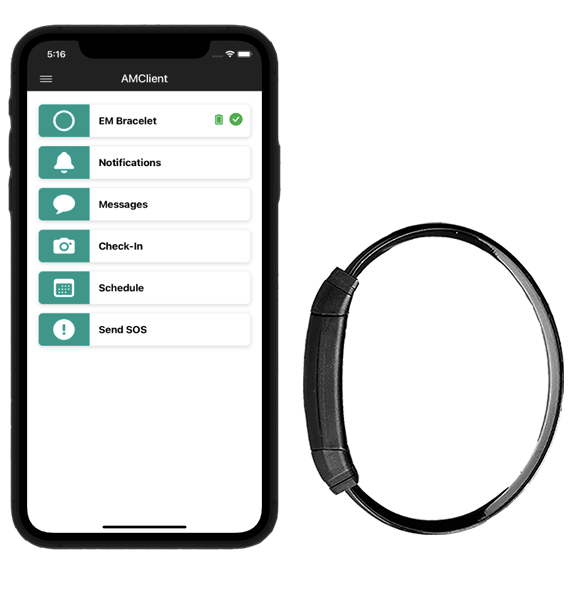
Here is how it works in practice. The i-Bracelet communicates via encrypted BLE (Bluetooth Low Energy) with the CO-EYE AMClient app—or any integrated third-party app—running on the defendant’s own smartphone. The app handles GPS location tracking, biometric check-ins, schedule management, and two-way communication with supervising officers. The wristband provides the critical missing piece that smartphone-only solutions lack: continuous physical verification that the monitored person and the phone are in the same place.
This is not theoretical. Our U.S. partner e-Cell (Fort Smith, Arkansas) has already integrated the CO-EYE i-Bracelet into their monitoring platform as the “E-Cell FOB”—Fiber Optic Band—serving courts and bail agencies across multiple states. The i-Bracelet carries FCC certification for U.S. deployment.
Why Smartphone-Only Monitoring Apps Fall Short
The U.S. market has dozens of pretrial monitoring apps: BI SmartLINK, TRACKphone Lite, Satellite Tracking’s smartphone modules, Corrisoft, and others. A 2025 NIJ Criminal Justice Testing and Evaluation Consortium brief cataloged the growing adoption, noting that COVID-19 accelerated remote supervision and that agencies increasingly seek “less stigmatizing methods of location tracking.”
But these apps share a fundamental architectural weakness. When supervision relies entirely on a defendant’s smartphone—a device they own, control, and can leave at home, hand to a friend, or simply turn off—the entire system depends on voluntary compliance. There is no physical tether. The GPS trace shows where the phone is, not where the person is.
This is why BI Incorporated themselves developed SmartBAND—a BLE wristband that pairs with SmartLINK to add proximity verification. The federal courts’ own Location Monitoring Reference Guide states explicitly that “GPS wrist worn devices are best suited to monitor low-risk, nonviolent defendants” and acknowledges the distinction between “Virtual Mobile Applications” as stand-alone monitoring versus hardware-paired supervision.
The i-Bracelet fills exactly this gap—but at a fraction of the size, weight, and cost of alternatives. At 17g with no charging requirement, it eliminates the two biggest operational headaches of traditional EM hardware: device management logistics and defendant non-compliance with charging schedules.
How the CO-EYE i-Bracelet Changes the Bail Reform Math
Consider what Washington’s CrR 3.2 debate looks like with this technology in the equation:
| Supervision Option | Daily Cost | Defendant Disruption | Court Compliance Verification |
|---|---|---|---|
| Pretrial detention | $75–200/day | Total (incarceration) | 100% |
| Traditional GPS ankle bracelet | $5–15/day | High (visible, daily charging, stigma) | Continuous GPS |
| Smartphone app only | $2–5/day | Low | Weak (phone ≠ person) |
| BLE i-Bracelet + smartphone app | $2–5/day | Near-zero (invisible, no charging) | Verified (BLE tether confirms proximity) |
The prosecutor who worries about accountability gets continuous identity-verified monitoring. The public defender who argues against wealth-based detention gets a supervision tool that costs less than a daily coffee. The defendant gets a device that is genuinely invisible to everyone around them—no stigma, no employment barriers, no social isolation.
This is not a compromise. It is a better answer than either side of the current debate is proposing.
What Courts Should Ask For in 2026
Whether Washington adopts the CrR 3.2 amendments or not, the underlying tension will not disappear. Forty-seven states have some form of bail reform legislation under discussion. Illinois eliminated cash bail entirely in 2023 under the Pretrial Fairness Act. New Jersey’s 2017 reforms reduced its jail population by 44% in the first year.
Every one of these reforms needs a technology backbone that can deliver three things simultaneously: verified supervision, minimal defendant burden, and manageable agency cost. The CO-EYE BLE i-Bracelet—weighing less than a house key, lasting 2 years without charging, paired with any smartphone app—represents the most practical answer currently available.
If you run a pretrial services agency, a bail monitoring company, or a community corrections program and want to evaluate how this approach works in practice, contact our team for evaluation hardware.