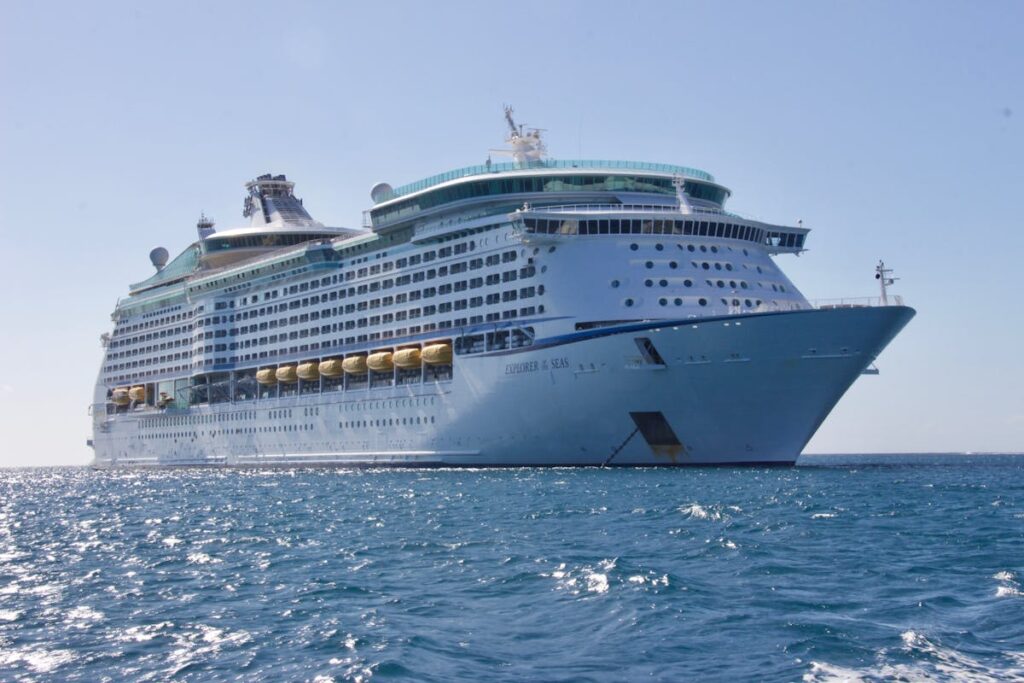
Three passengers dead. 147 people confined to cabins for over a week. A ship stranded 600 nautical miles from the nearest port with no way to verify who was actually staying in isolation.
The MV Hondius hantavirus outbreak of May 2026 isn’t just a public health crisis — it’s a case study in what happens when quarantine monitoring relies entirely on the honor system aboard a vessel where crew resources are already stretched thin.
What Happened on the MV Hondius
The Dutch-flagged polar cruise ship departed Ushuaia, Argentina on April 1, 2026, carrying 147 passengers and crew from 23 nationalities on an expedition through Antarctica, South Georgia, and remote South Atlantic islands. What started as an adventure of a lifetime turned deadly when passengers began falling ill with fever, gastrointestinal symptoms, and rapidly progressing pneumonia.
The first death — a Dutch man — occurred on April 11 as the ship steamed toward Tristan da Cunha, one of the most remote inhabited islands on Earth. His wife, who accompanied his body when it was disembarked at Saint Helena on April 24, deteriorated during a flight to Johannesburg and died upon arrival on April 26. A German national became the third fatality. The WHO confirmed hantavirus in laboratory testing and identified seven total cases — two confirmed, five suspected.
By early May, the ship sat anchored off Praia, Cape Verde. Passengers were ordered to isolate in their cabins. Cape Verde refused disembarkation. Spain eventually agreed to receive the vessel at the Canary Islands, but the ship faced a 3-4 day transit before anyone could step ashore for proper medical screening.

Why Did Cabin Isolation Fail as a Containment Strategy?
Oceanwide Expeditions activated its highest-level SHIELD response (Level 3), which included mask mandates, social distancing, and cabin isolation. Passengers like travel vlogger Kasem Hato and wildlife photographer Alejandra Rendon reported that crew members were doing their best — delivering meals to cabins, conducting manual health checks, and disinfecting common areas.
But here’s the operational reality that no press release addresses: how do you verify that 147 people across dozens of cabins are actually staying isolated, around the clock, with a crew that is simultaneously managing medical emergencies, disinfection protocols, and ship operations?
The answer, aboard MV Hondius, was the same approach used on the Diamond Princess in 2020: trust, periodic checks, and hope. Passengers were allowed solo deck walks for fresh air. Common areas were technically off-limits but physically accessible. There was no automated system to detect if a symptomatic passenger left their cabin at 2 AM, no way to verify that the person delivering meals wasn’t spending too long in close contact, and no proximity alerting when quarantined individuals violated minimum distance requirements.
The WHO’s Maria Van Kerkhove noted that human-to-human transmission likely occurred between “very close contacts, such as married couples and people providing medical care.” That assessment raises an obvious question: if proximity was the transmission vector, shouldn’t there have been a system to monitor and alert on proximity violations in real time?
What COVID-19 Taught Us — and What the Maritime Industry Forgot
The cruise industry isn’t unfamiliar with wearable monitoring technology. During COVID-19, several solutions emerged:
- TraceSafe BLE beacons enabled contact tracing through wristbands on multiple cruise lines
- The HS4U project (EU-funded) developed smart wearables combined with HVAC virus detection for cruise epidemic management
- The EmBRACE system used ultrasound distance metering with BLE communication to enforce social distancing
- The MS Artania in Western Australia demonstrated that structured quarantine with monitoring achieved a 4.8% attack rate among crew during a 14-day quarantine, with zero post-quarantine symptomatic cases (CDC Emerging Infectious Diseases, 2021)
Yet when hantavirus struck in 2026, MV Hondius had none of these systems deployed. The industry appears to have treated COVID-era monitoring technology as a pandemic-specific response rather than a permanent operational capability.
What Would Effective Onboard Quarantine Monitoring Look Like?
A functional quarantine monitoring system for maritime environments must solve four problems simultaneously:
- Cabin confinement verification — Is the quarantined individual actually in their cabin?
- Proximity violation detection — Did two quarantined individuals come within 2 meters of each other?
- Medical check-in compliance — Has the individual completed required temperature/symptom reporting?
- Contact tracing reconstruction — If a new case emerges, who was within transmission range in the past 72 hours?
These requirements map directly onto technology that already exists in the electronic monitoring industry — specifically, BLE (Bluetooth Low Energy) wearable devices paired with zone-aware infrastructure.
How BLE Wearable Quarantine Monitoring Works: Two Proven Architectures
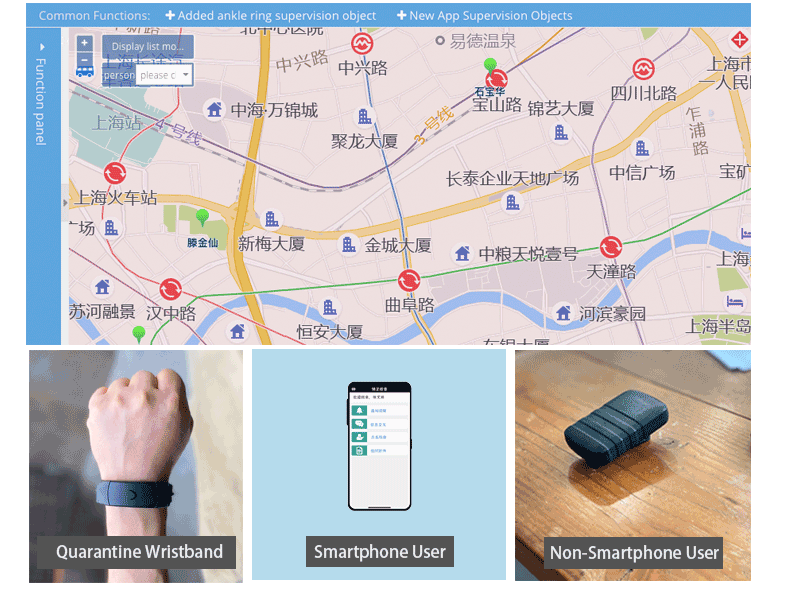
Deploying quarantine monitoring on a cruise ship doesn’t require building new technology from scratch. The electronic monitoring industry has spent two decades refining exactly this capability for corrections, immigration enforcement, and — during COVID-19 — public health quarantine programs. Two deployment architectures cover the full range of maritime quarantine scenarios:
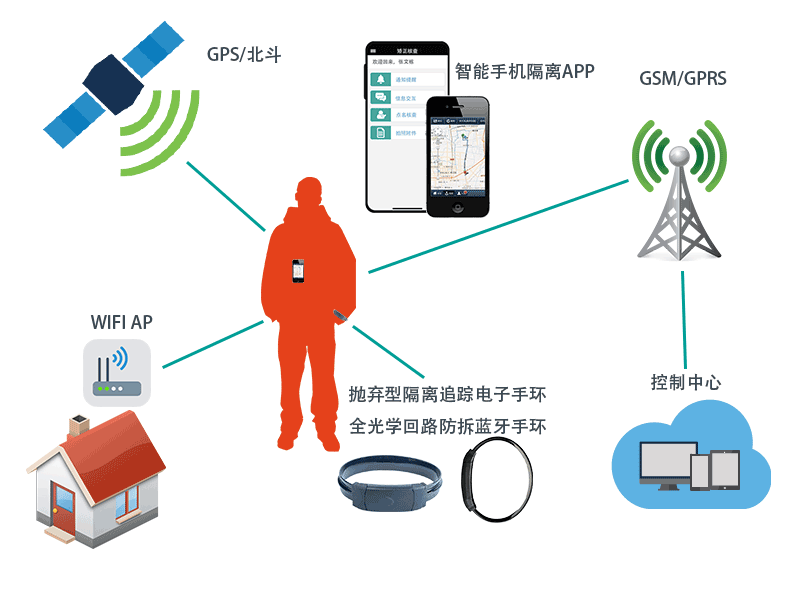
Architecture 1: BLE Bracelet + Smartphone App
Each quarantined individual wears a lightweight BLE bracelet (as light as 17 grams — comparable to a fitness band) that pairs with a smartphone application installed on their personal device. The smartphone serves as the communication gateway:
- Cabin geofencing via BLE RSSI — The app uses the bracelet’s signal strength to determine whether the wearer is within the designated cabin zone. If signal drops (indicating the person has left), the system generates an immediate alert to the ship’s medical command
- Proximity detection — When two bracelets come within a configurable distance threshold, both smartphones log the encounter with timestamps, duration, and estimated distance. This data feeds automatic contact tracing
- Scheduled health check-ins — The app prompts the wearer for temperature readings, symptom surveys, and photo verification at configurable intervals. Non-compliance triggers crew notification
- SOS and messaging — The quarantined individual can request medical assistance or communicate with the monitoring center without leaving the cabin
This architecture is ideal when passengers have smartphones and the ship has WiFi or cellular connectivity. The bracelet’s 2-year battery eliminates charging concerns during quarantine periods.
Architecture 2: BLE Bracelet + Fixed Monitoring Hardware
For scenarios where passengers don’t have smartphones, or where more robust infrastructure monitoring is needed, BLE bracelets pair with fixed hardware units installed at cabin doorways or corridor checkpoints:
- Fixed beacon units at cabin doors — A compact monitoring device (similar to a home alarm beacon) is attached at each quarantine cabin entrance. When the bracelet moves beyond the beacon’s range, the system instantly detects a quarantine breach. Coverage extends through 4 walls of standard cabin construction
- Portable tracking units for medical staff — Medical personnel carry small tracking devices that log every close encounter with quarantined individuals. These devices provide 20-meter indoor / 100-meter outdoor detection range, creating a complete contact map for health workers
- Corridor checkpoint monitoring — Fixed units at corridor intersections, dining areas, and deck access points detect any bracelet that shouldn’t be in that zone, providing ship-wide quarantine enforcement without requiring crew patrols
- Dual-SIM connectivity — Hardware units support independent 3G/WiFi data transmission to the ship’s monitoring center, functioning even if the ship’s main network is degraded
This architecture requires no passenger cooperation beyond wearing the bracelet, making it suitable for mandatory quarantine enforcement where compliance cannot be assumed.
Combining Both Architectures for Maximum Coverage
The most effective deployment uses both architectures simultaneously: passengers with smartphones use the app-based system for self-monitoring and communication, while fixed hardware provides independent verification and covers non-smartphone users. The central monitoring software aggregates data from both sources into a single quarantine compliance dashboard.
What the MV Hondius Timeline Reveals About Monitoring Gaps
Mapping the MV Hondius timeline against what automated monitoring could have provided exposes critical gaps:
| Date | What Happened | What Monitoring Could Have Done |
|---|---|---|
| April 11 | First passenger (Dutch man) dies at sea | Retrospective contact tracing: identify all passengers within 2m of the deceased in prior 14 days — instant vs. days of manual interviews |
| April 11–24 | Ship continues voyage; wife accompanies body at St. Helena on April 24 | Continuous monitoring of symptomatic wife’s movements and all close contacts during 13-day period before disembarkation |
| April 26 | Dutch woman dies in Johannesburg after flight from St. Helena | Flight passenger contact data from onboard monitoring would have accelerated WHO contact tracing for the St. Helena–Johannesburg flight |
| Late April | German passenger dies; British passenger evacuated to South Africa | Proximity data pinpoints exactly when and where secondary transmission likely occurred |
| May 3–5 | Ship anchored off Cape Verde; all passengers cabin-isolated; no disembarkation permitted | Automated cabin confinement verification replaces manual crew checks; compliance data shared with Cape Verde/WHO to demonstrate quarantine integrity |
| May 6+ | 3-4 day transit to Canary Islands for proper screening | Continuous monitoring during transit; verifiable quarantine compliance data presented to Spanish health authorities upon arrival — potentially accelerating disembarkation |
The most consequential gap is between April 11 and April 24. For 13 days after the first death, the ship continued operating without knowing who had been in close contact with the deceased. His wife — who was symptomatic — continued interacting with other passengers and crew before disembarking at St. Helena. Automated proximity logging would have identified every person who spent more than 15 minutes within 2 meters of either individual, enabling targeted isolation rather than the eventual blanket cabin lockdown of all 147 people.
Why Maritime Operators Should Deploy Quarantine Monitoring Now — Not After the Next Crisis
The economics of prevention versus response make this decision straightforward:
- MV Hondius estimated losses: ship held for 10+ days (fuel, crew wages, port fees), medical evacuations to South Africa and Europe, passenger compensation, reputational damage to Oceanwide Expeditions, WHO and multi-government diplomatic coordination
- Quarantine monitoring system cost: BLE bracelets at scale cost $15-30 per unit with multi-year battery life. Fixed monitoring hardware for cabin zones costs $50-100 per unit. For a 150-passenger vessel, full deployment costs less than a single medical evacuation flight
Beyond cost, there’s a regulatory dimension. The CDC’s Guidance for Cruise Ships on Management of Acute Respiratory Illness already mandates isolation, contact tracing, and health monitoring protocols. Wearable monitoring technology doesn’t create new obligations — it provides verifiable compliance with existing ones.
The HS4U project — an EU-funded initiative specifically designed for cruise ship epidemic management — has already validated smart wearables as a core component alongside HVAC virus detection and wastewater sampling. The technology exists. The protocols exist. What’s missing is deployment.
From Corrections to Cruise Ships: Why Electronic Monitoring Technology Transfers Directly
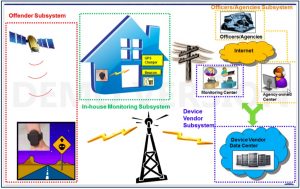
The quarantine monitoring use case is technically identical to house arrest electronic monitoring, where authorities must verify that an individual remains within a designated zone and detect any violations in real time. The same BLE bracelet that verifies a parolee is home at midnight can verify a quarantined passenger is in their cabin. The same proximity detection that alerts a probation officer to an exclusion zone violation can alert a ship’s medical officer to a quarantine breach.
What changes is the context, not the technology:
| Capability | Corrections Use | Quarantine Use |
|---|---|---|
| Zone confinement verification | Offender stays within home radius | Passenger stays within cabin |
| Proximity alerting | Victim notification (DV cases) | Contact tracing / social distancing |
| Scheduled check-ins | Probation compliance reporting | Temperature / symptom reporting |
| Historical movement data | Court evidence / parole review | Epidemiological contact tracing |
| Central monitoring dashboard | Corrections officer workstation | Ship medical command center |
REFINE Technology’s CO-EYE product line — originally designed for corrections and immigration monitoring — already includes both deployment architectures described above. The CO-EYE BLE i-Bracelet at 17 grams is lighter than most fitness trackers and runs for 2 years without charging. Paired with the AMClient smartphone app or HouseStation fixed beacons, it provides exactly the cabin-level confinement verification and proximity detection that MV Hondius lacked. During COVID-19, these systems were deployed for public health quarantine monitoring in multiple countries — the same technology, repurposed from criminal justice to epidemic response.
What Needs to Change
The MV Hondius incident will fade from headlines. The ship will dock in the Canary Islands. Passengers will be screened and sent home. Oceanwide Expeditions will update their SHIELD protocols. And the next expedition cruise will depart for Antarctica without any fundamental change to onboard quarantine capability.
Unless the maritime industry treats quarantine monitoring technology as standard safety equipment — like lifeboats and fire suppression systems — rather than pandemic-era novelty gear. The technology costs less than most passengers’ bar tab. The deployment is non-invasive. And the alternative, as 147 people anchored off Cape Verde can attest, is trusting cabin doors and crew willpower to contain a virus that kills within days.
Three people didn’t survive the honor system.