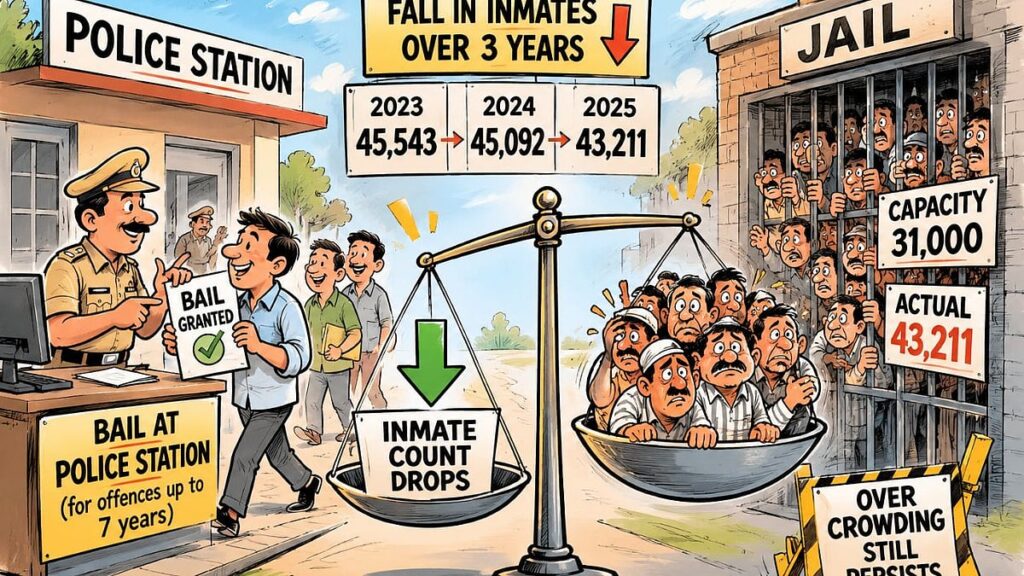
Madhya Pradesh just demonstrated what India’s Supreme Court has been arguing since its landmark Satender Kumar Antil v. CBI ruling in 2022: bail should be the rule, not the exception. Between December 2023 and December 2025, the state’s prison population dropped from 45,543 to 43,211 — a net reduction of 2,332 inmates — after India implemented Section 479 of the Bharatiya Nagarik Suraksha Sanhita (BNSS), its sweeping replacement for colonial-era criminal procedure.
But here’s what the headline numbers don’t tell you: India’s pretrial detention crisis runs far deeper than overcrowding percentages. It intersects with caste, poverty, and a legal system where — as the Supreme Court’s own research wing admits — “liberty has become a luxury.” And the tool that could bridge the gap between jail and unsupervised release sits at the center of a constitutional contradiction that makes India’s path to electronic monitoring uniquely complex.
The Real Crisis Behind the Numbers: Who Stays in Indian Jails and Why?
India’s prison overcrowding is not a simple capacity problem. It is a social justice crisis with deep structural roots.
Nationally, 78% of India’s 5.82 lakh prisoners are undertrials — people who have not been convicted of any crime. That is the highest proportion of pretrial detainees among major democracies. But the statistic masks a more disturbing reality: the people who remain trapped in pretrial detention are overwhelmingly poor, lower-caste, and from religious minorities.
According to NCRB 2023 data and the Citizens for Justice and Peace analysis:
- Dalits comprise more than one-fifth of India’s prison population — massively overrepresented relative to their 16.6% share of the general population
- Muslims make up 16.5% of prisoners against 14.2% of the general population — a persistent overrepresentation that the justice system has not addressed
- Adivasis (tribal communities) are similarly overrepresented, particularly in states with Maoist insurgency charges
- The common thread: inability to afford legal representation and bail surety. As researchers note, wealth determines who walks free and who waits months or years for trial behind bars
This is the context that makes Madhya Pradesh’s 2,332-inmate reduction both significant and insufficient. The state has the lowest undertrial ratio in India at 55% (down from 70% in 2020) — but that still means more than half of its 43,211 prisoners have not been convicted. Nationally, states like Bihar, Uttar Pradesh, and Jharkhand have undertrial ratios exceeding 80%.

What BNSS Section 479 Actually Changed — And Where It Falls Short
The Bharatiya Nagarik Suraksha Sanhita, which replaced the colonial-era Code of Criminal Procedure on July 1, 2024, was supposed to modernize Indian criminal justice. Section 479 is its centerpiece bail reform, creating a tiered release framework:
| Category | Detention Threshold for Mandatory Release | Release Type |
|---|---|---|
| First-time offenders | Detained for one-third of maximum sentence | Personal bond (no surety needed) |
| General undertrials | Detained for one-half of maximum sentence | Bail with surety |
| Any undertrial | Detained for full maximum sentence period | Mandatory release |
On paper, this should empty thousands of cells. In practice, legal scholars describe Section 479 as a case where “exceptions swallow the rule.”
Here’s the problem: Section 479(2) excludes anyone facing investigation or trial in multiple cases. This restriction did not exist in the old Section 436A of the CrPC. In the Indian system, where multiple FIRs (First Information Reports) against a single person are common — sometimes for what is essentially a single incident split across jurisdictions — this exclusion disqualifies a large proportion of the undertrial population.
The Supreme Court addressed this partially in August 2024, ruling that Section 479 applies retrospectively and directing jail superintendents to review eligible cases within three months. But even the Supreme Court’s NALSA Undertrial Review Committees show the gap: in Q1 2025, only 5,225 prisoners were released out of 13,430 reviewed — less than 40% of those identified as potentially eligible actually walked free.
India’s Constitutional Contradiction on GPS Monitoring
Here is where India’s story diverges sharply from every other country exploring electronic monitoring — and why a simplistic “just deploy ankle monitors” narrative misses the point.
In July 2024, the Supreme Court of India ruled that GPS tracking as a bail condition violates the constitutional right to privacy under Article 21. The case involved a lower court requiring an accused person to share Google Maps location data with investigating officers. The Supreme Court struck this down, holding that “any bail condition which enables the Police/Investigation Agency to track every movement of the accused by using any technology or otherwise would undoubtedly violate the right to privacy.”
Four months later, in November 2024, the Supreme Court’s own Centre for Research and Planning recommended electronic ankle monitoring as a solution to prison overcrowding. Their report, “Prisons in India: Mapping Prison Manuals and Measures for Reformation and Decongestion,” suggested pilot programs using ankle or bracelet trackers for low and moderate-risk undertrials released on parole or furlough.
This is not hypocrisy — it is a genuine constitutional tension that India must resolve before any large-scale EM deployment:
- The privacy ruling addresses police-directed surveillance of accused persons as a bail condition — where the accused has no meaningful consent
- The EM recommendation envisions consensual participation by prisoners seeking early release — where electronic monitoring replaces incarceration, and the individual chooses monitoring over continued detention
This distinction — compulsory surveillance as punishment versus voluntary monitoring as an alternative to incarceration — is the legal framework India will need to build. Countries like France, the UK, and several Australian states have established this distinction through dedicated legislation. India has not.
Madhya Pradesh By the Numbers: Where Bail Reform Reached and Where It Didn’t
| Facility Type | Count | Capacity | Actual Population | Overcrowding |
|---|---|---|---|---|
| Central Jails | 11 | 15,176 | 23,349 | +54% |
| District Jails | 41 | 10,169 | 13,742 | +35% |
| Sub-Jails | 73 | 5,501 | 6,002 | +9% |
| Open Jails | 8 | 138 | 118 | Under capacity |
Central jails carry the worst burden at 54% overcapacity — these house long-term detainees and convicted prisoners alongside undertrials facing serious charges. District jails at 35% over capacity are where Section 479 had the most impact, as many inmates there face charges under the seven-year threshold.
The eight open jails — semi-supervised facilities where inmates live and work with minimal security — are the only category operating below capacity. This matters: open jails represent India’s closest existing model to community supervision, and their success suggests a population that could transition to GPS-monitored release.
The Cost Argument India Cannot Ignore
The Supreme Court’s own research puts the number starkly: housing one undertrial prisoner costs the Indian state approximately ₹1 lakh (roughly $1,200) per year. A GPS monitoring device costs ₹10,000-15,000 ($120-180) annually — a 85-90% cost reduction per supervised individual.
With approximately 4.3 lakh undertrials nationwide (78% of 5.82 lakh total), even diverting 10% to electronic monitoring would save the exchequer ₹370-430 crore annually while reducing prison populations by 43,000.
But cost alone won’t drive adoption. India’s path to electronic monitoring runs through constitutional courts, legislative drafting, and a public conversation about whether GPS supervision is a tool of liberation (from jail) or a tool of surveillance (imposed by the state). The Supreme Court’s conflicting signals in 2024 — striking down GPS bail conditions while recommending GPS monitoring for decongestion — show this conversation has barely begun.
What Would an Indian EM Deployment Actually Require?
Any serious discussion of GPS ankle monitoring in India must account for ground realities that differ fundamentally from American or European deployments:
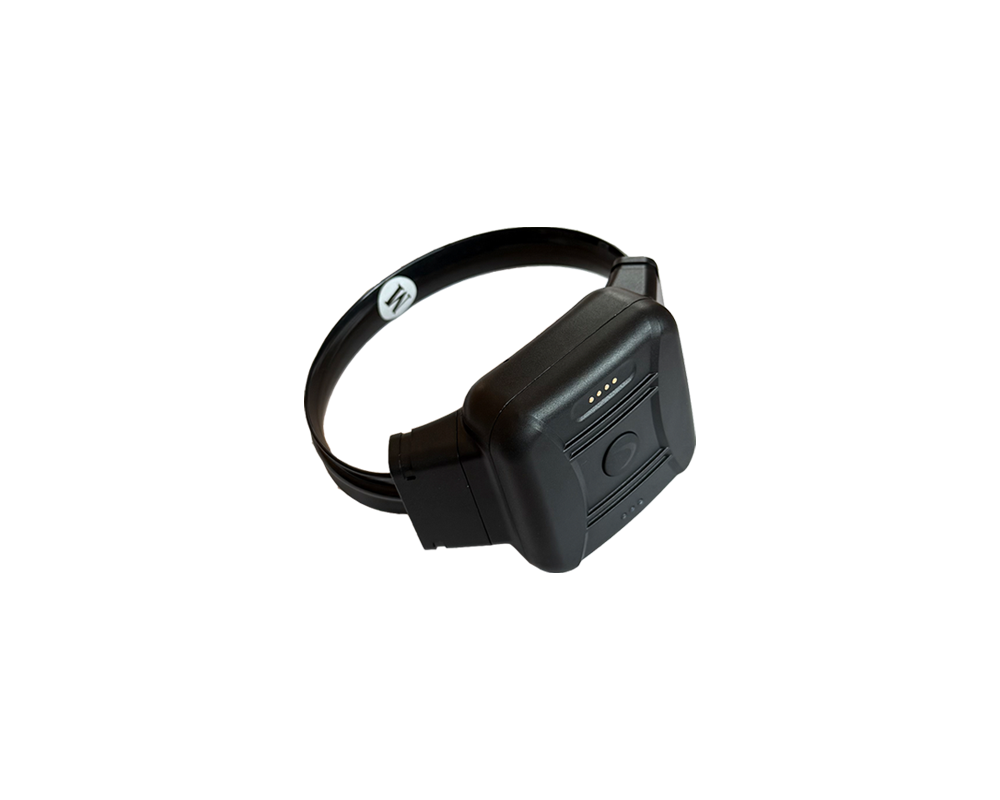
- Rural connectivity gaps: 65% of India’s population lives in rural areas where LTE coverage is inconsistent. Devices that rely solely on cellular connectivity will create supervision blackouts across entire districts. Multi-mode devices that switch between BLE, WiFi, and cellular networks — where a ₹500 WiFi repeater in a rural home eliminates a dead zone — are the only architecture that works at India’s scale
- Power infrastructure: Daily device charging is impractical for bail recipients in areas with scheduled power outages (6-12 hours daily in many rural districts). Battery life measured in weeks, not hours, is a deployment prerequisite
- Climate extremes: From Kashmir’s sub-zero winters to Rajasthan’s 48°C summers, from Kerala’s monsoons to Ladakh’s altitude — IP68 waterproof rating and wide temperature tolerance are non-negotiable
- Scale economics: India would need tens of thousands of units from day one of any pilot. One-piece designs with no external accessories (no home beacon, no proprietary charger dock) minimize per-unit TCO
- Privacy-by-design architecture: Given the Supreme Court’s 2024 privacy ruling, any EM system deployed in India will face immediate constitutional challenge unless it incorporates data minimization, purpose limitation, and judicial oversight at the architecture level — not as an afterthought
The Satender Kumar Antil Legacy: From Judgment to Implementation
The Supreme Court’s 2022 Satender Kumar Antil judgment did not merely restate that bail is the rule. It laid out a comprehensive reform framework: categorizing offenses by severity, mandating disposal of bail applications within two weeks, directing states to fill judicial vacancies, and — most ambitiously — recommending that Parliament enact a dedicated Bail Act.
Three years later, no Bail Act exists. Section 479 of the BNSS is the legislative response, but it addresses only one dimension of the problem (detention duration) while leaving others untouched: the quality of post-release supervision, the availability of alternatives to detention, and the persistent gap between judicial intent and ground-level implementation.
Electronic monitoring occupies that gap. Between the judge who wants to grant bail but fears flight risk, and the undertrial who cannot afford surety but poses no danger — that is where GPS supervision creates value. But India will need dedicated legislation that draws the constitutional line between surveillance-as-punishment and monitoring-as-alternative-to-incarceration. The Supreme Court’s own contradictory positions in 2024 make this legislative clarification not just desirable but unavoidable.
Madhya Pradesh’s 2,332-inmate reduction is a proof point that legislative reform works. The next proof point India needs is a properly designed, constitutionally grounded, pilot program for electronic monitoring — one that addresses the privacy concerns, serves the most marginalized prisoners first, and demonstrates that technology can make “bail as the rule” a reality rather than an aspiration.