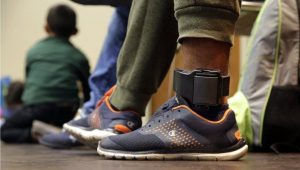
On July 28, 2026, the Japanese government approved emergency countermeasures at a ministerial meeting on crime prevention (Kyodo News) — including a landmark proposal to require high-risk stalkers under restraining orders to wear GPS tracking devices. Victims would receive automatic proximity alerts if the offender approaches a designated area, giving them time to evacuate or contact police.
This proposal — triggered by the fatal stabbing of 21-year-old Moe Harukawa at her workplace in Tokyo’s Ikebukuro district in March 2026 by a former partner who was already under a restraining order — represents a fundamental shift in how Japan approaches victim protection. It also validates what we have seen across 30+ countries where CO-EYE devices are deployed: restraining orders without technological enforcement are paper promises that determined offenders ignore.
Why Japan Needs GPS Stalker Monitoring: The Numbers
Japan’s National Police Agency data paints a stark picture:
- 1,546 stalking arrests in 2025 — the highest since the anti-stalking law took effect in 2000, and the fourth consecutive annual increase
- 3,037 restraining orders issued in 2025 (Japan Times) — also a record high
- 22,881 consultation requests from stalking victims in a single year
- 5.6% voluntary counseling uptake — only 184 of 3,271 referred offenders agreed to treatment in 2024
- 3 murders and 49 attempted murders in stalking-related cases in 2024 alone
The Ikebukuro case distilled the systemic failure: police arrested the stalker in December 2025, issued a restraining order in January 2026, and even advised the victim to change workplaces — but had no real-time mechanism to detect the offender approaching her until the knife was already drawn. A GPS monitoring device with proximity alerting would have triggered a notification the moment the stalker entered the vicinity of Sunshine City.

What Japan’s Stalker Monitoring System Requires — And How CO-EYE Meets Every Specification
The Japanese government outlined several technical requirements in its emergency measures package, including device miniaturization, victim notification capability, and operational reliability. Having deployed GPS victim-protection systems across multiple jurisdictions, we can map these requirements directly to proven capabilities.
Requirement 1: Automatic Victim Proximity Alert
Japan’s proposal specifies that victims receive alerts when offenders approach “a designated area.” This is precisely the architecture CO-EYE’s victim protection solution delivers:
- CO-EYE AMClient App installed on the victim’s smartphone creates a dynamic Mobile Exclusion Zone (MEZ) that follows the victim wherever they go — not just fixed addresses
- Dual proximity detection: GPS geofencing (1,000-foot outer warning + 300-foot inner alert) plus BLE close-range detection when victim and offender are in the same building
- SOS panic button: One-touch emergency notification that simultaneously alerts the monitoring center and police, transmitting the victim’s real-time GPS coordinates
- Sub-2-meter GPS accuracy: Critical in dense urban environments like Tokyo’s Ikebukuro district where 10-meter accuracy is insufficient to distinguish between adjacent buildings
Requirement 2: Device Miniaturization and Discreet Wear
Japan specifically referenced “miniaturization technologies” — likely reflecting concerns about proportionality and the constitutional right to personal freedom that Japanese courts weigh heavily. CO-EYE ONE addresses this directly:
- 108 grams / 60×58×24mm — the lightest one-piece GPS ankle monitor in production, 40-55% lighter than competing devices (150-252g)
- Compact sports-watch profile that fits under clothing without visible bulging
- 3-second tool-free installation with patent snap-lock mechanism — reducing processing time at police stations
- Pre-sized TPU fiber-optic straps (S/M/L/XL) — no cutting or fitting tools required
For courts balancing victim safety against proportionality, a 108-gram device that disappears under a trouser leg is substantively different from a 250-gram unit that screams “criminal” to every passerby. This distinction directly affects judicial approval rates — South Korea’s 75% court rejection rate for monitoring orders reflects, in part, concerns about device intrusiveness.
Requirement 3: Continuous Connectivity in Japanese Urban Environments
Tokyo presents unique monitoring challenges: underground shopping complexes (like the basement levels of Sunshine City where the attack occurred), extensive subway networks, reinforced-concrete apartment buildings, and elevator shafts all degrade cellular signals. A device that loses connectivity when the stalker enters a subway station — exactly when the victim needs maximum protection — creates a dangerous blind spot.
CO-EYE ONE’s adaptive multi-mode connectivity engine was designed for precisely this scenario:
| Mode | How It Works | Japan Stalker Use Case |
|---|---|---|
| LTE Standalone | Full GNSS + LTE tracking (7-day battery) | Outdoor movement, commuting, approaching victim locations |
| WiFi-Directed | Connects to WiFi networks for data relay (20-day battery) | Underground malls, basement apartments, WiFi-equipped subway stations — maintains supervision where LTE fails |
| BLE Connected | Offloads to paired smartphone or HouseStation (180-day battery) | Confirms home presence during curfew hours without burning LTE battery |
The device automatically switches between modes with zero human intervention — entering a subway triggers WiFi fallback; arriving home switches to BLE low-power. This eliminates the “device went offline” gap that has contributed to victim deaths in South Korea’s system.
Requirement 4: Tamper Detection That Holds Up Under Japanese Legal Standards
For GPS monitoring to function as a legally credible deterrent under Japanese law, device removal must be: (a) immediately detectable, (b) verifiable in court, and (c) impossible to explain away as “device malfunction.” CO-EYE’s fiber-optic tamper detection meets all three criteria:
- Dual fiber-optic loops monitoring both the strap and device housing — a binary pass/fail signal that produces zero false alarms
- 3-month tamper protection after battery depletion — even if the stalker allows the battery to die, any removal attempt is still detected and recorded
- Court-admissible digital evidence: ECDSA hardware-signed event data with SHA-256 cascading hash chain ensures tamper events cannot be fabricated, modified, or disputed
- Optional steel cut-resistant fiber-optic strap for cases assessed as highest-risk (violent history, prior escape attempts)
Requirement 5: Extended Battery Life for Long-Term Court Orders
Japan’s proposal leaves open “how long devices would need to be worn.” In stalking cases internationally, monitoring periods typically range from 6 months to 2+ years. A device requiring daily charging over that duration creates thousands of potential failure points — each missed charge generating a “low battery” alert that diverts police resources and potentially desensitizes officers to real emergencies.
CO-EYE ONE’s three-mode power architecture transforms this calculus:
- BLE mode (180 days): When the offender is at home during curfew hours — covers 60-70% of total monitoring time at near-zero power consumption
- WiFi mode (20 days): When at work or in buildings with WiFi coverage
- LTE mode (7 days): Reserved for outdoor movement and critical proximity events
In practice, mixed-mode operation means the device requires charging approximately once every 2-3 weeks rather than daily — reducing charging-related failure modes by 85% compared to legacy devices operating on 24-72 hour LTE-only cycles.
South Korea’s Experience: What Japan Can Improve
South Korea amended its Anti-Stalking Punishment Act in 2023 to allow pre-conviction electronic monitoring and has approximately 4,000 monitored individuals (Korea Ministry of Justice). In July 2026, Korea upgraded its system to give victims real-time mobile access to monitored offenders’ location and direction of movement — after 23 victims were killed or attacked between 2021 and 2025 despite carrying emergency alert devices.
Japan has the advantage of learning from Korea’s implementation challenges:
| Korean Challenge | Root Cause | How CO-EYE Architecture Addresses It |
|---|---|---|
| 75% court rejection rate | Proportionality concerns — devices perceived as excessively restrictive | 108g ultra-lightweight, invisible under clothing, minimal lifestyle impact |
| Victims killed despite emergency devices | Response time gap between alert and police arrival | Tiered proximity zones: 1,000-ft early warning → 300-ft dispatch trigger → BLE close-range detection for same-building scenarios |
| Institutional silos between probation and police | Separate monitoring/enforcement systems | Unified monitoring platform with multi-agency access, automated dispatch routing, WhatsApp/Telegram/SMS parallel notification channels |
| Device offline in underground areas | LTE-only connectivity architecture | BLE + WiFi + LTE adaptive switching — maintains supervision in subways, basements, underground malls |
CO-EYE Victim Protection Solution: Complete System Architecture
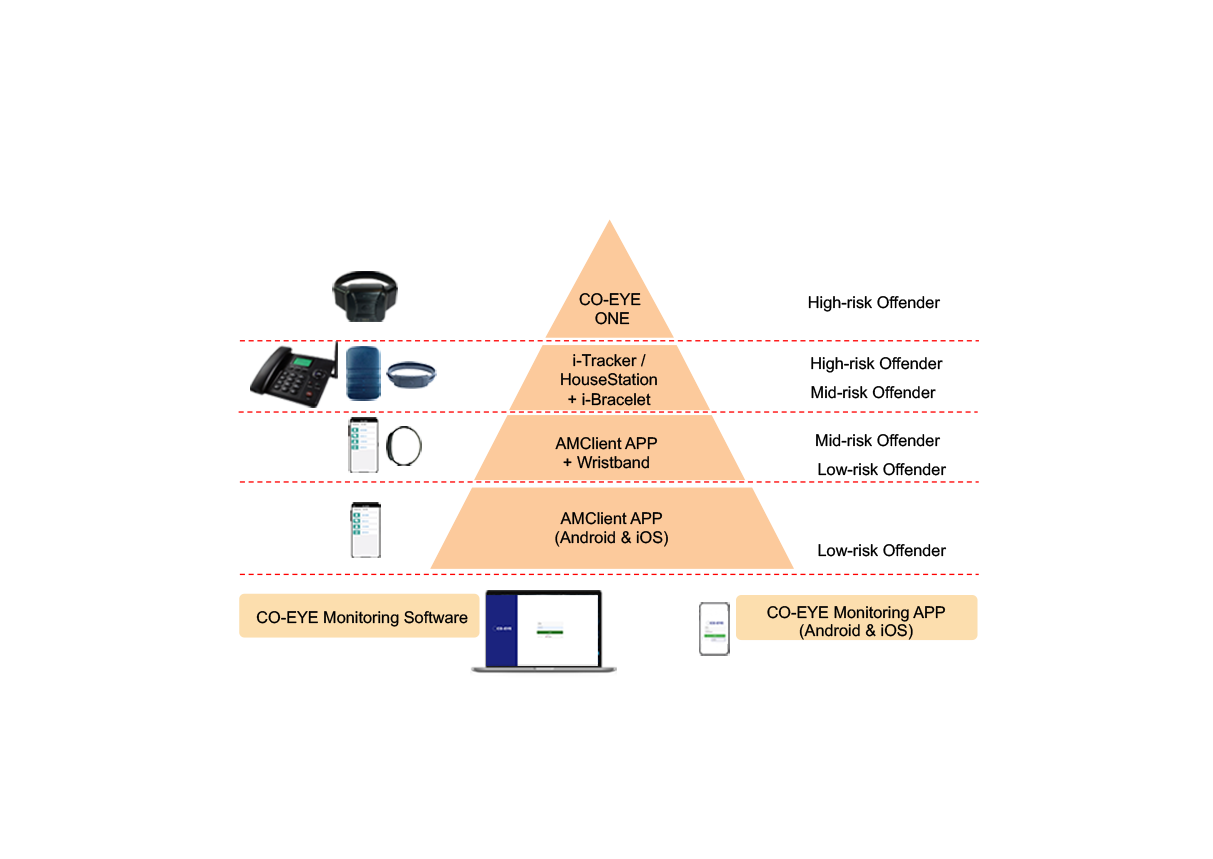
Stalker monitoring is not a device problem — it is a system problem. The GPS ankle monitor is one component of a multi-layered protection architecture that CO-EYE deploys as an integrated solution:
| Component | Function | Stalker Scenario Role |
|---|---|---|
| CO-EYE ONE GPS Ankle Monitor | Offender location tracking + tamper detection | Worn by stalker; 24/7 position reporting; instant tamper alert if removed |
| CO-EYE AMClient App (Victim) | Victim location + proximity alert + SOS | Installed on victim’s phone; creates mobile exclusion zone; auto-alerts when stalker approaches |
| CO-EYE HouseStation | Home presence verification + BLE range extension | Confirms stalker is home during curfew; extends BLE detection range through 4 concrete walls |
| CO-EYE Monitoring Platform | Centralized supervision + alert routing | Police/probation dashboard; automated dispatch; court-grade evidence logging |
This integrated architecture means Japan’s police agencies don’t need to assemble a system from disparate vendors — the entire victim protection workflow, from offender enrollment to proximity breach response to court evidence presentation, operates on a single unified platform.
Implementation Considerations for Japan
Based on deployments in 30+ countries, including several with similarly advanced legal systems and constitutional protections, we recommend Japan consider these implementation factors:
Phased rollout: Begin with restraining-order violators (those already proven to disregard court orders) before expanding to all restraining order subjects. This addresses proportionality concerns while covering the highest-risk population first.
Dual-device protocol: Issue both the offender ankle monitor AND the victim smartphone app simultaneously. Korea’s experience shows that monitoring the offender alone is insufficient — the victim needs direct, real-time situational awareness.
Multi-language support: Japan’s stalking statistics include cases involving foreign nationals. CO-EYE’s monitoring platform and AMClient app support 15+ languages including Japanese, addressing the multilingual operational requirement.
eSIM flexibility: CO-EYE ONE supports both eSIM and Nano SIM, allowing deployment on any Japanese carrier (NTT docomo, SoftBank, KDDI) without hardware modification — and enabling carrier switching if coverage proves inadequate in specific areas.
The Path Forward
Japan’s GPS stalker monitoring proposal represents a watershed moment — the world’s third-largest economy acknowledging that traditional law enforcement approaches cannot protect victims from determined stalkers without technological force multiplication.
The Ikebukuro tragedy did not have to happen. A 108-gram device on Taiki Hirokawa’s ankle, paired with an alert app on Moe Harukawa’s phone, would have triggered a notification the moment he stepped off the train at Ikebukuro Station — giving her minutes, not seconds, to reach safety. That is not a hypothetical: it is the operational reality in jurisdictions where integrated GPS victim-protection systems are already deployed.
As Japan’s National Police Agency studies international models over the coming months, the technical capability to implement this system exists today. The only question is how quickly Japan’s legislative process can translate political will into deployed protection.
CO-EYE GPS ankle monitors and victim protection solutions are deployed in 30+ countries for domestic violence, stalking, and restraining order enforcement. For technical specifications and deployment consultation, contact marketing@rfidcn.com.
About REFINE Technology (CO-EYE)
REFINE Technology is the leading electronic monitoring solutions provider in China with over 16 years of experience in the criminal justice industry. As the exclusive supplier for top security agencies, REFINE Technology has deployed 200,000+ devices across 30+ countries, monitoring 130,000+ individuals. The CO-EYE product line — featuring the next-generation all-in-one GPS ankle monitor, BLE wristbands, RF home beacons, and a unified monitoring platform — delivers high-security, low-stigma supervision for high-risk, mid-risk, and low-risk offender monitoring and victim protection. All CO-EYE devices carry full European NB CE directives (RED/Cybersecurity/LVD/SAR) and FCC certifications, with IP68 waterproof and REACH/RoHS/WEEE compliance. CO-EYE solutions are trusted in the USA, Europe, Africa, Bhutan, Papua New Guinea, Dominican Republic, Armenia, and expanding globally.
For more information, visit www.ankle-monitor.com or contact marketing@rfidcn.com.
Related: GPS Ankle Bracelet Guide 2026: Costs, Technology & Vendor Selection