The quote says $8 per device per day. Your finance director approves the contract. Eighteen months later, your actual cost-per-enrollee is $14.60 — and nobody can explain where the extra $6.60 went.
It went into charger replacements for batteries that degraded after 8 months of deep-cycle abuse. Into overtime hours responding to false tamper alerts at 2 AM. Into emergency hardware swaps when your carrier announced 3G shutdown six months ahead of schedule. Into biohazard-grade cleaning supplies because the vendor never designed their device to be sanitized and reissued between enrollees.
This is not a hypothetical. This is the standard experience of agencies who evaluate GPS ankle monitors on acquisition cost alone.
Why Acquisition Cost Is the Least Important Number in Your Budget
A GPS ankle monitor’s purchase price typically represents 15-25% of its total cost of ownership over a 5-year contract. The remaining 75-85% hides in operational line items that most procurement teams never model before signing.
We’ve supported EM programs in 30+ countries over 16 years, and the pattern is consistent: agencies that model TCO before procurement save 30-45% over agencies that optimize for lowest unit price. The math isn’t complicated — but it requires asking questions that vendors selling cheap hardware actively discourage.
The 7 Hidden Cost Categories That Destroy EM Budgets
1. Battery Degradation and Charging Infrastructure ($2.10-4.50/device/day hidden cost)
This is the single largest hidden cost in electronic monitoring — and it’s where the difference between professional EM devices and rebranded consumer trackers becomes financially devastating.
The physics problem: A traditional GPS ankle monitor running continuous GNSS + LTE drains its battery in 24-72 hours. This means daily or every-other-day charging. Over a 5-year contract, that’s 900-1,800 charge cycles per device. Lithium-polymer cells are rated for 300-500 full cycles before capacity drops below 80%. By month 8-12, your “48-hour battery” is a 30-hour battery. By month 18, it’s a 20-hour battery.
The operational cascade:
- Degraded batteries → more frequent low-battery alerts → officers responding to alerts that aren’t violations
- Enrollees missing charge windows → genuine low-battery violations that require officer response
- Device replacements at $200-400/unit when batteries can no longer hold minimum charge
- Charger/cradle replacements (magnetic contacts wear, cables fray) at $30-60 per set
What changes the math: Devices with adaptive multi-mode connectivity (BLE + WiFi + LTE switching) reduce charge cycles from daily to weekly or monthly. A device charging once per week accumulates 260 cycles over 5 years — well within lithium-polymer lifecycle limits. The battery still holds 90%+ capacity at contract end. This single architectural difference eliminates the $2.10-4.50/device/day charging management overhead.
2. False Alarm Response Costs ($1.80-3.20/device/day)
Every false tamper alert, false zone violation, or false signal-loss event requires officer time. At loaded labor rates of $45-65/hour for corrections officers, even a 15-minute response costs $11-16 per incident.
Industry baseline false-alarm rates vary dramatically by tamper detection technology:
| Tamper Detection Type | Typical False Alarm Rate | Annual Cost per 100 Devices |
|---|---|---|
| Accelerometer / motion-based | 3-8 per device/week | $85,000 – $220,000 |
| Electrical continuity (wire loop) | 1-3 per device/week | $28,000 – $85,000 |
| Fiber-optic strap only | 0.1-0.5 per device/week | $2,800 – $14,000 |
| Fiber-optic dual loop (strap + case) | Zero | $0 |
For a 500-device program, the difference between accelerometer-based detection and fiber-optic dual-loop detection is $425,000 – $1.1 million per year in avoided false-alarm costs alone.
3. Device Reuse and Turnaround Costs ($0.80-2.40/device/day)
EM devices are not single-use. When an enrollee completes their monitoring term, the device must be recovered, sanitized, refurbished, and reissued to the next enrollee. This cycle repeats 3-6 times per device over a 5-year contract.
What professional EM devices are designed for:
- Tool-free strap removal and replacement — swap a pre-configured TPU fiber-optic strap in under 30 seconds, no technician required
- Medical-grade surface materials — housing and strap materials rated for repeated disinfection with standard EPA-registered solutions without material degradation
- Sealed charging contacts — magnetic pogo-pin charging that doesn’t trap biological material in crevices
- Factory-reset workflow — one-tap secure wipe of enrollee data, immediate re-enrollment capability
- Strap sizing inventory — pre-configured S/M/L/XL straps allow instant fitting without cutting or adjustment tools
What consumer-grade devices force you to do:
- Send devices back to the manufacturer for strap replacement ($15-30 shipping + 1-2 weeks out of service)
- Accept that silicone straps absorb sweat and odor permanently — replacement, not cleaning
- Use alcohol wipes on housing not rated for chemical exposure — surface crazing within 6 months
- Manually re-pair and re-provision each device (30-60 minutes of technician time per turnaround)
A fleet of 500 devices turning over 4x/year = 2,000 turnaround events. At 45 minutes per turnaround (consumer device) vs. 5 minutes (professional device), the labor difference alone is $58,000/year.
4. Network Sunset Replacement Costs (One-time $150,000-400,000 per 500 devices)
Every cellular network generation has a finite lifespan. Agencies that purchased 3G-only devices in 2019-2022 are now facing forced fleet replacements as carriers shut down 3G infrastructure. This is not a theoretical future risk — it is happening now across all major US carriers.
Professional EM devices built on LTE-M/NB-IoT cellular modems operate on 5G-era infrastructure and won’t face network sunset for 15-20 years. eSIM capability adds carrier flexibility without hardware changes.
TCO impact: A 500-device fleet replacement at $300-800/device = $150,000-400,000 unbudgeted capital expenditure, often occurring mid-contract when the procurement team that signed the original deal has moved on.
5. Cellular Dead Zone Workarounds ($0.60-1.80/device/day)
When a GPS ankle monitor loses cellular connectivity, it cannot report location data. The monitoring center sees “signal loss” — indistinguishable from an enrollee who has cut their device and fled. Each signal-loss event triggers investigation.
Traditional solutions: relocate the enrollee (expensive, legally complex), accept monitoring gaps (liability risk), or install expensive cellular repeaters ($2,000-5,000 per site).
Modern solution: Devices with WiFi-directed connectivity use a $10 WiFi repeater to maintain data transmission in cellular dead zones — basements, rural areas, concrete buildings. This eliminates signal-loss false alarms entirely for indoor-dwelling enrollees while simultaneously extending battery life (WiFi data transmission uses 3-5x less power than LTE).
6. Software Platform and Integration Costs ($1.20-2.80/device/day)
The monitoring platform is often quoted separately or buried in “monthly service fees.” Key hidden costs include:
- Per-seat licensing for monitoring officers ($50-150/officer/month)
- API integration fees to connect with existing case management systems ($5,000-25,000 one-time)
- Custom report development ($150-300/hour for vendor professional services)
- Data export/migration fees at contract end (some vendors charge $2-5 per record)
- Training costs for platform updates pushed by the vendor
7. Court Challenge and Liability Costs (Variable — $5,000-50,000 per incident)
When a defense attorney challenges electronic monitoring evidence, the agency bears the cost of expert witness testimony, forensic data analysis, and potential case dismissal. Devices without cryptographic evidence signing, hash-chain audit trails, and FIPS-grade encryption are vulnerable to Daubert challenges that can invalidate entire monitoring programs.
One successful challenge doesn’t just affect one case — it establishes precedent that threatens every active monitoring order using the same technology.
5-Year TCO Model: Professional EM Device vs. Consumer-Grade Tracker
Below is a representative TCO comparison for a 500-device program over a 5-year contract period. Figures are based on aggregated program data from multiple deployments.
| Cost Category | Professional EM Device (5yr) | Consumer-Grade Tracker (5yr) |
|---|---|---|
| Device acquisition (500 units) | $375,000 | $175,000 |
| Replacement devices (degradation/damage) | $37,500 | $140,000 |
| Charging infrastructure + management labor | $45,000 | $548,000 |
| False alarm response labor | $12,000 | $425,000 |
| Device turnaround (cleaning/reissue) | $25,000 | $290,000 |
| Network sunset replacement | $0 | $200,000 |
| Dead zone workarounds | $5,000 | $165,000 |
| Platform + integration | $180,000 | $210,000 |
| Court challenges (est. 2 incidents) | $0 | $60,000 |
| TOTAL 5-YEAR TCO | $679,500 | $2,213,000 |
| Cost per device per day | $0.74 | $2.42 |
The “expensive” professional device costs 69% less over the contract lifecycle. The “cheap” consumer tracker’s $175,000 acquisition savings is erased by $2 million in operational costs that the procurement team never modeled.
How to Build a TCO Model for Your RFP
Include these line items in your next GPS ankle monitor procurement evaluation:
- Charging cycle projection: Request vendor-specified charge interval → calculate total cycles over contract → assess whether battery chemistry survives without replacement
- False alarm rate SLA: Require vendors to guarantee a maximum false-alarm rate with financial penalties for exceedance
- Turnaround labor estimate: Time the full device-recovery-to-reissue workflow during pilot. Multiply by expected annual turnovers × loaded labor rate
- Network technology roadmap: Confirm LTE-M/NB-IoT support. If 3G/4G-only, budget a full fleet replacement within 5 years
- Connectivity dead zone plan: Identify enrollees in known dead zones. Cost the vendor’s proposed solution (repeater vs. WiFi vs. accept gaps)
- Evidence integrity audit: Ask the vendor’s counsel whether their data has survived a Daubert challenge. If not, budget expert witness costs
- Exit costs: Data export fees, transition support, device return logistics at contract end
Frequently Asked Questions
What is the average total cost of electronic monitoring per enrollee per day?
Across US EM programs, the fully-loaded cost ranges from $4.50 to $18.00 per enrollee per day depending on device quality, monitoring intensity, and operational efficiency. Agencies using professional-grade devices with low false-alarm rates and extended battery life cluster at the $4.50-7.00 range. Agencies using consumer-grade devices with high operational overhead cluster at $12-18.
How does battery life affect 5-year TCO?
Battery life determines charge cycle frequency, which determines battery degradation rate, which determines fleet replacement timeline. A device charging daily accumulates 1,825 cycles in 5 years — far exceeding lithium-polymer lifecycle limits. Battery capacity drops below usable thresholds by month 12-18, forcing $200-400/unit replacements. Devices with weekly or monthly charging stay within lifecycle limits for the full contract.
What percentage of EM program costs are hidden operational expenses?
Typically 65-80% of total program cost is operational — labor for alert response, charging management, device turnaround, dead zone troubleshooting, and platform administration. Only 15-25% is hardware acquisition. Procurement teams that focus solely on device price are optimizing for the smallest portion of their budget.
About REFINE Technology (CO-EYE)
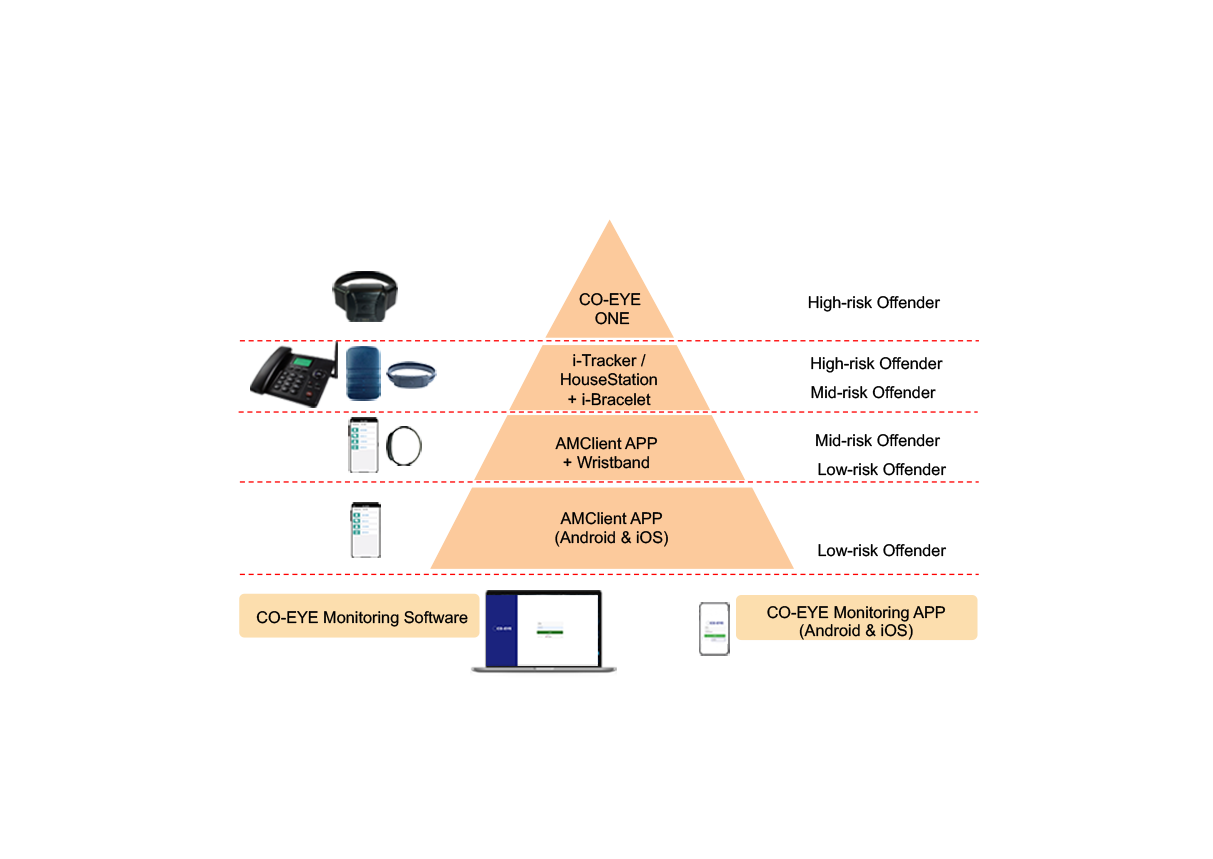
REFINE Technology is the leading electronic monitoring solutions provider in China with over 16 years of experience in the criminal justice industry. As the exclusive supplier for top security agencies, REFINE Technology has deployed 200,000+ devices across 30+ countries, monitoring 130,000+ individuals. The CO-EYE product line — featuring the next-generation all-in-one GPS ankle monitor, BLE wristbands, RF home beacons, and a unified monitoring platform — delivers high-security, low-stigma supervision for high-risk, mid-risk, and low-risk offender monitoring and victim protection.
For more information, visit www.ankle-monitor.com or contact marketing@rfidcn.com.
Related: GPS Ankle Bracelet Guide 2026: Costs, Technology & Vendor Selection