
Why Parole Tracking Software Platform Scale Matters
County probation programs may supervise a few hundred offenders. State parole programs routinely manage 5,000-25,000 monitored individuals across dozens of district offices. Parole monitoring cloud platforms that work for county deployment often fail under state-level load. Parole tracking software platforms must handle thousands of concurrent device connections, hundreds of officer sessions, and cross-jurisdictional coordination when parolees relocate between districts.
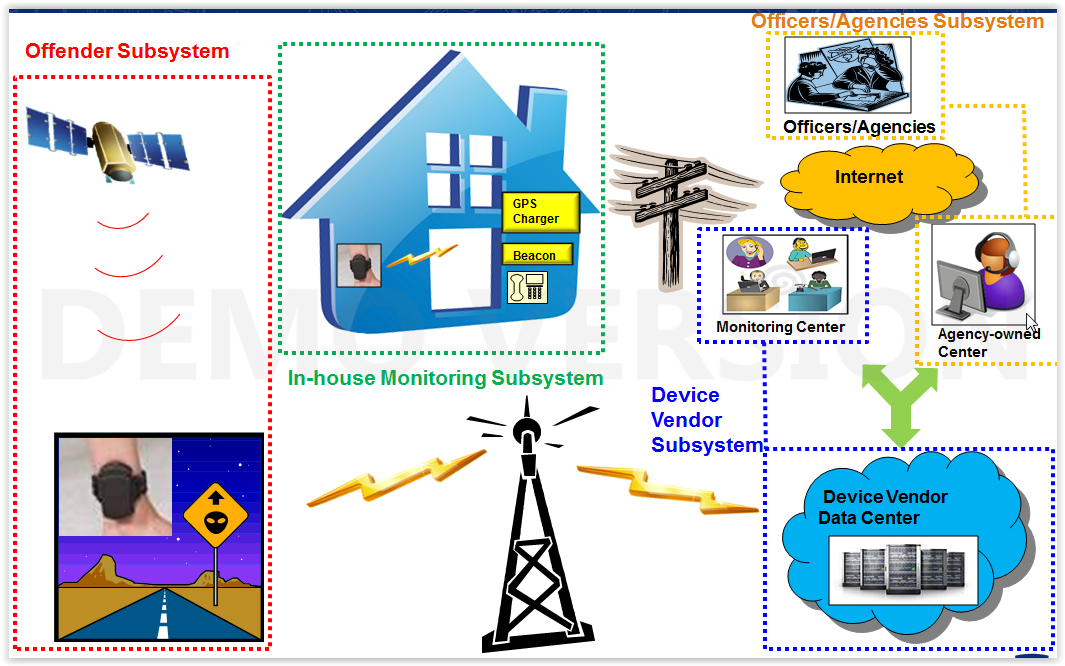
This article covers state-level scalability requirements, CJIS compliance, API integrations with offender management systems and parole boards, and data residency concerns for parole monitoring program software.
State-Level Scalability Requirements
Parole monitoring command center software evaluated for state deployment should demonstrate:
| Requirement | Minimum Specification | Rationale |
|---|---|---|
| Concurrent monitored offenders | 10,000+ | State parole populations exceed 800,000; 15-20% on EM |
| Concurrent officer sessions | 500+ | Multiple offices, shifts, remote access |
| Alert processing throughput | 10,000+ alerts/hour | Peak hours (curfew, shift changes) generate spikes |
| Cross-district offender transfer | Supported | Parolees relocate; case handoff must be seamless |
| Multi-protocol support | Per-district configurable | Different offices may use different supervision protocols |
Parole supervision analytics systems should provide agency-level dashboards (state director view) alongside district and officer-level views. Role-based access ensures officers see only their caseload while supervisors see their team, and administrators see program-wide metrics.
CJIS Compliance for Parole Monitoring Platforms
Parole monitoring software platforms process criminal justice information. The FBI Criminal Justice Information Services (CJIS) Security Policy mandates specific controls for systems that store, process, or transmit CJIS data. Parole monitoring cloud platforms must demonstrate:
- CJIS Security Policy compliance — Access control, identification and authentication, configuration management, incident response, auditing
- SOC 2 Type II certification — Independent audit of cloud infrastructure security controls
- Encryption in transit and at rest — FIPS 140-2 validated cryptographic modules where applicable
- Background checks for personnel — Vendor staff with access to production data must meet CJIS personnel security requirements
Procurement documents should require CJIS compliance attestation. Vendors that cannot provide it are not suitable for parole monitoring program software deployment.
API Integrations with OMS and Parole Boards
Parole monitoring data does not exist in isolation. Parole tracking software platforms must integrate with:
- Offender Management System (OMS): Bi-directional sync for offender demographics, conditions, case notes, and enrollment status. Officers should not re-enter data that already exists in the OMS.
- Parole board information system: Automated violation reporting for board review. When a parolee accumulates violations, the monitoring platform should generate formatted reports for parole revocation hearings.
- Court case management: Compliance reports formatted for submission to courts and revocation proceedings.
- Law enforcement databases: Real-time location sharing with authorized law enforcement during active investigations — with strict access controls and audit logging.
Evaluate parole monitoring command center software for REST or SOAP API availability, supported integration patterns (batch sync vs. real-time), and documented data schemas. Vendors that offer only manual export/import create ongoing operational friction.
Data Residency and Sovereignty Concerns
State and federal requirements increasingly specify where criminal justice data may reside. Parole monitoring cloud platforms should:
- Host production data within the United States — No offshore data processing or storage for CJIS data
- Document data center locations — Provide physical and logical location of all infrastructure handling parole monitoring data
- Support state-specific requirements — Some states require in-state data residency; evaluate whether the vendor can accommodate
- Define data retention and deletion — Clear policies for how long data is retained and procedures for secure deletion upon request or contract termination
When evaluating parole monitoring software vendors, request a data flow diagram showing where data resides at rest and in transit. Document any subcontractors or cloud providers with data access and confirm their CJIS compliance.
Parole Supervision Analytics Systems
Beyond real-time monitoring, parole monitoring program software should support:
- Program effectiveness metrics: Completion rates, violation rates, recidivism during monitoring, cost per supervised day
- Operational metrics: False alert rate per device, average response time to critical alerts, device uptime percentage
- Comparative analytics: Compliance trends by district, by risk level, by supervision protocol
- Export for external analysis: Data export in standard formats for research, grant reporting, or legislative oversight
Parole monitoring command center software that locks analytics into proprietary dashboards without export capability limits program evaluation and external accountability.
What Makes Parole Electronic Monitoring Software Requirements Different from Probation?
Parole monitoring software must handle higher-risk populations with stricter supervision requirements, including mandatory exclusion zones around schools and victim residences, sex offender registry compliance tracking, interstate compact data sharing, and real-time integration with law enforcement notification systems for absconder response.
While probation and parole both use GPS ankle bracelet technology, the software requirements diverge significantly due to the population risk profile. Parolees have been convicted and incarcerated — they represent a statistically higher reoffense risk than probationers, and their supervision conditions typically include more restrictive geographic limitations and more frequent officer contact requirements.
Parole-specific software capabilities include:
- Dynamic exclusion zone management: Parole conditions often include exclusion zones that change — a domestic violence victim may relocate, school zones shift with redistricting, or new businesses open in restricted areas. The monitoring platform must support geofence modifications that take effect immediately across all affected ankle monitor devices without requiring physical device access.
- Interstate compact compliance: Parolees who receive approval to transfer supervision between states require seamless data transfer between parole authorities. The Interstate Compact Offender Tracking System (ICOTS) integration ensures that GPS monitoring data follows the parolee across jurisdictional boundaries.
- Absconder response integration: When a parolee removes or disables their GPS ankle monitor and fails to report, the monitoring software must immediately notify law enforcement dispatch systems, generate last-known-location reports, and activate enhanced surveillance protocols — ideally within minutes of the confirmed tamper or no-communication event.
How Do State Parole Boards Evaluate Electronic Monitoring Platforms?
State parole boards evaluate electronic monitoring platforms through multi-phase procurements that include technical demonstrations, reference checks with existing deployments, pilot programs with live enrollees, and security audits — a process that typically spans 6-12 months from RFP issuance to contract award.
The evaluation criteria for state-level parole GPS ankle monitor platform procurement typically include CJIS compliance certification, demonstrated uptime exceeding 99.9% over 12 months, scalability to handle the state’s full parolee caseload, data sovereignty requirements (on-premise or U.S.-hosted only), and evidence of successful deployments in agencies with comparable population sizes.
Agencies evaluating electronic monitoring vendors for parole programs should request detailed incident response plans documenting how the vendor handles device failures, server outages, and data breaches. The monitoring platform’s reliability directly affects public safety — a system outage that delays tamper alerts by even 30 minutes can have serious consequences for high-risk parolee supervision.
Related Resources
For a full overview of parole electronic monitoring technology, hardware selection, dashboards, and vendor evaluation, see the Parole Electronic Monitoring Guide. Additional resources:
- CO-EYE Software — Web-based parole monitoring platform with scalable architecture
- Parole Electronic Monitoring Technology Guide — Device selection and supervision best practices