Community supervision is undergoing an electronic ankle monitor technology shift: smartphones are now credible platforms for electronic monitoring workflows that once depended entirely on dedicated hardware. Yet the same devices that improve engagement and reduce stigma also introduce circumvention and evidentiary questions—especially when agencies compare an ankle monitor app program with a purpose-built GPS ankle bracelet. This guide translates policy into procurement language: what smartphone monitoring can prove, what it cannot, and how tethered versus periodic models change risk for community supervision and probation GPS programs.
Scale explains the pressure to innovate. Roughly 69% of the correctional population is under community supervision, while historical analyses have long noted that only about 12% of corrections spending flows to probation and parole—figures commonly cited from Bureau of Justice Statistics (BJS, 2018) population framing and Pew Charitable Trusts (2009) spending analysis. Smartphone penetration matters for program design: 81% of U.S. adults owned a smartphone according to Pew Research Center (2019), making bring-your-own-device (BYOD) supervision technically feasible at national scale.
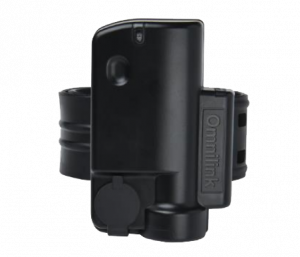
For product context, see the CO-EYE ONE GPS ankle monitor, the CO-EYE AMClient supervision app, the CO-EYE BLE wristband (i-Bracelet) tether option, our GPS ankle monitor guide, and what is an ankle monitor — a baseline explainer for stakeholders new to hardware programs. For commercial scoping, use Contact Sales or Request Quote on ankle-monitor.com.
How Smartphone Monitoring Apps Work
The American Probation and Parole Association (APPA) white paper Leveraging the Power of Smartphone Applications to Enhance Community Supervision (2020) frames smartphone tools as complements to professional judgment when consent, policy, and verification models are explicit. Programs typically choose between two hardware ownership models:
| Model | How it works | Pros | Cons |
|---|---|---|---|
| BYOD (bring your own device) | The participant installs a supervision app on a personally owned phone; agencies may reimburse data or mandate minimum OS levels. | Lower capex, faster enrollment, leverages devices people already carry, can feel less stigmatizing than visible hardware. | Harder to standardize sensors, greater OS fragmentation, privacy boundaries require clear policy, easier to leave the phone at home. |
| Corporate-owned | The agency issues a locked-down handset with mobile device management (MDM), controlled app inventory, and uniform security baselines. | Predictable configuration, stronger remote wipe and policy enforcement, simpler chain-of-custody narratives for audits. | Higher per-seat cost, logistics for damage and swaps, participants may still perceive the phone as a supervision device. |
Three identity and proximity verification methods
APPA stresses that architectures differ materially in assurance. Most implementations map to:
- Periodic confirmation — biometric or knowledge-based check-ins (face match, voice, PIN) on a cadence. Suitable for lower-risk caseloads where the goal is accountability nudges and documentation rather than continuous proof of presence.
- Continuous confirmation — a BLE tether (Bluetooth Low Energy) between a wearable tag and the smartphone, analogous to two-piece GPS ankle monitor designs where the phone becomes the cellular hub. Separation events can be generated quickly when the tag and phone diverge.
- Hybrid — tether plus scheduled biometric verification, combining proximity integrity with periodic identity proof.
APPA notes that solutions that periodically confirm client identity or proximity to the smartphone are generally not as comparable to traditional tracking systems—a line procurement teams should paste into court-facing technology memos when judges ask whether an ankle monitor app is interchangeable with strap-based electronic monitoring.
Location monitoring: continuous tracking vs periodic sampling
Supervision apps differ in how often location fixes are taken and whether background collection is continuous. Continuous tracking attempts to stream GNSS/Wi-Fi/cell-derived positions on a policy interval (subject to OS battery optimizations and user permissions). Periodic sampling captures location only at check-in events or when the app is foregrounded—useful for accountability and services, but weaker for geofence narratives that assume uninterrupted integrity.
Agencies should document which model each risk tier uses, because revocation hearings often turn on whether a gap was a dead zone, a power-saving feature, or an attempted workaround. For probation GPS officers, the practical difference is workload: continuous models generate more events to triage but tell a simpler story in court; periodic models reduce noise but require explicit order language so judges understand what “presence” means in technical terms.
Key Features of Modern Monitoring Apps
Leading supervision stacks typically bundle several capability layers:
- Location tracking — fused positioning using GNSS, Wi-Fi fingerprints, and cellular location when the OS permits background collection.
- Remote reporting and virtual check-ins — officer dashboards, acknowledgment logs, and escalation queues integrated with the agency electronic monitoring platform.
- Calendar and appointment reminders — court-date and treatment prompts tied to acknowledgments. The National Center for State Courts (NCSC) reported reminder-oriented pretrial practices associated with roughly 30% reductions in failure-to-appear (FTA) rates in studied implementations (2018).
- Positive reinforcement and gamification — Spohr, Taxman, and Walters (2015) highlight how structured prompts and reinforcement can support treatment attendance and compliance behaviors when paired with community supervision services.
- Remote alcohol testing — scheduled or random breath tests with camera verification, subject to vendor validation and local evidentiary rules.
- Resource connection — modules linking participants to cognitive-behavioral tools, employment supports, and treatment access.
Feature breadth does not equal security depth. A polished ankle monitor app on a non-tethered BYOD phone may still be inappropriate for high-stakes exclusion zones where orders assume continuous track integrity.
Operational practices that make apps succeed
Deployments that perform best pair software with officer playbooks: randomized acknowledgment windows during work hours, standardized escalation when location quality degrades, and written rules for subway tunnels, hospitals, and other GNSS-hostile venues so community supervision staff classify gaps consistently. Training should also cover participant barriers—charger access, night-shift employment, shared housing—that otherwise look like noncompliance in raw event feeds.
Smartphone Apps vs GPS Ankle Monitors: Head-to-Head Comparison
Use this matrix when stakeholders ask whether smartphone software can replace dedicated hardware one-to-one.
| Feature | Smartphone App (Tethered) | Smartphone App (Untethered) | GPS Ankle Monitor |
|---|---|---|---|
| Stigma / visibility | Phone plus small wearable; often less visible than a one-piece ankle unit. | Lowest hardware visibility if no band—stigma shifts to app UX and policy. | Most visible; some courts prefer strap-grade signaling for deterrence and victim notification optics. |
| Positive reinforcement / UX | Strong—native reminders, micro-goals, and services links on the handset. | Strong—same UX without proximity tether discipline. | Growing via companion workflows; hardware-first industrial design. |
| Location accuracy | Depends on phone GNSS/Wi-Fi/cell fusion and whether background GPS is uninterrupted. | Often weaker for continuous geofence proof—gaps from battery savers and user behavior. | Purpose-built multi-constellation GNSS modules and supervision-tuned reporting (e.g., CO-EYE ONE <2 m CEP-class GPS). |
| Tamper detection | Wearable strap tamper adds hardware-grade events when paired with justice-grade bands. | Mostly app/MDM signals; limited strap integrity story. | Strap and case architectures built for evidentiary programs (e.g., CO-EYE ONE fiber-optic tamper with zero false-positive detection). |
| Battery / operations | Daily phone charging; wearable may use long-life coin cells (e.g., BLE band ~2-year battery). | User-managed; high continuous GPS use drains phones quickly. | Dedicated power budget—CO-EYE ONE delivers about seven days standalone on typical LTE-M/NB reporting plans. |
| Cost posture | Middle ground—licenses, tether hardware, optional MDM. | Lower hardware capex; help-desk and replacement costs still matter. | Higher device TCO; justified when integrity requirements dominate. |
| Security / circumvention | Lower than untethered if tether is enforced; still exposed to phone-centric attacks. | Higher—phone left behind, spoofing tools, airplane mode, SIM removal (see next section). | Lowest for dedicated cellular ankle units with robust tamper telemetry and controlled firmware. |
Bottom line: tethered smartphone approaches can approach dedicated GPS ankle monitor programs when a justice-grade wearable enforces proximity. Untethered ankle monitor app models—no matter how polished—do not provide the same continuous integrity chain unless orders explicitly accept periodic sampling.
The Hybrid Solution: Best of Both Worlds
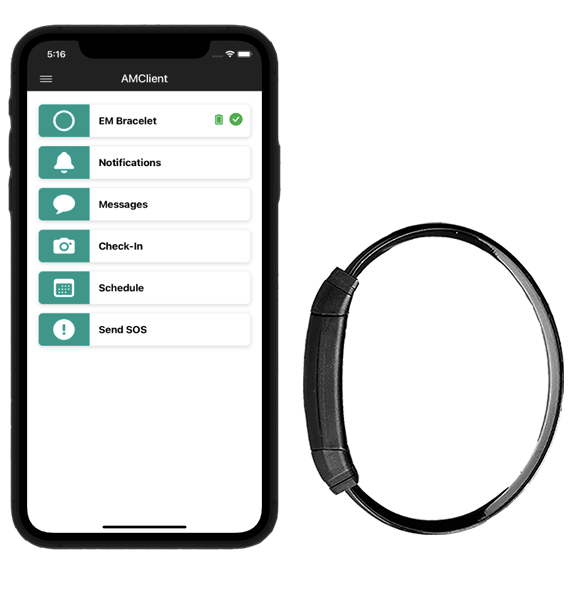
Risk is not binary, and neither should your technology stack be. Agencies increasingly blend modalities so budgets align with supervision objectives while preserving a step-down pathway as compliance stabilizes.
- High risk — CO-EYE ONE one-piece GPS ankle monitor: 108 g, multi-constellation GNSS with <2 m GPS accuracy (CEP), about seven-day battery in typical standalone LTE-M/NB reporting, fiber-optic strap and case tamper with zero false-positive tamper detection, IP68, and <3 second tool-free installation.
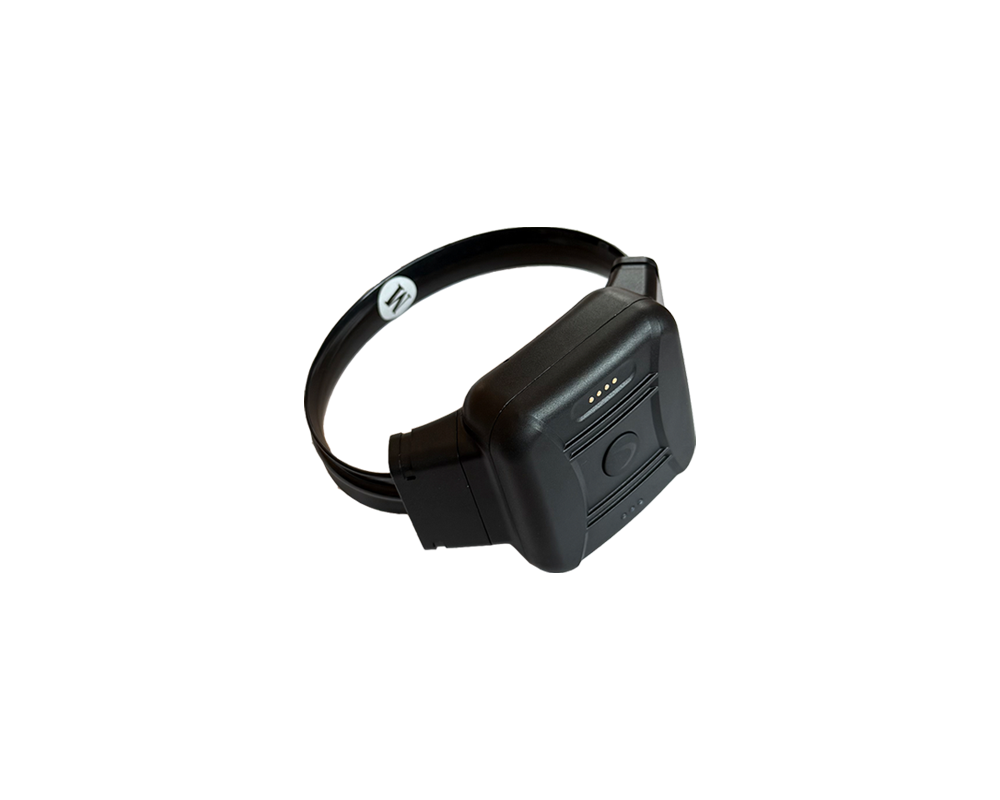
- Medium risk — CO-EYE AMClient + CO-EYE BLE wristband (i-Bracelet): iOS/Android continuous tracking with SOS, check-ins, and BLE tether support; wearable at 17 g with approximately two-year battery life for tethered proximity logic.
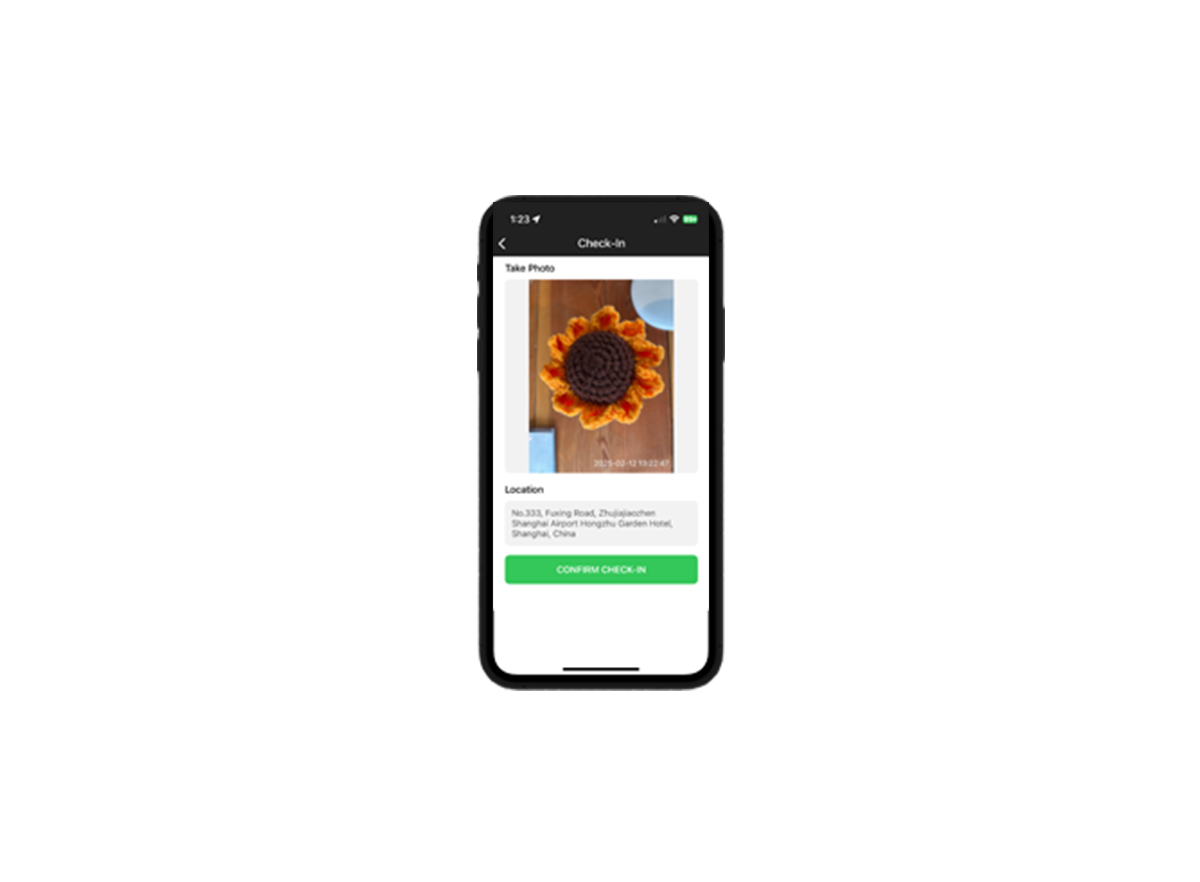
- Low risk — CO-EYE AMClient only: periodic biometric check-ins and location sampling when orders permit non-continuous assurance—ideal for graduated community supervision tracks with explicit integrity rules.
- Step-down pathway — begin on CO-EYE ONE when courts demand maximum integrity; migrate to AMClient plus BLE wristband for employment- or treatment-heavy caseloads; finish on AMClient-only smartphone monitoring when risk and order language allow.
Explore hardware on CO-EYE ONE, app workflows on AMClient, and tether hardware on CO-EYE wristband. For foundational context, pair this article with our GPS ankle monitor guide and what is an ankle monitor explainer.
Security Considerations
BYOD smartphone programs inherit consumer-device threat models. GPS spoofing apps and external radios can fabricate plausible tracks on poorly defended handsets; forensic policies should define how supervisors respond to impossible-speed jumps or inconsistent sensor bundles. Airplane mode, disabled location services, aggressive OEM battery savers, and SIM removal can create reporting gaps that look identical to dead zones—your electronic monitoring SOP should classify technical gaps versus willful interference.
Corporate-owned fleets reduce—but do not eliminate—those variables: MDM can block sideloading, enforce OS versions, and standardize encryption, improving chain-of-custody narratives for audits. Either model must address data privacy: consent language, retention limits, subprocessors, and whether health-adjacent services trigger HIPAA-style safeguards when apps coordinate with treatment providers. When substance-use telehealth or lab results sync into supervision dashboards, sign a business associate workflow only if PHI is actually stored or transmitted—otherwise architect integrations so clinical data stays in the provider’s certified environment and the electronic monitoring platform receives status flags instead of detailed records.
Incident response should be rehearsed: lost phones, suspected spoofing, and account takeovers need 24-hour paths that do not assume participants can walk into an office the next morning. Corporate-owned devices simplify remote wipe; BYOD programs need contractual clarity on whether officers can require factory resets and how evidence is preserved before a reset occurs.
Choosing the Right Solution for Your Agency
Use a decision framework tied to risk, budget, and evidentiary expectations:
- Risk tier — statutory exposure and victim-safety triggers favor CO-EYE ONE–class hardware; medium risk favors tethered ankle monitor app models; low risk may tolerate periodic confirmation only when orders explicitly permit it.
- Budget and staffing — BYOD lowers device spend but increases help-desk load; corporate-owned standardizes support at higher capex.
- Supervision objectives — FTA reduction and services linkage favor rich smartphone UX; continuous geofence enforcement favors dedicated GPS ankle monitor integrity.
- Evidence expectations — consult prosecutors on metadata needed for revocation hearings; gap analysis usually decides tether versus untether.
When requirements span multiple rows, hybrid deployments are normal: keep hardware on the highest-risk slice while moving long-tail participants to smartphone monitoring with explicit verification rules. Procurement teams should separate functional requirements (UI languages, geofence editors, exports) from assurance requirements (maximum gap length, tamper taxonomies, whether periodic biometrics are acceptable per tier).
Vendor evaluation checkpoints
Ask vendors to document how their ankle monitor app behaves under iOS Focus modes, Android battery optimization, and offline periods. Request sample exports that match your case management schema and confirm whether location uncertainty (horizontal accuracy estimates) is stored—prosecutors increasingly ask. For blended fleets, verify that CO-EYE ONE hardware events and AMClient smartphone events reconcile into a single officer timeline so supervisors are not toggling siloed dashboards during critical incidents.
Finally, pilot metrics should extend beyond technical uptime: measure FTA changes after reminder modules go live, average minutes spent per case on location review, and participant-reported usability. Those numbers justify continued investment in smartphone monitoring where appropriate—and protect budget for strap-grade GPS ankle monitor capacity where court orders still demand it.
Frequently Asked Questions
Is an ankle monitor app the same as a GPS ankle monitor? Not necessarily. An ankle monitor app is smartphone software for supervision. A GPS ankle monitor is dedicated hardware with integrated GNSS, cellular backhaul, and strap tamper. Only tethered smartphone models approach hardware-grade continuity.
Does BYOD save money for agencies? Often on acquisition, but model MDM licenses, spare phones, help-desk time, and replacement rules when devices break.
What did APPA conclude about periodic check-ins? APPA cautions that periodic identity or proximity confirmation is generally not as comparable to traditional tracking systems—a key distinction for court orders.
Can smartphone monitoring satisfy GPS exclusion zones? Sometimes, if background location is continuous, policies address battery-saving workarounds, and prosecutors accept the integrity model. High-stakes victim-safety geofences often still warrant dedicated ankle hardware.
How do agencies purchase CO-EYE AMClient or CO-EYE ONE? Use Contact Sales or Request Quote on ankle-monitor.com for commercial pricing, integration timelines, and training—no trial-device promises; we scope production deployments with agency IT and legal stakeholders.