

When an agency evaluates electronic monitoring equipment, one question rarely appears on the RFP checklist — yet it determines whether the entire program succeeds or fails: should the device be worn on the wrist or the ankle?
The answer is not a matter of preference. It is dictated by anatomy, physics, and the risk profile of the person being monitored. This guide explains the biomechanical and operational reasons why ankle placement provides secure containment while wrist placement provides compliance facilitation — and why confusing the two categories leads to program failure.
The Risk Segmentation Framework Every Agency Needs
The electronic monitoring industry has organically developed a risk-based segmentation model. BI Incorporated — the largest EM manufacturer in the United States and a subsidiary of GEO Group — demonstrates this clearly through its own product line:
| Risk Level | BI Product | Placement | Security Model | Use Case |
|---|---|---|---|---|
| High Risk | LOC8 XT | Ankle | Physical containment — tamper-resistant strap + conductive loop | Probation, parole, DV, sex offender registry |
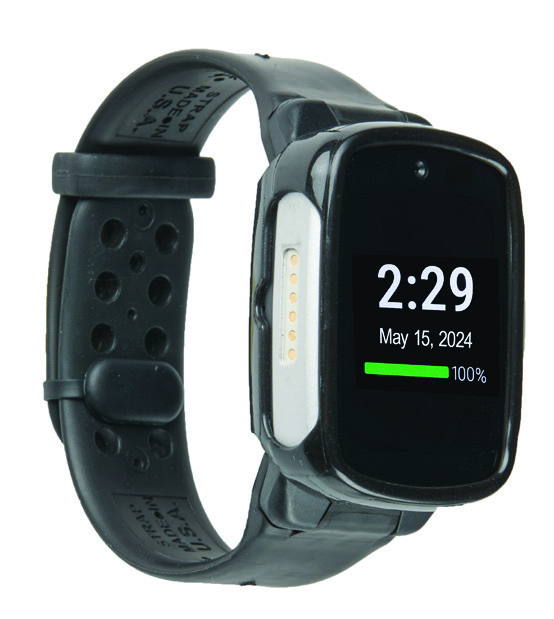
| Medium Risk | VeriWatch | Wrist | Biometric compliance — facial recognition + proximity sensor | Low-risk offenders, immigration compliance |
| Low Risk | SmartBAND + SmartLINK | Wrist + Phone | App-based check-in — BLE tether to smartphone | Administrative monitoring, scheduled check-ins |
| Minimal Risk | SmartLINK App | Phone only | Self-reporting — GPS + facial recognition via phone | Court date reminders, compliance tracking |
This segmentation is not arbitrary. BI chose ankle placement for high-risk individuals and wrist placement for low-risk individuals because the anatomy of each body part dictates the security ceiling of any device attached to it.
Why the Ankle Is Secure: The Calcaneus Lock
The human ankle has a unique anatomical feature that makes it ideal for secure monitoring: the calcaneus (heel bone) protrudes 4.5–5.0 cm posteriorly from the ankle joint, creating a natural mechanical lock. Any band placed above this protrusion cannot slide downward over the foot without being cut.

This is why every credible high-security EM program worldwide uses ankle placement. The security is anatomical — it does not depend on the wearer’s cooperation, the device’s battery level, or a software algorithm.
Why the Wrist Is Not Secure: The Hand Compression Problem
The wrist has no equivalent bone lock. According to U.S. military anthropometric data (Garrett, 1971), the average adult male wrist circumference is 16.5–17.5 cm while hand breadth at the metacarpals is 8.5–9.5 cm. By folding the thumb inward and compressing the palm — the same technique used to slip poorly fitted handcuffs — the effective cross-section of the hand approaches wrist diameter.

Any monitoring band fitted loosely enough for comfortable long-term wear (months to years) can be removed using this technique. Tightening the band to prevent removal causes pressure injuries, nerve compression, and skin breakdown within days — making it medically unsustainable.
This is the fundamental paradox of wrist-worn monitoring: comfortable enough to wear long-term = loose enough to remove.
BI VeriWatch: The Industry’s Own Proof of Concept
BI’s VeriWatch is the most instructive case study in this segmentation debate — not because it is a bad product, but because BI itself explicitly limits its use to low-risk populations.
Key facts from BI’s own documentation and public deployments:
- BI’s positioning: “GPS Technology that Clients Can Wear with Confidence” — note the word is confidence, not security
- Target users: “lower-risk adult populations and the juvenile justice system” (BI.com)
- ICE deployment: Used in the Alternatives to Detention (ATD) program for immigration compliance — not for criminal containment
- Scale: ~3,000 VeriWatch units active vs. 155,000+ on SmartLINK app vs. ~5,000 on GPS ankle monitors (TRAC data)
- Battery: 16 hours per charge (32 with clip-on battery) — requires daily charging, same operational burden as legacy ankle GPS
- Removable version exists: Half of ICE’s VeriWatch users wear a version that can be removed for charging — BI would never offer this option for high-risk offenders
Warren County, Ohio judge Robert Peeler, who piloted VeriWatch for low-threat offenders, compared traditional ankle monitors to “a scarlet letter” and noted the $5/day operating cost versus $93/day for incarceration. His framing is telling: the purpose was to reduce stigma for people who posed minimal flight risk, not to secure dangerous individuals.
What “Tamper Detection” Actually Means on Each Device Type
| Feature | Ankle GPS (e.g. CO-EYE ONE) | Wrist GPS (e.g. VeriWatch) |
|---|---|---|
| Removal prevention | Physical — calcaneus bone lock + fiber-optic strap integrity | None — hand anatomy allows slippage |
| Tamper detection method | Fiber optic: binary signal (light passes or doesn’t) = zero false alarms | Proximity sensor + biometric check-in = depends on wearer cooperation |
| Response to removal | Instant, irreversible tamper alert — no check-in needed | Prompts a check-in request; wearer must respond with face photo |
| If wearer ignores alert | Alert already sent — wearer cannot prevent notification | Officer gets a “missed check-in” alert — wearer had time to flee |
| Battery depleted security | CO-EYE: 3-month tamper protection after battery death | Device goes dark — no tamper detection |
The difference is architectural, not incremental. Ankle-based tamper detection operates at the physical layer — independent of batteries, software, and cooperation. Wrist-based tamper detection operates at the application layer — it requires power, connectivity, and a cooperative wearer to function.
The Procurement Decision Matrix
For agencies evaluating monitoring equipment, the selection should follow the risk profile of the supervised population:
| Population | Risk Level | Required Security | Correct Device Type |
|---|---|---|---|
| DV protection orders, sex offender registry | Critical | Physical containment + victim alerting | Ankle GPS with fiber-optic tamper detection |
| Probation, parole, house arrest | High | Continuous tracking + removal prevention | Ankle GPS with multi-mode connectivity |
| Pretrial release (non-violent) | Medium | Location tracking + identity verification | Ankle GPS or wrist GPS (case-by-case) |
| Immigration compliance, low-risk juvenile | Low | Compliance facilitation + check-in | Wrist device or smartphone app |
| Administrative monitoring, court reminders | Minimal | Scheduled reporting only | Smartphone app (e.g. CO-EYE AMClient) |
Agencies that deploy wrist-worn devices on high-risk populations are not saving money — they are creating liability. When a domestic violence offender removes a wrist band and approaches a protected victim, the agency that chose wrist over ankle placement faces both legal exposure and public accountability.
What to Look for in a Secure Ankle GPS Monitor
For agencies that manage medium-to-critical risk populations, the ankle GPS monitor must meet specific technical standards. The GPS ankle bracelet market offers significant variation in capability:
- Anti-tamper technology: Fiber-optic detection (zero false alarms) vs. conductive loop (5–15% false alarm rate) vs. PPG/heart rate (15–30% false alarms)
- Battery endurance: Next-generation devices like the CO-EYE ONE offer 7 days on LTE standalone, 3 weeks on WiFi-directed mode, and up to 6 months in BLE-connected mode — eliminating the daily-charging burden that plagues both ankle and wrist legacy devices
- Weight and comfort: CO-EYE ONE at 108g is the lightest one-piece GPS ankle monitor available, reducing compliance issues associated with heavier devices (150–250g typical for competitors)
- Dead-zone coverage: WiFi-directed mode eliminates cellular blind spots with a $10 WiFi repeater — a problem that affects both ankle and wrist devices relying solely on LTE
- Post-depletion security: CO-EYE ONE maintains tamper detection for 3+ months after battery depletion — no wrist device offers this capability
For a comprehensive evaluation framework, see the GPS ankle monitor buyer’s guide and the full GPS ankle monitor technology guide.
Frequently Asked Questions
Can a wrist-worn monitor replace an ankle monitor for probation?
No, for most probation cases. Wrist monitors are designed for compliance facilitation, not secure containment. The human hand’s compressible anatomy allows removal of any comfort-fit wrist band. BI Incorporated, the largest U.S. EM manufacturer, explicitly markets its wrist device (VeriWatch) for “lower-risk adult populations” and uses its ankle device (LOC8 XT) for criminal supervision.
Why does BI VeriWatch use biometric authentication instead of physical tamper prevention?
Because physical tamper prevention is anatomically impossible on the wrist. BI compensates with proximity sensors and facial recognition check-ins, but these require wearer cooperation. If a wearer removes the device and ignores the check-in prompt, the system produces a delayed alert — not an instantaneous tamper alarm.
What risk level is appropriate for wrist-worn monitoring?
Wrist-worn devices are appropriate for individuals who have strong incentives to comply voluntarily — such as immigration applicants awaiting court dates (99% compliance rate per CBS News), low-risk juveniles, or individuals on minimal administrative supervision. Any individual with motivation to evade supervision requires ankle placement.
Is a wrist monitor cheaper than an ankle monitor?
The per-device cost difference is marginal. BI VeriWatch operates at roughly $5–8/day compared to $5–15/day for ankle GPS. However, the total cost of a security failure — fugitive search, victim harm, legal liability, program credibility loss — far exceeds any per-diem savings from choosing a less secure device for an inappropriate risk level.
What happens if a wrist monitor battery dies?
The device goes dark with no tamper protection. VeriWatch has a 16-hour battery (32 with clip-on transfer battery), requiring daily charging. By contrast, advanced ankle monitors like CO-EYE ONE maintain tamper detection for 3+ months after battery depletion, and offer 7-day to 6-month battery life depending on connectivity mode.