

On June 10, 2026, South Korea’s National Police Agency and Ministry of Justice announced a ₩4.203 billion ($3 million) project to merge their electronic monitoring systems into a single, real-time integrated platform — scheduled for completion by December 2026. The announcement came three months after a 44-year-old man wearing a GPS ankle monitor murdered his 27-year-old ex-girlfriend on a street in Namyangju despite multiple restraining orders, a police-issued smartwatch for the victim, and active electronic monitoring by the Justice Ministry.
The Namyangju case exposed a fundamental architectural flaw: two government agencies operating parallel monitoring systems with no real-time data bridge between them. The Justice Ministry tracked the offender’s location. The police protected the victim. But when the offender breached the restraining order and approached the victim, the alert traveled between agencies via SMS text message — a manual, sequential process that introduced fatal delays at every step.
This isn’t just a Korean problem. It’s a systemic vulnerability present in virtually every country that operates electronic monitoring for stalking, domestic violence, or sex offenses. The question isn’t whether other countries have the same gap — they do. The question is what South Korea’s $3 million fix actually looks like, whether it will work, and what the global EM industry should learn from it.
What Happened in Namyangju — and Why the System Failed
Kim Hoon, 44, had two prior prison sentences for sexual offenses — rape in 2009 and again in 2013. After his release, he was fitted with a GPS ankle monitor under a court order and placed under probation officer supervision with nighttime movement restrictions and travel bans. He began dating a woman in her 20s, identified as Ms. B, and when the relationship ended, he escalated to stalking.
Ms. B filed multiple police reports. The police secured restraining orders prohibiting Kim from approaching her. They issued her a smartwatch connected to the 112 emergency dispatch system, capable of locating her within 50 meters with 94% accuracy. On paper, the protective framework was comprehensive: the offender was electronically monitored, the victim had a panic device, and multiple legal orders barred contact.
On the morning of March 14, 2026, Kim drove to Ms. B’s location in Onam-eup, Namyangju, broke the windows of the car she was riding in, and stabbed her multiple times. She was found in cardiac arrest and died at the hospital. Kim then destroyed his ankle monitor and fled, captured by police in Yangpyeong County about an hour later.

The Three Points of Failure
Post-incident investigations by the National Police Agency, the Gyeonggi Bukbu Provincial Police, and President Lee Jae-myung’s direct inspection identified three specific systemic breakdowns:
1. No information sharing between police and probation officers. The police who handled Ms. B’s stalking reports never notified the probation officer supervising Kim’s ankle monitor. The probation officer — responsible for monitoring Kim’s movements hourly — didn’t know about the restraining orders, the stalking history, or the elevated risk. As the Kyunghyang Shinmun reported: “The probation officer did not track his movements because the police-side stalking case was never communicated to probation.”
2. Police failed to apply Provisional Measure 3-2. Since January 2024, Korean law has allowed courts to order GPS ankle monitor attachment specifically for stalking offenders as a provisional measure (잠정조치 3호의 2). Kim already wore an ankle monitor for sex offenses — activating the stalking-specific proximity alert function would have required only adding the victim’s location to the monitoring parameters. The Gyeonggi Bukbu police station applied for this measure in only 0.9% of stalking cases in 2024 (8 out of 886 arrests) and 1.8% in 2025 (22 out of 1,206 arrests).
3. Alert transmission via SMS text message. When the Justice Ministry’s Location Tracking Control Center detected an approach violation or device tampering, the notification was sent to police as an MMS text message. The police 112 situation room then had to: receive the text → manually verify the location data → determine the jurisdictional police station → issue a dispatch order. Each step introduced minutes of delay. Once officers arrived at the scene, they had no way to see the offender’s real-time location on their devices — they were responding blind.
What the ₩4.2 Billion Integration Actually Builds
The system now under construction addresses the third failure point directly — and partially addresses the first two through its architectural design. The National Police Agency is investing ₩3.309 billion and the Ministry of Justice ₩894 million, with completion targeted for December 2026.
The technical specification involves three core changes:
Automated alert routing. Risk alerts generated by the Justice Ministry’s Location Tracking Control Center — approach violations, device tampering, geofence breaches — will be automatically pushed to the police 112 dispatch system via API integration, bypassing the SMS notification entirely. When a stalking offender wearing an electronic device breaches a proximity zone, the 112 system will receive the alert and generate a dispatch order without human intervention at the situation room level.
Real-time location overlay for field officers. Dispatched police officers will be able to view the offender’s real-time movement route on a map through their field terminals. This is the single biggest operational improvement: officers currently arrive at a scene with only a static location from a text message and no ongoing tracking capability. Under the new system, they can watch the offender moving in real time and intercept accordingly.
Shared situational awareness. Both the Justice Ministry’s control center and the police 112 system will operate on a common situational picture — meaning both agencies see the same offender data, victim location, alert history, and response status simultaneously. This eliminates the information asymmetry that allowed Kim Hoon to fall through the gap between two agencies that each had partial information but couldn’t see the full picture.
South Korea’s EM Scale — The Numbers Behind the Integration
Understanding why this integration matters requires understanding the scale of South Korea’s electronic monitoring program, which has grown dramatically since its 2008 introduction:
- 4,827 individuals wore electronic ankle monitors in 2025 — a record high, up from 151 when the system launched in 2008 (a 32× increase over 17 years)
- Sexual violence offenders account for 2,576 (53%) of all monitored individuals
- Parolees: 985 | Murder: 541 | Electronic bail: 489
- Stalking provisional measures (Measure 3-2): 325 applications in 2024, 858 in 2025, 962 cumulative through April 2026 — court approval rate just 37.1%
- Annual violations: approximately 1,000 cases per year of movement restriction breaches and prohibited zone violations
- Probation officer caseload: 21.6 monitored individuals per officer (vs. the guideline of 10 per officer — a 2× overload)
- Recidivism rate under EM: approximately 2% for sex offenders (vs. 5% for general probationers without EM)
The key insight from this data: the system is already operating at double its designed capacity. With nearly 5,000 monitored individuals and an average of 1,000 violations per year, the manual SMS-based alert process was handling roughly 3 alerts per day that required inter-agency coordination. Every one of those alerts went through the same text-message-to-dispatch pipeline that failed in Namyangju.
Why This Matters Beyond South Korea — The Global Inter-Agency Gap
South Korea’s SMS-based alert system isn’t an outlier. It’s the norm. Most countries operating electronic monitoring for high-risk offenders face the same structural problem: the agency that monitors the device is not the agency that responds to emergencies.
In the United States, probation/parole departments or private monitoring companies operate the EM control centers, while local police departments handle field response. Alert transmission methods vary widely — from automated phone calls to email notifications to, in some jurisdictions, fax machines. A 2024 Government Accountability Office (GAO) review found that 44% of federal pretrial services officers reported difficulty contacting local law enforcement quickly enough when GPS violations occurred.
In the United Kingdom, the Ministry of Justice contracts with private monitoring companies (Serco, G4S/Allied Universal) to operate electronic tagging, while police forces handle enforcement. Alert protocols vary by police force area, with no national standard for response time to EM breach notifications.
In France, the Penitentiary Administration’s National Center for Electronic Surveillance (CNSEP) monitors ankle bracelets, while gendarmes and police handle field response — a jurisdictional split that mirrors Korea’s pre-integration architecture exactly.
The pattern is universal: monitoring agency ≠ response agency, and the communication channel between them is the weakest link in the entire system.
Before vs. After: South Korea’s EM Alert Architecture
❌ Before (SMS-Based)
1. EM device detects violation
2. Alert → Justice Ministry Control Center
3. Operator sends MMS text to police
4. Police 112 room receives text
5. Manual location verification
6. Jurisdiction determination
7. Dispatch order issued
8. Officers respond without real-time tracking
⏱ Estimated delay: 5–15 minutes
✅ After (API Integration)
1. EM device detects violation
2. Alert → Justice Ministry Control Center
3. Automatic API push to police 112
4. Auto-dispatch with GPS coordinates
5. Officers see real-time offender location
6. Continuous tracking on field terminals
⏱ Estimated delay: <30 seconds
What a Next-Generation Integrated System Should Actually Look Like
South Korea’s ₩4.2 billion investment addresses the communication channel between monitoring and response agencies. But the deeper question — which South Korea’s reform partially acknowledges but doesn’t fully solve — is whether the device architecture itself is designed for multi-agency interoperability from the ground up.
The current generation of GPS ankle monitors used globally, including in South Korea, operates on a fundamentally single-pipeline architecture: the device communicates exclusively via cellular (LTE/3G) to a single monitoring server operated by a single agency. When that agency needs to share data with another agency, it requires a separate integration layer — which is exactly what South Korea is now building at a cost of $3 million.
A genuinely next-generation approach would build multi-agency data sharing into the device architecture itself, rather than bolting it on afterward. The key technical capabilities required:
Multi-mode connectivity for resilient alert delivery. Devices that rely exclusively on cellular connectivity fail in exactly the environments where stalking incidents often occur — basements, parking garages, rural areas with poor coverage. A system designed for victim protection needs redundant communication paths: cellular (LTE-M/NB-IoT) as the primary channel, WiFi as a backup for indoor/dead-zone coverage, and BLE for proximity detection when the offender approaches a victim’s location.
Direct API integration with emergency dispatch. Rather than routing alerts through a centralized monitoring server and then re-transmitting to police, the monitoring platform should push alerts directly to 112/911 dispatch systems via standardized APIs — exactly what South Korea is building, but designed into the platform from day one rather than retrofitted.
Field-officer real-time tracking. Patrol officers need real-time offender location on their mobile devices, not a static coordinate from a text message. This requires a monitoring platform with WebSocket or push-notification capability that can stream location updates to authorized mobile endpoints in real time.
Victim-offender proximity alerting at the device level. The most advanced approach uses BLE (Bluetooth Low Energy) beacons on both the offender’s ankle monitor and the victim’s smartwatch or smartphone app to detect proximity independently of GPS or cellular — providing sub-second alert capability even when both parties are indoors with no GPS signal.
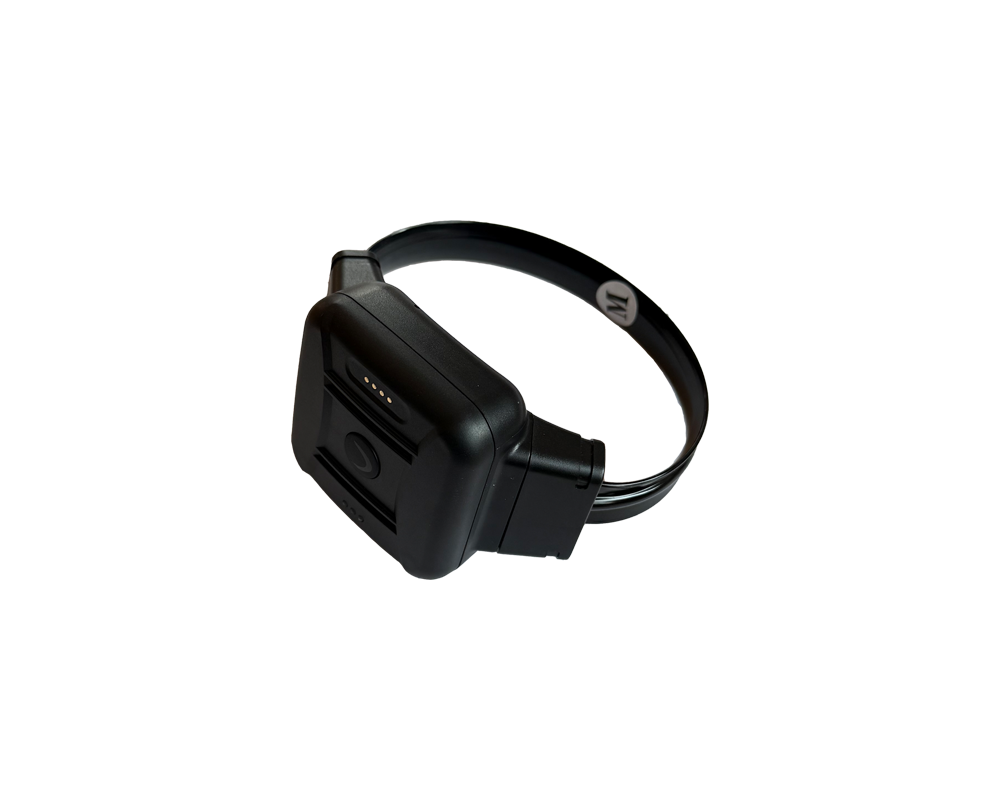
Devices like the CO-EYE ONE from REFINE Technology already incorporate this multi-mode architecture: BLE connectivity for proximity detection and companion device pairing, WiFi-directed mode for indoor/dead-zone coverage, and LTE-M for wide-area tracking — with automatic switching between modes based on environmental conditions. The monitoring platform provides REST API and WebSocket interfaces for third-party integration, enabling the kind of automated alert-to-dispatch pipeline that South Korea is spending $3 million to build as a separate system layer.
The architectural lesson from Namyangju is clear: when victim safety depends on milliseconds, the integration between monitoring and response cannot be an afterthought. It must be built into the hardware, the communication protocol, and the software platform from the initial design.
The Korean Inquiry — and What It Signals for Asian EM Markets
Three weeks before this article’s publication, our sales team received an inquiry from a South Korean government-affiliated organization exploring next-generation GPS ankle monitoring solutions. The timing — following the Namyangju incident and preceding the June 10 system integration announcement — suggests that Korean authorities are not just fixing the inter-agency communication gap but actively evaluating whether the underlying device technology needs upgrading.
South Korea’s current EM fleet was largely procured in the 2010s, when single-mode cellular GPS trackers were the only available technology. The new integrated system will expose the limitations of these legacy devices: officers viewing offender locations on field terminals will discover that indoor tracking is unreliable, that cellular dead zones create data gaps exactly when they matter most, and that alert latency from the device to the monitoring server adds seconds that compound the inter-agency delays the integration is designed to eliminate.
For EM vendors with multi-mode connectivity, victim-offender proximity detection, and open API platforms, South Korea’s $3 million integration project creates a natural follow-on procurement opportunity: once the system architecture demands real-time, multi-agency interoperability, the device hardware must deliver it.
Lessons for the Global EM Industry
South Korea’s post-Namyangju reform offers three specific lessons for any country operating electronic monitoring for stalking or domestic violence:
1. SMS/MMS alert transmission is a critical vulnerability. Any EM system that relies on text messages, emails, or phone calls to transmit alerts between monitoring and response agencies has the same failure mode that killed Ms. B in Namyangju. The fix is API-level integration between monitoring platforms and emergency dispatch systems — not faster texting.
2. Field officers need real-time location, not static coordinates. The value of GPS ankle monitoring is dramatically reduced when the officers who actually respond to incidents can only see where the offender was, not where the offender is. Real-time streaming of offender location to field terminals is not a luxury feature — it’s a minimum requirement for effective victim protection.
3. Device architecture determines integration capability. If the ankle monitor can only communicate via a single cellular channel to a single monitoring server, every additional agency that needs access requires a custom integration layer. Multi-mode devices with open API platforms reduce this integration cost from millions of dollars to a configuration change.
South Korea is investing $3 million to fix a communication gap that killed a young woman. That investment will save lives. But the deeper question — whether the underlying device architecture supports the kind of seamless, real-time, multi-agency monitoring that modern stalking and DV protection demands — is one that every country with an EM program should be asking right now.
About REFINE Technology (CO-EYE)
REFINE Technology is the leading electronic monitoring solutions provider in China with over 16 years of experience in the criminal justice industry. As the exclusive supplier for top security agencies, REFINE Technology has deployed 200,000+ devices across 30+ countries, monitoring 130,000+ individuals. The CO-EYE product line — featuring the next-generation all-in-one GPS ankle monitor, BLE wristbands, RF home beacons, and a unified monitoring platform — delivers high-security, low-stigma supervision for high-risk, mid-risk, and low-risk offender monitoring and victim protection. All CO-EYE devices carry full European NB CE directives (RED/Cybersecurity/LVD/SAR) and FCC certifications, with IP68 waterproof and REACH/RoHS/WEEE compliance. CO-EYE solutions are trusted in the USA, Europe, Africa, Bhutan, Papua New Guinea, Dominican Republic, Armenia, and expanding globally.
For more information, visit www.ankle-monitor.com or contact marketing@rfidcn.com.