

On August 5, 2026, Taiwan People’s Party founder Ko Wen-je arrived at Taipei’s Ren’ai Police Station on crutches to swap his electronic ankle monitor for a wrist bracelet. The Taiwan High Court approved the switch after reviewing 10 months of monitoring data that revealed a staggering 3,803 alert incidents — 98% of which were system malfunctions, not actual compliance violations. But beyond the political drama, this case exposes fundamental truths about electronic monitoring technology that every corrections agency should understand.
What Happened: A Ligament Injury Forced the Change
Ko Wen-je had worn an electronic ankle bracelet since September 15, 2025, as a condition of bail while appealing a 17-year sentence. During that time, the device altered his gait mechanics — the added weight and bulk on one ankle caused compensatory movement patterns that eventually led to a ligament injury in his bathroom. “The ankle monitor affected how I walk. I kept kicking things, and then I twisted my ankle in the bathroom,” Ko told reporters. (see our comprehensive GPS ankle bracelet guide for detailed analysis)
The High Court’s decision wasn’t based on Ko’s comfort complaints. The court cited the principle of proportionality: given that 98% of the 3,803 alerts were triggered by “device offline for more than 30 minutes” and “carrier anomaly (copper strip abnormality)” rather than actual escape attempts, the monitoring burden on police resources was disproportionate. Officers had to verify each alert, creating an enormous administrative load with virtually zero security value.
Why Ankle Placement Is Always the First Choice for Effective Monitoring
Ko’s forced switch from ankle to wrist perfectly illustrates a principle that every EM professional knows: the ankle is the optimal anatomical location for electronic monitoring, and the wrist is always a compromise. Here’s why:
Anatomical security. The ankle joint is bounded by the calcaneus (heel bone) posteriorly and the malleoli (ankle bones) on both sides. Once a properly fitted strap passes behind the Achilles tendon and under the malleoli, the skeletal geometry physically prevents removal without cutting the strap. The wrist has no equivalent bone structure — the hand tapers smoothly from wrist to fingers, making slip-off possible unless the band is cinched extremely tight.
Concealment and social impact. An ankle-worn device sits below trouser legs or long skirts, making it effectively invisible in daily life. A wrist device is constantly exposed — visible during every handshake, every work meeting, every public appearance. For someone like Ko Wen-je, who immediately turned his wrist device into political commentary by plastering it with satirical stickers, the visibility issue is obvious. But for regular monitored individuals trying to maintain employment and social relationships, a visible wrist device creates far more stigma.
GPS signal reception. The ankle position offers relatively unobstructed sky view for GNSS satellites when walking outdoors. The wrist position frequently faces downward, is blocked by the body during arm movement, and enters more indoor “dead zones” as arms move through doorways, vehicles, and tight spaces.
The Wrist Bracelet Dilemma: Tight Enough to Stay On, Loose Enough Not to Injure
Taiwan’s High Prosecutors Office acknowledged in October 2025 that electronic monitoring devices use a “one-time design” — they must be cut off for removal. This design prevents tamper-free removal but creates a fundamental wrist-wearing problem that ankle devices avoid.
A wrist bracelet faces an impossible engineering trade-off:
- Too loose: The device can slide over the hand (especially when wet or with soap). Unlike the ankle’s bone geometry, nothing prevents a determined subject from lubrication-assisted removal.
- Too tight: Continuous pressure on wrist skin causes contact dermatitis, redness, swelling, and in severe cases, blistering and tissue breakdown. Research published in the journal Fashion and Textiles confirmed that wrist-worn devices exceeding 40 grams create measurable pressure points after 5+ days of continuous wear. Taiwanese dermatologists have documented cases where wearable devices caused “grape-like clusters of blisters” within 5-7 days of continuous wear.
Medical research confirms that prolonged skin contact with monitoring device materials — particularly nickel and chromium components in buckles, combined with sweat accumulation under non-breathable bands — triggers inflammatory responses. The Taiwanese news outlet TVBS reported multiple cases of severe allergic reactions from prolonged wearable device contact, with dermatologists warning that “heat, sweat, friction, and long-term occlusion work together to cause contact dermatitis.”
For a consumer smartwatch, the solution is simple: take it off at night. For a criminal justice monitoring device that must remain on 24/7, there is no such relief. The monitored person endures continuous skin pressure with no breaks — a fundamentally different use case than any consumer wearable.
The Market Gap: Why Most “Wrist Monitors” Are Consumer Devices in Disguise
Agencies forced to consider wrist-worn monitoring face a disturbing reality: the market is flooded with devices that look like monitoring equipment but lack fundamental security features.
The most common offenders are Chinese export-market products derived from children’s GPS watches — consumer devices with basic GSM/GPS modules, minimal battery life, zero tamper detection, and no law enforcement-grade security protocols. These devices:
- Use consumer-grade GPS with 10-50 meter accuracy (vs. sub-2-meter corrections-grade)
- Have no fiber-optic or hardware tamper detection — removing them triggers no alert
- Lack encryption, authentication, or audit trails meeting CJIS security requirements
- Offer 12-24 hour battery life requiring daily charging (creating monitoring gaps)
- Use standard watch buckles that can be unclasped without cutting
When evaluated against actual monitoring requirements — continuous tracking, tamper-proof attachment, court-admissible data integrity, multi-day battery life, reliable connectivity — these consumer derivatives fail on every metric. Yet they appear in procurement catalogs at attractive price points, tempting budget-constrained agencies into false economies.
What Professional EM Agencies Actually Need in a Wrist Solution
A legitimate wrist monitoring device must meet the same security and reliability standards as professional ankle monitors. The CO-EYE product line addresses the full risk spectrum through purpose-built devices:
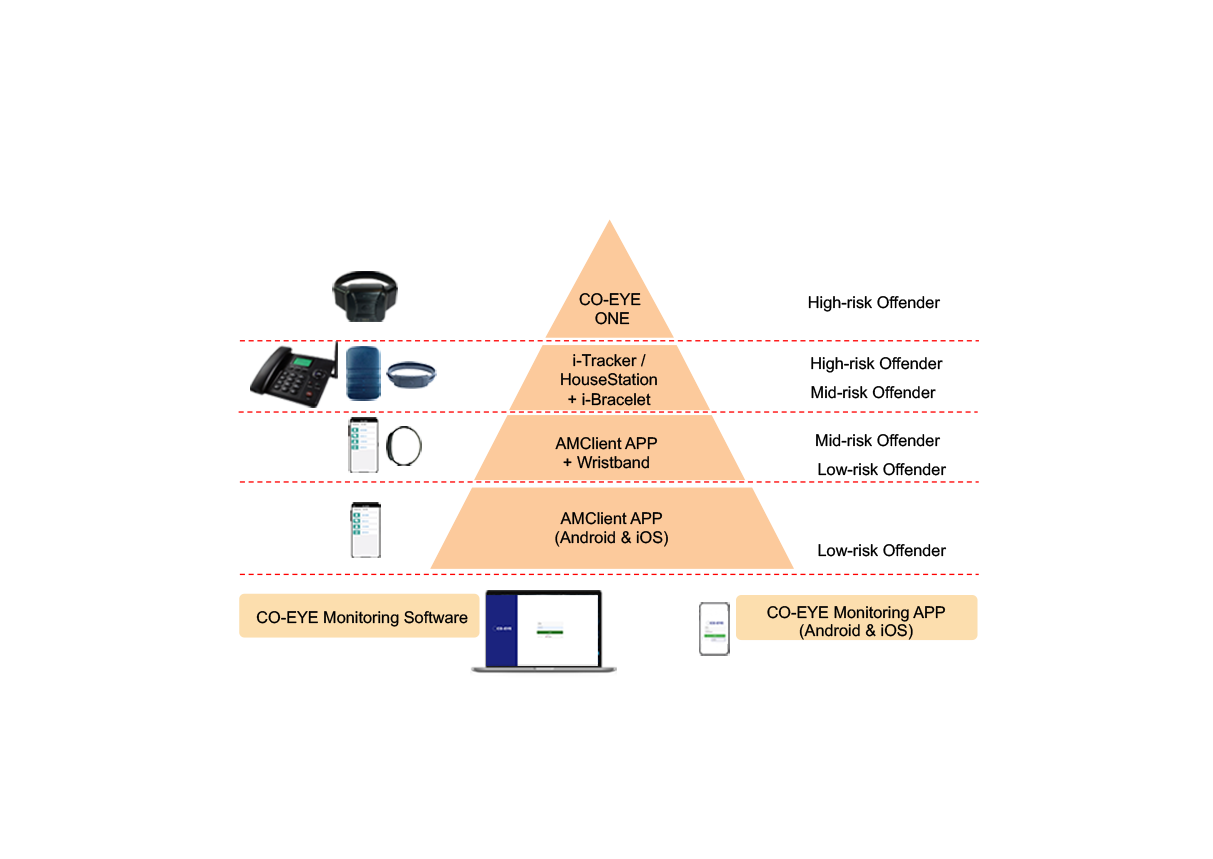
For wrist-level monitoring specifically, the CO-EYE BLE i-Bracelet represents what a professional wrist device actually requires:
- 17-gram weight — dramatically lighter than repurposed GPS watches (typically 50-80g), reducing skin pressure and contact dermatitis risk
- 2-year battery life — eliminates daily charging that creates monitoring gaps and compliance burden
- Purpose-built tamper detection — not a consumer buckle, but a one-time attachment designed for security applications
- BLE communication with encrypted pairing to a HouseStation or AMClient smartphone app — not standalone GPS that drains batteries in hours
The critical distinction: the i-Bracelet is designed as part of an integrated monitoring ecosystem, not as a standalone GPS tracker pretending to be a monitoring device. It pairs with the CO-EYE monitoring platform through SHA256-authenticated, AES-encrypted BLE connections — the same security architecture used by the CO-EYE ONE GPS ankle monitor that serves high-risk supervision.
Lessons From the Ko Wen-je Case for EM Program Administrators
1. False alert rates destroy program credibility. When 98% of 3,803 alerts are system malfunctions, the monitoring system has negative value — it wastes police resources while providing zero security benefit. Modern devices using adaptive multi-mode connectivity (BLE/WiFi/LTE auto-switching) dramatically reduce “device offline” alerts by maintaining connection through multiple fallback paths.
2. Ankle placement remains the gold standard. The switch to wrist should only occur when medical necessity demands it — as in Ko’s ligament injury case. For routine monitoring, the ankle’s skeletal geometry, concealability, and GPS reception superiority make it the only defensible choice for high-security supervision.
3. Device weight directly affects injury risk. Ko’s ankle device altered his gait enough to cause a ligament injury. Lighter devices (like the 108-gram CO-EYE ONE vs. industry-typical 180-250g) reduce biomechanical impact and long-term injury potential.
4. Wrist monitoring requires purpose-built equipment. Consumer GPS watches repackaged as monitoring devices will fail in court, fail in security, and fail the people wearing them. Agencies must demand corrections-grade tamper detection, encrypted communication, and extended battery life — not consumer electronics with a new label.
5. Procurement due diligence is non-negotiable. Before selecting any wrist monitoring device, verify: Does it have fiber-optic or hardware tamper detection? Does it meet corrections-grade security requirements? Can it maintain connection without daily charging? Is the manufacturer a corrections-industry specialist or a consumer electronics company seeking new revenue?
What Does Taiwan’s 98% False Alert Rate Tell Us About EM Technology?
According to the U.S. Department of Justice (DOJ/NIJ), effective electronic monitoring requires device reliability rates that minimize false alerts and maximize supervision integrity. The Taiwan High Court’s finding that 98% of monitoring alerts were “carrier offline” or “copper strip anomaly” system errors — not actual compliance violations — should alarm any EM program administrator. This failure rate points to fundamental device architecture problems: single-mode cellular connectivity that fails in signal-poor environments, inadequate onboard storage for offline events, and tamper detection mechanisms (copper strips) prone to environmental false positives.
Next-generation devices address these exact failure modes. Adaptive connectivity that automatically switches between BLE, WiFi, and LTE ensures continuous data transmission regardless of cellular coverage. Fiber-optic tamper detection provides binary (intact/cut) status with zero false positives — no “copper strip anomalies.” And 20,000-event onboard storage ensures no data loss during temporary connectivity gaps.
The technology exists to reduce false alert rates to near zero. The question for corrections agencies worldwide is whether they’ll continue accepting 1990s-era failure rates or demand the reliability that modern architecture provides.
About REFINE Technology (CO-EYE)
REFINE Technology is the leading electronic monitoring solutions provider in China with over 16 years of experience in the criminal justice industry. As the exclusive supplier for top security agencies, REFINE Technology has deployed 200,000+ devices across 30+ countries, monitoring 130,000+ individuals. The CO-EYE product line — featuring the next-generation all-in-one GPS ankle monitor, BLE wristbands, RF home beacons, and a unified monitoring platform — delivers high-security, low-stigma supervision for high-risk, mid-risk, and low-risk offender monitoring and victim protection. All CO-EYE devices carry full European NB CE directives (RED/Cybersecurity/LVD/SAR) and FCC certifications, with IP68 waterproof and REACH/RoHS/WEEE compliance. CO-EYE solutions are trusted in the USA, Europe, Africa, Bhutan, Papua New Guinea, Dominican Republic, Armenia, and expanding globally.
For more information, visit www.ankle-monitor.com or contact marketing@rfidcn.com.