
GPS vs RF Ankle Monitors: Complete Comparison for Corrections Agencies
The choice between GPS and RF ankle monitoring technology is one of the most consequential decisions a corrections agency makes. It directly affects public safety outcomes, operational costs, officer workload, and offender compliance rates. This guide provides a comprehensive, data-driven comparison to help agencies make informed procurement decisions.
According to the National Institute of Justice (NIJ), electronic monitoring through GPS and RF technologies has grown to serve over 175,000 individuals at any given time across 48 U.S. states. Research from the Florida Department of Corrections demonstrates that properly implemented EM programs are associated with a 31% reduction in recidivism compared to standard supervision.
How GPS Ankle Monitors Work
GPS (Global Positioning System) ankle monitors are self-contained tracking devices worn on the ankle that use satellite positioning to determine the wearer’s location continuously. Modern devices use multi-GNSS technology — combining GPS, GLONASS, Galileo, and BeiDou satellite constellations — to achieve positioning accuracy under 2 meters even in challenging urban environments.
GPS Technology Components
- GNSS receiver: Calculates position from 4+ satellite signals (multi-constellation for redundancy)
- Cellular modem: Transmits location data to the monitoring center via LTE-M, NB-IoT, or GSM
- Wi-Fi positioning: Supplements GPS in indoor environments where satellite signals are weak
- LBS (Location-Based Services): Cellular tower triangulation as a fallback positioning method
- Anti-tamper sensors: Fiber optic straps, accelerometers, and skin contact detection
- Rechargeable battery: Ranging from 1 day (older models) to 7 days (modern one-piece designs like the CO-EYE ONE)
One-Piece vs Two-Piece GPS Systems
GPS ankle monitors come in two architectures:
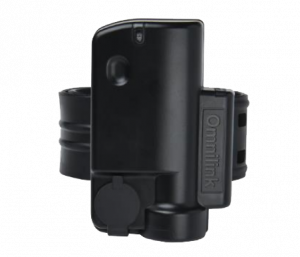
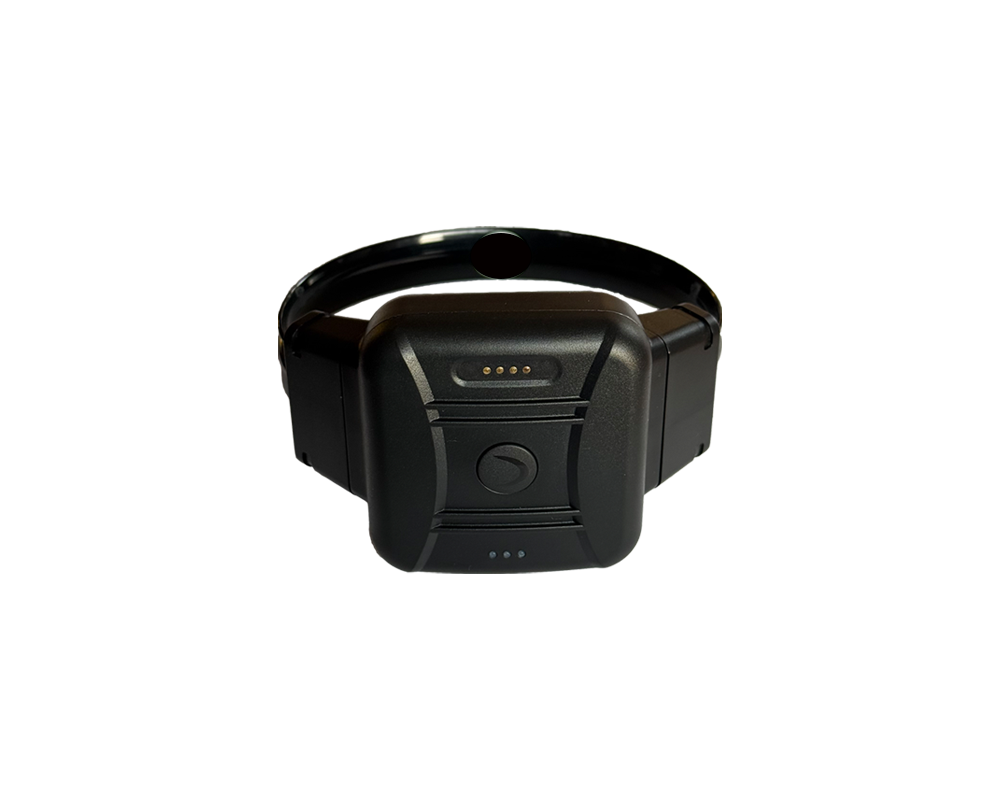
- One-piece (integrated): All components in a single ankle-worn device. Simpler to deploy, harder to tamper with, lower loss rates. Example: CO-EYE ONE (108g, 60×58×24mm).
- Two-piece (separate): Ankle tag (RF or BLE) pairs with a separate GPS tracking unit carried by the offender. More components to manage, higher loss/damage rates, but ankle unit is smaller.
The industry trend is strongly toward one-piece designs due to lower total cost of ownership and simpler deployment logistics.
How RF Ankle Monitors Work
RF (Radio Frequency) ankle monitors use a simple radio beacon system. The ankle device transmits a continuous RF signal at 433 MHz, which is detected by a base station (home unit) installed at the offender’s approved residence. The system only determines whether the offender is within range of the base station — it cannot track location outside the home.
RF Technology Components
- Ankle transmitter: Battery-powered RF beacon (typically 433 MHz, range 20-50m indoor / 100-200m outdoor)
- Home base station: Receives the RF signal and communicates with the monitoring center via landline or cellular
- Tamper detection: Strap integrity monitoring (fiber optic in premium models, conductive wire in basic models)
Head-to-Head Technical Comparison
| Feature | GPS Ankle Monitor | RF Ankle Monitor |
|---|---|---|
| Location Tracking | Continuous real-time (24/7), anywhere outdoors | Home presence only (in/out detection) |
| Accuracy | < 2m (multi-GNSS) to 10m (GPS-only) | 20-200m range detection (not precision) |
| Zone Enforcement | Inclusion zones, exclusion zones, corridor zones | Home zone only |
| Daily Cost | $8 – $25/day | $5 – $15/day |
| Battery Life | 1-7 days (rechargeable) | 1-2 years (non-rechargeable ankle tag) |
| Charging Required | Yes (daily to weekly) | No (base station plugged in) |
| Data Generated | Complete movement history, speed, routes | Check-in/check-out timestamps only |
| Indoor Tracking | WiFi + LBS (limited accuracy) | Home presence confirmed |
| Tamper Detection | Fiber optic + accelerometer + skin sensor | Strap integrity + signal continuity |
| Best For | High-risk: DV, sex offenders, gang, pretrial flight risk | Low-medium risk: curfew, house arrest, minor offenses |
| Weight | 100-200g (one-piece) | 50-100g (ankle tag only) |
| Waterproof | IP68 (modern devices) | Varies (IP65-IP67 typical) |
When to Use GPS vs RF: Decision Framework
The U.S. Courts guidance recommends selecting “the most cost-effective and least restrictive option appropriate for the individual.” Here’s a practical decision framework:
Use GPS When:
- The offender is classified as high risk (violent offense, sex offense, gang affiliation)
- Court orders include exclusion zones (victim’s residence, schools, specific areas)
- Domestic violence cases requiring distance enforcement from the victim
- The offender has a history of absconding or failure to appear
- Pretrial release with travel restrictions
- Sex offender registration requiring proximity alerts near schools/parks
- The court needs complete movement data for compliance verification
Use RF When:
- The offender is low to medium risk (DUI, minor property crimes, first offense)
- Supervision requires only curfew enforcement (home by X time)
- House arrest where the offender should stay home except for approved activities
- Budget constraints require the lowest possible daily cost
- The offender is elderly or medically fragile (lighter device, no charging needed)
- Short-term monitoring (< 30 days) where GPS setup cost isn't justified
Cost Analysis: GPS vs RF Total Cost of Ownership
While RF appears cheaper on a per-day basis, the total cost picture is more nuanced when you factor in equipment costs, false alarm rates, and officer response time.
| Cost Factor | GPS | RF |
|---|---|---|
| Device cost (purchase) | $800-$2,500 | $300-$800 (tag + base station) |
| Monthly monitoring fee | $240-$750 | $150-$450 |
| False alarm rate | Zero (fiber optic tamper) | 5-15% (environmental interference) |
| Officer response cost per false alarm | $0 | $50-$150 |
| Annual false alarm cost (100 devices) | $0 | $30,000-$100,000 |
When accounting for false alarm response costs, GPS monitoring with zero-false-positive tamper detection can be more cost-effective than RF for agencies with 50+ devices. The complete ankle monitor cost analysis provides detailed TCO calculations.
Technology Trends: The Future of GPS and RF Monitoring
- GPS is replacing RF: Industry data shows GPS now accounts for approximately 60% of all EM deployments, up from 40% a decade ago. The trend is accelerating.
- LTE-M/NB-IoT connectivity: As 2G/3G networks sunset, modern GPS devices use LTE-M and NB-IoT for better coverage and lower power consumption.
- Multi-GNSS accuracy: The combination of GPS + GLONASS + Galileo + BeiDou improves urban accuracy from ~10m to under 2m, making GPS viable even in dense city environments.
- Hybrid devices emerging: Some manufacturers now offer devices that combine GPS tracking with RF home detection in a single unit, providing the benefits of both technologies.
- Smartphone monitoring: For the lowest-risk populations, smartphone apps are emerging as an even less restrictive alternative to RF ankle monitors.
NIJ Standards for GPS and RF Devices
The National Institute of Justice published NIJ Standard 1004.00 (Offender Tracking Systems) which establishes performance benchmarks for both GPS and RF technologies:
- GPS accuracy benchmark: 10-meter CEP (Circular Error Probable) for 95% of fixes in open-sky conditions; 30-meter for urban environments
- RF detection range: Base station must reliably detect the ankle transmitter within the specified range (typically 50-200 feet)
- Tamper detection: Must generate an alert within 3 minutes of a tamper event
- Battery life reporting: Device must report remaining battery percentage to the monitoring center
Modern GPS devices like the CO-EYE ONE exceed these standards with sub-2-meter accuracy using multi-GNSS technology — significantly better than the NIJ 10m benchmark.
Case Study: Mixed GPS + RF Deployment
A mid-sized county corrections department in Florida deployed a mixed fleet of 200 GPS and 150 RF devices across their pretrial and probation caseloads. After 12 months:
- GPS group: 94% compliance rate, 2.1% absconder rate, zero false tamper alarms (fiber optic devices)
- RF group: 89% compliance rate, 4.8% curfew violation rate, 8.3% false alarm rate (environmental interference with base stations)
- Cost per successful supervision day: GPS $12.40, RF $10.80 (including false alarm response costs for RF)
The agency concluded that while RF remained appropriate for curfew-only cases, GPS provided better outcomes per dollar for any case requiring more than basic home detention.
Frequently Asked Questions
What is the main difference between GPS and RF ankle monitors?
GPS ankle monitors track the wearer’s real-time location continuously using satellite positioning, providing a complete movement history. RF ankle monitors only detect whether the wearer is within range of a home base station — they confirm presence or absence at home but cannot track where the person goes when away. GPS is used for high-risk supervision; RF is used for curfew and house arrest enforcement.
Is GPS or RF ankle monitoring more accurate?
GPS is far more precise for location tracking. Modern multi-GNSS ankle monitors achieve under 2 meters accuracy in open conditions and 5-10 meters in urban areas. RF monitors don’t provide location accuracy — they only detect proximity to the base station, with detection ranges of 20-200 meters depending on the environment.
Which costs more: GPS or RF ankle monitors?
GPS monitoring costs $8-$25 per day compared to $5-$15 per day for RF. However, when factoring in false alarm response costs (RF systems have 5-15% false alarm rates vs. zero for fiber optic GPS tamper detection), GPS can be more cost-effective for agencies with larger caseloads. Equipment purchase prices are also higher for GPS ($800-$2,500 vs. $300-$800 for RF).
Can GPS ankle monitors work indoors?
GPS satellite signals are weak indoors, but modern ankle monitors supplement GPS with Wi-Fi positioning and cellular tower triangulation (LBS) for indoor location estimates. Indoor accuracy is typically 10-30 meters — less precise than outdoor GPS but sufficient for zone enforcement. RF monitors, by contrast, work well indoors since the radio signal penetrates walls from the base station.
Should agencies use GPS or RF ankle monitors?
Most agencies use both. The best practice is to match the technology to the risk level: GPS for high-risk offenders requiring continuous location tracking (DV, sex offenders, flight risks), and RF for low-risk individuals on house arrest or curfew only. This risk-based approach optimizes both public safety outcomes and budget efficiency.