
When New York State Sen. Pam Helming stood beside Republican gubernatorial candidate Bruce Blakeman in Gates, N.Y. on August 17, 2026, the legislation they were pushing — the PROTECT Act (Pretrial Risk Overview for Threat Evaluation, Custody, and Treatment) — amounted to the most significant proposed overhaul of New York’s pretrial release framework since the landmark 2019 bail reform. The bill’s core mechanism: a statewide standardized risk assessment instrument that would drive every pretrial detention, bail, and release decision for felony and Class A misdemeanor cases.
What makes this consequential for electronic monitoring programs across the state is a single, underappreciated provision: the assessment instrument would recommend not just whether to release a defendant, but which non-monetary conditions — including GPS ankle monitoring — should be imposed. That shifts electronic monitoring from an ad hoc judicial decision to a data-driven, systematic deployment tool.
What Does the PROTECT Act Actually Propose?
Senate Bill S2282A, currently sitting in the Senate Codes Committee, would fundamentally restructure New York Criminal Procedure Law in three ways.
First, it mandates that the Division of Criminal Justice Services (DCJS) create a risk assessment instrument — an evidence-based scoring tool that evaluates a defendant’s likelihood of flight, threat to public safety, and risk to specific individuals. The instrument must incorporate criminal history, current charges, community ties, and “any other factors which may aid in determining whether a principal poses a risk” (S2282A, Section 845-f).
Second, the legislation repeals the current qualifying-offense framework. Under existing law, judges can only set bail or order detention for a limited list of qualifying offenses. The PROTECT Act replaces this categorical approach with individualized risk assessment — meaning a judge could detain someone charged with a non-qualifying offense if the assessment identifies genuine safety concerns, and conversely, release someone facing a serious charge if the data shows low risk.
Third, and critically for electronic monitoring stakeholders: the risk assessment must recommend specific non-monetary release conditions, including electronic monitoring, when the instrument determines release is appropriate but supervision is warranted. This creates a systematic pipeline for EM deployment that doesn’t exist in New York’s current statutory framework.

Why Does New York Need This? The 2019 Reform’s Unfinished Business
New York’s 2019 bail reform eliminated money bail for most misdemeanors and nonviolent felonies, a change that kept an estimated 80,000 people out of jail between 2019 and 2021 (MediaJustice, 2023). Pretrial release statewide jumped from 56% in 2019 to 66% in 2020, according to the Data Collaborative for Justice.
But the reform also created a patchwork problem. The law made electronic monitoring available for all felonies and select misdemeanors, yet left deployment entirely to individual judicial discretion. The result, documented by the Data Collaborative for Justice’s five-year evaluation published in February 2026: massive geographic disparity.
In New York City, judges ordered electronic monitoring in just 5 total cases between 2020 and 2021 combined. Meanwhile, in Suburban NYC, 49% of violent felony cases released with non-monetary conditions in 2021 involved EM. Upstate courts landed at 16%. By 2024, Suburban NYC and Upstate judges were ordering electronic monitoring in 9% and 11% of nonviolent and violent felony cases with non-monetary conditions, respectively — while NYC judges rarely ordered it at all (DCJ, Bail Reform at Five Years, 2026).
The PROTECT Act’s standardized assessment instrument would directly address this inconsistency. A defendant in Rochester and a defendant in Brooklyn facing identical charges and risk profiles would receive the same assessment score — and the same range of recommended supervision conditions. That doesn’t guarantee identical outcomes, but it creates accountability for disparate treatment that currently doesn’t exist.
What Risk Assessment Means for Electronic Monitoring Programs
For agencies operating electronic monitoring programs in New York, the PROTECT Act represents a structural shift from reactive to proactive deployment.
Under the current framework, a judge decides on a case-by-case basis whether to order GPS monitoring — a decision shaped by personal judicial philosophy, county resources, available vendors, and familiarity with EM technology. The PROTECT Act replaces this with a structured decision pathway: the assessment instrument produces a recommendation, and the judge must respond to that recommendation on the record.
This has three practical implications.
EM demand will become predictable. When electronic monitoring is a standardized recommendation rather than an ad hoc judicial choice, agencies can forecast caseload volume based on charge categories and risk score distributions. County pretrial services offices that currently manage 50-100 EM subjects could see that number double or triple as the assessment instrument identifies cases where supervision was warranted but never ordered.
Equipment reliability becomes a policy issue. When a risk assessment tool recommends electronic monitoring as a condition of release, any monitoring gap — a dead GPS signal in a basement apartment, a battery that dies overnight, a false tamper alert that dispatches officers on a 3 AM call — isn’t just an operational inconvenience. It’s a failure in the risk management framework the legislature mandated. Agencies need devices that work in the environments where defendants actually live: underground apartments, rural dead zones, multi-story buildings with weak cellular coverage.
Data quality drives program credibility. The PROTECT Act’s assessment instrument must be “empirically validated” — meaning it needs outcomes data to prove it works. Electronic monitoring programs will be evaluated not just on compliance rates, but on whether GPS-monitored defendants produced better public safety outcomes than those released without conditions. That demands monitoring systems that generate clean, court-admissible data — not alert logs cluttered with false positives that obscure actual risk signals.
The Technology Gap the PROTECT Act Exposes
New York’s geographic disparity in EM usage isn’t just a judicial philosophy problem — it’s partly a technology problem. The MediaJustice report on electronic monitoring in New York noted that NYC’s “built environment, with its vast expanses of high-rise buildings and extensive underground subways, makes maintaining a signal extremely challenging.” That’s why NYC judges ordered EM in only 5 cases over two years — the technology available to them wasn’t reliable enough to justify ordering it.
The traditional GPS ankle monitor architecture — a single device running continuous GNSS and LTE cellular radio — was designed for open suburban environments. In dense urban settings like New York City, this architecture faces three compounding failures:
- GPS signal attenuation in steel-and-concrete canyon environments drops positioning accuracy from 3-5 meters to 30+ meters — or complete signal loss
- Cellular dead zones in subway stations, basements, and interior building spaces create monitoring gaps that generate “location unknown” alerts
- Battery depletion from constant radio scanning in poor signal environments accelerates drain from days to hours, creating chronic low-battery alert fatigue
If the PROTECT Act becomes law, NYC courts can’t justify excluding electronic monitoring from the risk assessment framework simply because available devices don’t work in urban environments. The mandate creates regulatory pressure for monitoring equipment that functions across the full spectrum of New York housing and infrastructure conditions.
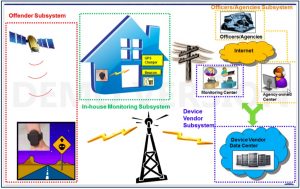
Next-generation one-piece GPS ankle monitors address these challenges through multi-mode connectivity — devices that automatically switch between BLE, WiFi, and cellular connections based on environment. In a subway station: BLE connection to the defendant’s smartphone maintains supervision. In a basement apartment: a WiFi repeater provides data backhaul without cellular coverage. On the street: full GNSS/LTE positioning engages automatically. This adaptive architecture delivers continuous monitoring across the exact environments that have historically excluded New York City from meaningful EM deployment.

The Risk Assessment Debate: What the Research Shows
The PROTECT Act’s reliance on a standardized risk assessment instrument isn’t without controversy. Risk assessment tools have been criticized for embedding racial and socioeconomic bias — defendants with longer criminal histories (which correlate with over-policed communities) score higher on risk instruments, potentially perpetuating disparities the bail reform was designed to eliminate.
But the alternative — pure judicial discretion — has produced its own inequities. The Data Collaborative for Justice’s five-year evaluation found that over 85% of people charged with violent felonies attend every court date when released, suggesting that flight risk exists in only a small fraction of cases. Yet judges in some regions detained or set bail in the majority of these cases, while judges in other regions released them routinely. A validated, transparent instrument at least provides a common baseline for identifying actual risk — and creates accountability when judicial decisions diverge from empirical recommendations.
The evidence on electronic monitoring’s effectiveness supports its inclusion in a risk-calibrated toolkit. A large NIJ-funded study of 5,034 medium-to-high-risk Florida offenders found that EM reduced the risk of failure under community supervision by approximately 31% compared to other supervision forms (NIJ, 2011). The GAO found that about 25% of federal pretrial defendants were required to use a monitoring device between 2018 and 2022, with 92% completing their supervision period without new criminal charges (GAO-23-105873). Nationally, the Vera Institute counted 254,700 adults under electronic monitoring in 2021 — a fivefold increase since 2005, driven largely by bail reform legislation across multiple states.
New York’s own EM growth trajectory confirms this trend. The state’s pretrial electronic monitoring population grew from 2,162 in September 2018 to 3,543 in September 2020 — a 64% increase in just two years following the initial bail reform. The PROTECT Act would likely accelerate this trajectory by making EM a formally recommended condition rather than an informal judicial option.
For a real-world example of these challenges, see our analysis of Cook County’s electronic monitoring crisis, where 327 defendants went missing from America’s largest EM program.
What Happens Next — and What Agencies Should Prepare For
The PROTECT Act currently sits in the Senate Codes Committee. It would need to pass both chambers and be signed by Governor Kathy Hochul — a path complicated by the political dynamics around bail reform in New York. The 2019 reform triggered intense backlash, leading to amendments in 2020 and 2023 that expanded bail eligibility. Any new legislation touching pretrial release faces scrutiny from both directions: reform advocates concerned about expanding surveillance, and law enforcement groups demanding stricter detention authority.
“I feel very strongly that the PROTECT Act balances the rights of the accused with the rights of the victim and the need to keep our community safe,” Sen. Helming said at the Gates press conference.
Whether the bill passes this session or not, the direction is clear. New York is moving — slowly, contentiously, but inevitably — toward structured pretrial decision-making. That means electronic monitoring will play a larger, more formalized role in the state’s pretrial framework. Agencies that invest now in EM infrastructure capable of handling urban environments, generating court-grade data, and integrating with risk assessment workflows will be positioned when the legislative framework catches up.
For the 20+ million people living in New York State, the stakes are concrete: a pretrial system where detention decisions are driven by evidence rather than geography, where supervision conditions match actual risk profiles, and where the technology backing those conditions actually works in the places New Yorkers live.
About REFINE Technology (CO-EYE)
REFINE Technology is the leading electronic monitoring solutions provider in China with over 16 years of experience in the criminal justice industry. As the exclusive supplier for top security agencies, REFINE Technology has deployed 200,000+ devices across 30+ countries, monitoring 130,000+ individuals. The CO-EYE product line — featuring the next-generation all-in-one GPS ankle monitor, BLE wristbands, RF home beacons, and a unified monitoring platform — delivers high-security, low-stigma supervision for high-risk, mid-risk, and low-risk offender monitoring and victim protection. All CO-EYE devices carry full European NB CE directives (RED/Cybersecurity/LVD/SAR) and FCC certifications, with IP68 waterproof and REACH/RoHS/WEEE compliance. CO-EYE solutions are trusted in the USA, Europe, Africa, Bhutan, Papua New Guinea, Dominican Republic, Armenia, and expanding globally.
For more information, visit www.ankle-monitor.com or contact marketing@rfidcn.com.